Actinidia melanandra Franch.
Red kiwi; Red kiwifruit
Photographs not checked
iNaturalist was skipped (not asked) when this page was built. Not asked, or not answered, is not "none": nothing here claims there is none. Why the site says it this way.Summary
Actinidia melanandra, known as purple kiwi or red kiwi is a fruiting plant in the genus Actinidia, which contains three commercially grown species of kiwifruit. The plant is native to parts of Hubei, Sichuan, and Yunnan provinces of China. The fruit has a fuzzy purple skin with reddish flesh. Although the fruit is edible, is not commercially cultivated, however it is occasionally sold as a landscape plant under the erroneous name Actinidia melandra.
Quoted from Wikipedia, "Actinidia melanandra", CC BY-SA 4.0.
About the genus · Actinidia
Actinidia is a genus of woody and, with a few exceptions, dioecious plants native to temperate eastern Asia, occurring throughout most of China, Taiwan, Korea, and Japan, and extending north to southern areas of Russian Far East and south into Indochina. The genus includes shrubs growing to 6 metres tall, and vigorous, strong-growing vines, growing up to 30 m (100 ft) in tree canopies. They mostly tolerate temperatures down to around −15 °C (5 °F), and some are much hardier.
Quoted from Wikipedia, "Actinidia", CC BY-SA 4.0.
Cultivation
Climate across the habitat
Natural habitat
How this section is made
Photographs
Related
Other Actinidia 10 in the reference
 Actinidia arguta Tara vine Photo: CC BY, Repina Tatyana
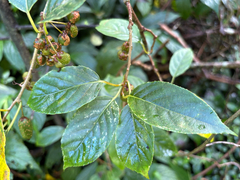 Actinidia callosa Actinidiaceae Photo: CC BY, 黃美滿
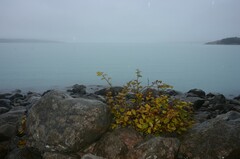 Actinidia chinensis Kiwi Photo: CC BY, Jon Sullivan
 Actinidia eriantha Velvetvine Photo: CC BY, angryphyco
 Actinidia kolomikta Arctic beauty kiwi Photo: CC BY, Violetta Dzizyurova
 Actinidia macrosperma Actinidiaceae Photo: CC BY, Sun Jiao
 Actinidia pilosula Actinidiaceae Photo: CC BY-SA, Steve Law from Henfield, England
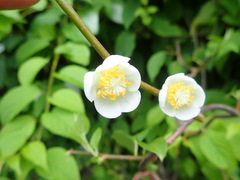 Actinidia polygama Silver vine Photo: CC BY, 村山史世 (Fumiyo MURAYAMA)
 Actinidia rubricaulis Actinidiaceae Photo: CC0, 江国彬
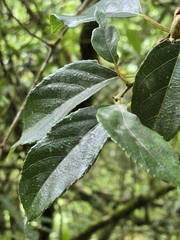 Actinidia rufa Reddish-brown hardy kiwi Photo: CC BY, 賴碧珠
Names & registers
Also known as Actinidia changii; Actinidia globosa; Actinidia henanensis; Actinidia hypoglauca; Actinidia melanandra var. cretacea and 3 more. (GBIF Backbone)
The record
Every figure here is derived from public data by a stated rule and names its source; nothing about this species is written for its page by a person or by AI, apart from the marked, credited quotations. How →
Where this page came from built 2026-10-21
gbif.species answeredasked 2026-10-21gbif.synonyms answeredasked 2026-10-21gbif.vernacular answeredasked 2026-10-21names fetched 2026-10-21wcvp.distribution answeredas of 2026-06-04gbif.occurrences answeredas of 2026-10-21GBIF occurrence download https://doi.org/10.15468/dl.hbdw64, of 2026-10-21climate nothing to reportasked 2026-10-21142 in-range records, none placed to within 10 kmwikidata answeredasked 2026-10-21wikipedia answeredasked 2026-10-21inat.photos.wild nothing to reportasked 2026-10-22from iNaturalist's open data of 2026-09-27: research-grade observations with an open-licence photograph, the 24 whose photographs iNaturalist received last (the open data holds no votes); filled 2026-10-22inat.photos.cultivated not askedgbif.media nothing to reportasked 2026-10-21commons nothing to reportasked 2026-10-21openalex not askednot yet asked for this reference; a later fill takes the papers from OpenAlex's snapshotEvery source is recorded as having answered, reported nothing, refused, failed, not been asked, or answered twice where one answer is taken (“not taken: two items answered”), and, for a source asked when this page was built, when: the figures are as the source held them that day; a source read from a file (Kew's World Checklist, a GBIF download) says "as of" the file's day instead; a row carried from an earlier build of the page names that build instead. Only “nothing to report” is ever shown as an absence. Records came from 14 datasets via GBIF.org; each carries its own licence.