


 12 photographs ›
Summary
Aloe bakeri is a species of flowering plant in the family Asphodelaceae, native to Madagascar, where it grows on rocky hills at low elevations. Growing to 10–20 cm (4–8 in) tall by 40 cm (16 in) wide, it is an evergreen perennial forming multiple rosettes of spidery succulent green or reddish-green toothed leaves, heavily mottled with white. The leaves are typically 10 cm (4 in) long and bear straight or slightly curved white teeth that are 1 mm long and about 1-2 mm apart. In summer it produces red or orange, green-tipped tubular flowers. More on Wikipedia ›
Quoted from Wikipedia, "Aloe bakeri", CC BY-SA 4.0.
About the genus · Aloe
Aloe is a genus containing 594 species of flowering succulent plants. The most widely known species is Aloe vera, or "true aloe", which is cultivated as a source for topical uses and dietary supplements. Other species, such as Aloe ferox, are also cultivated or harvested from the wild for similar applications.
Quoted from Wikipedia, "Aloe", CC BY-SA 4.0.
Cultivation
Grouped as a cactus or succulent, listed under the genus Aloe in the archetype table, and Kew describes it as “succulent subshrub”.
How this section is made
Each card states this species' habitat figures with their sources, and what two fixed rules read from them; nothing here says what the plant does, wants or tolerates. The rules · the terms.
Group. Listed under the genus Aloe in the archetype table, and Kew describes it as “succulent subshrub”. A group is taken only where Kew's description of the species agrees with the table's listing. The table gives no figure and no prose; the cold floor is the habitat's alone.
Climate across the habitat
Natural habitat
Photographs


Photographs: BotBln, CC BY 2.5, via Wikimedia Commons (2); peganum from Henfield, England, CC BY-SA 2.0, via Wikimedia Commons (2); Krzysztof Ziarnek, Kenraiz, CC BY-SA 4.0, via Wikimedia Commons; Salicyna, CC BY-SA 4.0, via Wikimedia Commons.
Related
Other Aloe 198 in the reference
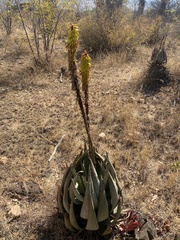 Aloe aculeata Tent Cent Aloe Photo: CC0, author not stated
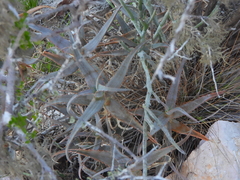 Aloe acutissima Asphodelaceae Photo: CC BY, amantedarmanin
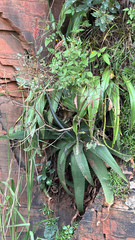 Aloe affinis Spotted aloe Photo: CC BY-SA, alanbedfordshaw
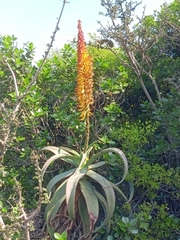 Aloe africana African aloe Photo: CC BY, Malte Krömer
 Aloe albiflora Asphodelaceae Photo: CC BY-SA, S Molteno
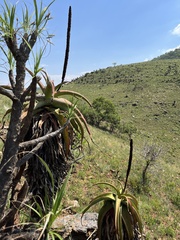 Aloe alooides Graskop aloe Photo: CC BY, katuchka
 Aloe amudatensis Asphodelaceae Photo: CC BY-SA, Susan Brown
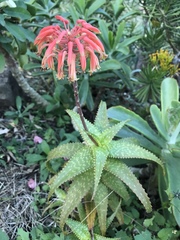 Aloe andongensis Asphodelaceae Photo: CC BY, Presha Soogrim
 Aloe angelica Wylliespoort aloe Photo: CC0, Daderot
 Aloe antandroi Asphodelaceae Photo: CC BY-SA, Andrew Hankey
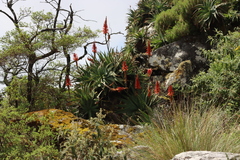 Aloe arborescens Candelabra aloe Photo: CC BY-SA, Tony Rebelo
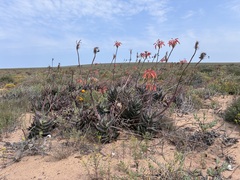 Aloe arenicola Beach Aloe Photo: CC0, author not stated all 199 ›
Names & registers
Also known as Guillauminia bakeri. (GBIF Backbone)
The record
Every figure here is derived from public data by a stated rule and names its source; nothing about this species is written for its page by a person or by AI, apart from the marked, credited quotations. How →
Where this page came from built 2026-10-21
gbif.species answeredasked 2026-10-21gbif.synonyms answeredasked 2026-10-21gbif.vernacular answeredasked 2026-10-21names fetched 2026-10-21wcvp.distribution answeredas of 2026-06-04Kew's entry lists no native regiongbif.occurrences answeredas of 2026-10-21GBIF occurrence download https://doi.org/10.15468/dl.hbdw64, of 2026-10-21; 3 records within 1 km of a botanic garden, herbarium or zoo left out (3 at a botanic garden or arboretum; Wikidata's list)climate nothing to reportasked 2026-10-21native range not verified: no WCVP distribution with native status for this name, so records cannot be told from cultivation and no habitat climate is derivedwikidata answeredasked 2026-10-21wikipedia answeredasked 2026-10-21inat.photos.wild nothing to reportasked 2026-10-22from iNaturalist's open data of 2026-09-27: research-grade observations with an open-licence photograph, the 24 whose photographs iNaturalist received last (the open data holds no votes); filled 2026-10-22inat.photos.cultivated not askedgbif.media nothing to reportasked 2026-10-21commons answeredasked 2026-10-21openalex not askednot yet asked for this reference; a later fill takes the papers from OpenAlex's snapshotEvery source is recorded as having answered, reported nothing, refused, failed, not been asked, or answered twice where one answer is taken (“not taken: two items answered”), and, for a source asked when this page was built, when: the figures are as the source held them that day; a source read from a file (Kew's World Checklist, a GBIF download) says "as of" the file's day instead; a row carried from an earlier build of the page names that build instead. Only “nothing to report” is ever shown as an absence. Records came from 5 datasets via GBIF.org; each carries its own licence.