
Begonia polygonoides Hook.f.
Cited as Kew's World Checklist cites it, Begonia polygonoides Hook.f.: GBIF's backbone key for this page carries the name with another author, Hook.fil.


 10 photographs ›
Summary
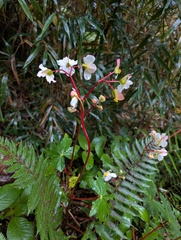
Begonia polygonoides is a species of flowering plant in the family Begoniaceae, native to west central Africa. Though it grows primarily in wet tropical biomes, it is epiphytic and grows in the tree canopy where atmospheric conditions are much drier.
Quoted from Wikipedia, "Begonia polygonoides", CC BY-SA 4.0.
About the genus · Begonia
Begonia is a genus of perennial flowering plants in the family Begoniaceae. The genus contains more than 2,000 different plant species, distributed primarily across tropical and subtropical regions of Africa, Asia, and Central and South America, with Africa considered the center of origin. Some species are commonly grown indoors as ornamental houseplants in cooler climates, or cultivated outside in summertime for their bright colorful flowers, which have petals but no sepals.
Quoted from Wikipedia, "Begonia", CC BY-SA 4.0.
Cultivation
Grouped as a tropical foliage plant, listed under the genus Begonia in the archetype table, and Kew describes it as “epiphytic subshrub or shrub”, “wet tropical”.
How this section is made
Each card states this species' habitat figures with their sources, and what two fixed rules read from them; nothing here says what the plant does, wants or tolerates. The rules · the terms.
Group. Listed under the genus Begonia in the archetype table, and Kew describes it as “epiphytic subshrub or shrub”, “wet tropical”. A group is taken only where Kew's description of the species agrees with the table's listing. The table gives no figure and no prose; the cold floor is the habitat's alone.
Climate across the habitat
Natural habitat
How this section is made
Photographs


Photographs: Björn S..., CC BY-SA 2.0, via Wikimedia Commons (2); Krzysztof Ziarnek, Kenraiz, CC BY-SA 4.0, via Wikimedia Commons (4).
Related
Other Begonia 279 in the reference
 Begonia acerifolia Maple-leaved begonia Photo: CC BY, Yuri Sofronov
 Begonia acetosa Ruby begonia Photo: CC0, Daderot Begonia acetosella Begoniaceae
 Begonia acida Begoniaceae Photo: CC BY-SA, Michael Wolf
 Begonia aconitifolia Aconite Leaved Begonia Photo: CC BY-SA, rubens curvelo
 Begonia acutifolia Begoniaceae Photo: CC BY, Cliff from I now live in Arlington, VA… Begonia albomaculata Begoniaceae Begonia × albopicta Begoniaceae Begonia alice-clarkiae Begoniaceae Begonia almedana Begoniaceae Begonia amphioxus Begoniaceae all 280 ›
Names & registers
Also known as Begonia cataractarum; Begonia epilobioides; Begonia ramicola; Begonia rhipsaloides. (GBIF Backbone)
The record
Every figure here is derived from public data by a stated rule and names its source; nothing about this species is written for its page by a person or by AI, apart from the marked, credited quotations. How →
Where this page came from built 2026-10-21
gbif.species answeredasked 2026-10-21GBIF's key 7597622 is Begonia polygonoides Hook.fil.; the page links Kew's Begonia polygonoides Hook.f., and the name is cited as Kew cites itgbif.synonyms answeredasked 2026-10-21gbif.vernacular answeredasked 2026-10-21names fetched 2026-10-21wcvp.distribution answeredas of 2026-06-04gbif.occurrences answeredas of 2026-10-21GBIF occurrence download https://doi.org/10.15468/dl.hbdw64, of 2026-10-21; 4 records within 1 km of a botanic garden, herbarium or zoo left out (4 at a botanic garden or arboretum; Wikidata's list)climate nothing to reportasked 2026-10-21only 2 distinct land cells of the climate grid hold an in-range record placed to within 10 km; three are needed for an envelopewikidata answeredasked 2026-10-21found by its label; its IPNI identifier 105468-1 is Kew's for Begonia polygonoides Hook.f.wikipedia answeredasked 2026-10-21inat.taxon not askedinat.photos.wild not askedinat.photos.cultivated not askedgbif.media nothing to reportasked 2026-10-21commons answeredasked 2026-10-21openalex not askednot yet asked for this reference; a later fill takes the papers from OpenAlex's snapshotEvery source is recorded as having answered, reported nothing, refused, failed, not been asked, or answered twice where one answer is taken (“not taken: two items answered”), and, for a source asked when this page was built, when: the figures are as the source held them that day; a source read from a file (Kew's World Checklist, a GBIF download) says "as of" the file's day instead; a row carried from an earlier build of the page names that build instead. Only “nothing to report” is ever shown as an absence. Records came from 15 datasets via GBIF.org; each carries its own licence.