
Caryota no Becc.
English names not checked: Wikidata's common names were not read for this page.
GBIF's records not checked. GBIF's backbone holds no one accepted species of this name, and a name it holds only as another species' synonym is not taken for this one, so GBIF's records were not asked. So this page has no points on its map, no map marker, no habitat climate, no cultivation sheet and no species of nearest climate; the range is Kew's. Not a statement that none exist. How.


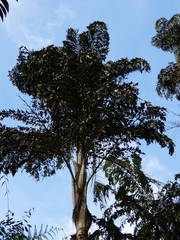
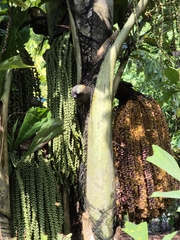
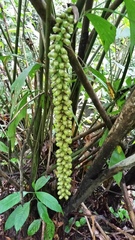
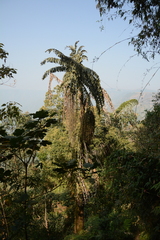
 12 photographs ›
Summary
Caryota no is a species of flowering plant in the family Arecaceae. It is endemic to the Island of Borneo. Its specific epithet is from the common name in Malaysian, cajù nó. It is called baroch by the Dayak people of Singhi. More on Wikipedia ›
Quoted from Wikipedia, "Caryota no", CC BY-SA 4.0.
About the genus · Caryota
Caryota is a genus of palm trees. They are often known as fishtail palms because of the shape of their leaves.
Quoted from Wikipedia, "Caryota", CC BY-SA 4.0.
Cultivation
Grouped as a tropical foliage plant, listed under the genus Caryota in the archetype table, and Kew describes it as “tree”, “wet tropical”.
How this section is made
Each card states this species' habitat figures with their sources, and what two fixed rules read from them; nothing here says what the plant does, wants or tolerates. The rules · the terms.
Group. Listed under the genus Caryota in the archetype table, and Kew describes it as “tree”, “wet tropical”. A group is taken only where Kew's description of the species agrees with the table's listing. The table gives no figure and no prose; the cold floor is the habitat's alone.
Climate across the habitat
Natural habitat
Photographs


Photographs: Dryas, CC BY-SA 3.0, via Wikimedia Commons; Bernard DUPONT from FRANCE, CC BY-SA 2.0, via Wikimedia Commons (5).
Related
Similar habitat climate Not checked: GBIF's records were not asked (why, under the name), and the nearest habitat climates are read from the climate they give.
Other Caryota 9 in the reference
 Caryota cumingii Philippines fishtail palm Photo: CC BY, 岸本年郎 Caryota kiriwongensis Giant Caryota
 Caryota maxima Arecaceae Photo: CC BY, Kai Squires
 Caryota mitis Burmese fishtail palm Photo: CC BY, Rainer Breitling
 Caryota monostachya Arecaceae Photo: CC BY, Eugene Popov
 Caryota obtusa Giant fishtail palm Photo: CC BY, Siddarth Machado
 Caryota rumphiana Albert palm Photo: CC BY, Fabian Brambach
 Caryota urens Jaggery palm Photo: CC BY, renjus box Caryota zebrina Arecaceae
Names & registers
Also known as Caryota rumphiana var. borneensis. (WCVP, RBG Kew)
The record
Every figure here is derived from public data by a stated rule and names its source; nothing about this species is written for its page by a person or by AI, apart from the marked, credited quotations. How →
Where this page came from built 2026-10-22
kew.names answeredas of 2026-06-04Kew's entry Caryota no Becc. (plant_name_id 34781), read from Kew's names filegbif.species not askedGBIF's backbone holds no one accepted species of this name, and a name it holds only as another species' synonym is not taken for this one, so GBIF's records were not askedgbif.synonyms not askedGBIF's backbone holds no one accepted species of this name, and a name it holds only as another species' synonym is not taken for this one, so GBIF's records were not askedgbif.vernacular not askedGBIF's backbone holds no one accepted species of this name, and a name it holds only as another species' synonym is not taken for this one, so GBIF's records were not askedgbif.occurrences not askedGBIF's backbone holds no one accepted species of this name, and a name it holds only as another species' synonym is not taken for this one, so GBIF's records were not askedwcvp.distribution answeredas of 2026-06-04climate not askedGBIF's backbone holds no one accepted species of this name, and a name it holds only as another species' synonym is not taken for this one, so GBIF's records were not asked, and the habitat climate is read only from themwikidata answeredasked 2026-10-22found by Kew's IPNI identifier 665621-1, POWO 665621-1wikipedia answeredasked 2026-10-22inat.photos.wild not askedinat.photos.cultivated not askedgbif.media not askedGBIF's backbone holds no one accepted species of this name, and a name it holds only as another species' synonym is not taken for this one, so GBIF's records were not askedcommons answeredasked 2026-10-22openalex not askednot yet asked for this reference; a later fill takes the papers from OpenAlex's snapshotEvery source is recorded as having answered, reported nothing, refused, failed, not been asked, or answered twice where one answer is taken (“not taken: two items answered”), and, for a source asked when this page was built, when: the figures are as the source held them that day; a source read from a file (Kew's World Checklist, a GBIF download) says "as of" the file's day instead; a row carried from an earlier build of the page names that build instead. Only “nothing to report” is ever shown as an absence.