
Clematis florida Thunb.
Asian virginsbower; Cream clematis


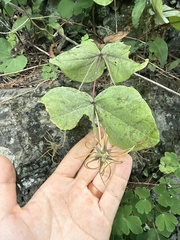
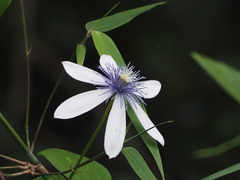
 5 photographs ›
Summary
Clematis florida, the Asian virginsbower, or passion flower clematis, is a species of flowering plant in the family Ranunculaceae.
Quoted from Wikipedia, "Clematis florida", CC BY-SA 4.0.
About the genus · Clematis
Clematis is a genus of about 380 species within the buttercup family, Ranunculaceae. Their garden hybrids and cultivars have been popular among gardeners, beginning with Clematis 'Jackmanii', a garden staple since 1862. More cultivars are being produced constantly, mainly of Chinese and Japanese origin.
Quoted from Wikipedia, "Clematis", CC BY-SA 4.0.
Cultivation
Grouped as a temperate garden plant, listed under the genus Clematis in the archetype table, and Kew describes it as “climbing perennial or subshrub”, “temperate”.
How this section is made
Each card states this species' habitat figures with their sources, and what two fixed rules read from them; nothing here says what the plant does, wants or tolerates. The rules · the terms.
Group. Listed under the genus Clematis in the archetype table, and Kew describes it as “climbing perennial or subshrub”, “temperate”. A group is taken only where Kew's description of the species agrees with the table's listing. The table gives no figure and no prose; the cold floor is the habitat's alone.
Climate across the habitat
Natural habitat
How this section is made
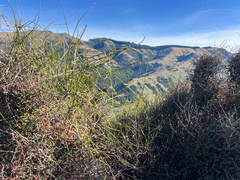
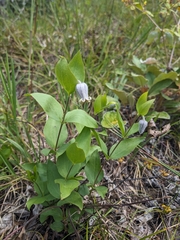
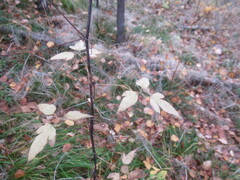
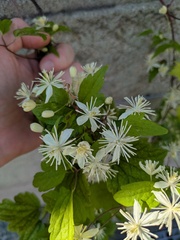
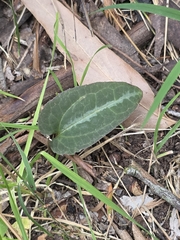
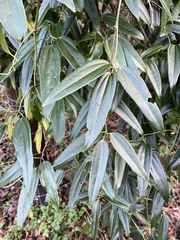
Photographs


Photographs: Fan Wen, CC BY-SA 4.0, via Wikimedia Commons; 阿橋 HQ, CC BY-SA 2.0, via Wikimedia Commons; Nina R, CC BY 2.0, via Wikimedia Commons; Honmingjun, CC BY-SA 4.0, via Wikimedia Commons.
Related
Other Clematis 112 in the reference
 Clematis addisonii Addison Brown's clematis Photo: CC0, author not stated
 Clematis aethusifolia Parsley-leaf clematis Photo: CC BY, zhangshen
 Clematis afoliata Rush-stem clematis Photo: CC BY, Rock McLaren Clematis akebioides Ranunculaceae
 Clematis akoensis Ranunculaceae Photo: CC0, 葉子
 Clematis albicoma White-haired leather-flower Photo: CC BY, Alaina Krakowiak
 Clematis alpina Alpine Clematis Photo: CC0, author not stated
 Clematis apiifolia Three-leaf clematis Photo: CC BY, Timur Kalininsky
 Clematis aristata Goat's-beard Photo: CC BY, Ian Rainbow
 Clematis armandii Evergreen Clematis Photo: CC0, author not stated Clematis aureolata Ranunculaceae
 Clematis brachiata Traveler's-joy Photo: CC0, author not stated all 113 ›
Names & registers
Also known as Anemone japonica; Atragene florida; Atragene indica; Clematis anemonoides; Clematis bicolor and 23 more. (GBIF Backbone)
Under another author Clematis japonica (Houtt.) Makino is an older name of this species, not Clematis japonica, a species of the reference. (GBIF Backbone)
The record
Every figure here is derived from public data by a stated rule and names its source; nothing about this species is written for its page by a person or by AI, apart from the marked, credited quotations. How →
Where this page came from built 2026-10-21
gbif.species answeredasked 2026-10-21gbif.synonyms answeredasked 2026-10-21gbif.vernacular answeredasked 2026-10-21names fetched 2026-10-21wcvp.distribution answeredas of 2026-06-04gbif.occurrences answeredas of 2026-10-21GBIF occurrence download https://doi.org/10.15468/dl.hbdw64, of 2026-10-21; 8 records within 1 km of a botanic garden, herbarium or zoo left out (4 at a botanic garden or arboretum, 2 at a herbarium, 2 at a zoo; Wikidata's list)climate nothing to reportasked 2026-10-21only 1 distinct land cell of the climate grid holds an in-range record placed to within 10 km; three are needed for an envelopewikidata answeredasked 2026-10-21wikipedia answeredasked 2026-10-21inat.photos.wild nothing to reportasked 2026-10-22from iNaturalist's open data of 2026-09-27: research-grade observations with an open-licence photograph, the 24 whose photographs iNaturalist received last (the open data holds no votes); filled 2026-10-22inat.photos.cultivated not askedgbif.media nothing to reportasked 2026-10-21commons answeredasked 2026-10-21openalex not askednot yet asked for this reference; a later fill takes the papers from OpenAlex's snapshotEvery source is recorded as having answered, reported nothing, refused, failed, not been asked, or answered twice where one answer is taken (“not taken: two items answered”), and, for a source asked when this page was built, when: the figures are as the source held them that day; a source read from a file (Kew's World Checklist, a GBIF download) says "as of" the file's day instead; a row carried from an earlier build of the page names that build instead. Only “nothing to report” is ever shown as an absence. Records came from 32 datasets via GBIF.org; each carries its own licence.