Rosaceae › Cotoneaster › 44 of 104
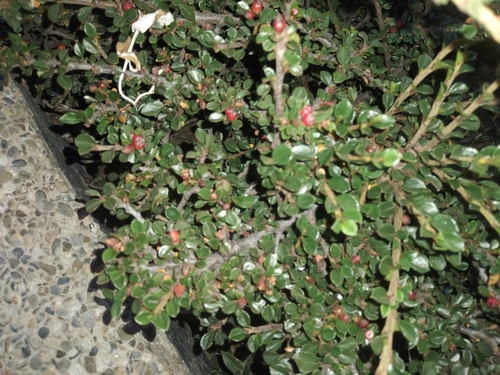
Cotoneaster horizontalis Decne.
Wall cotoneaster; Rock cotoneaster; Rock-spray; Rockspray cotoneaster
Also called Cotoneaster acuminata var. prostrata, Cotoneaster acuminatus subsp. prostratus, and 14 more.
| Family | Rosaceae |
|---|---|
| Native to | China South-Central, China North-Central, China Southeast, Taiwan · Kew's World Checklist, file of 2026-06-04 |
| Your plants | Add one · related species |
Rosaceae · China South-Central +3
Also called Rock cotoneaster; Rock-spray; Rockspray cotoneaster
Family Rosaceae
Native to China South-Central, China North-Central, China Southeast, Taiwan


 73 photographs ›
Summary
Cotoneaster horizontalis is a species of flowering plant in the genus Cotoneaster of the family Rosaceae.
Quoted from Wikipedia, "Cotoneaster horizontalis", its opening paragraph, revision 1354839885, read 2026-11-08, CC BY-SA 4.0.
About the genus · Cotoneaster
Cotoneaster is a genus of flowering plants in the rose family, Rosaceae, native to the Palaearctic region (temperate Asia, Europe, north Africa), with a strong concentration of diversity in the genus in the mountains of southwestern China and the Himalayas. They are related to hawthorns (Crataegus), firethorns (Pyracantha), photinias (Photinia), and rowans (Sorbus).
Quoted from Wikipedia, "Cotoneaster", its opening paragraph, revision 1373906117, read 2026-11-08, CC BY-SA 4.0.
Cultivation
Climate across the habitat
Natural habitat
Flowering by month
- 0Jan
- 0Feb
- 1Mar
- 5Apr
- 13May
- 1Jun
- 0Jul
- 0Aug
- 0Sep
- 1Oct
- 0Nov
- 0Dec
Flowering observations of wild plants on iNaturalist, as iNaturalist shares them with GBIF: GBIF.org (2026-11-15) GBIF Occurrence Download https://doi.org/10.15468/dl.y8zpkp: 21 observations, research grade, openly licensed (CC0, CC BY or CC BY-NC), counted under the page's GBIF keys. Calendar months, as each plant was observed; not moved to your hemisphere.
How this section is made
Photographs
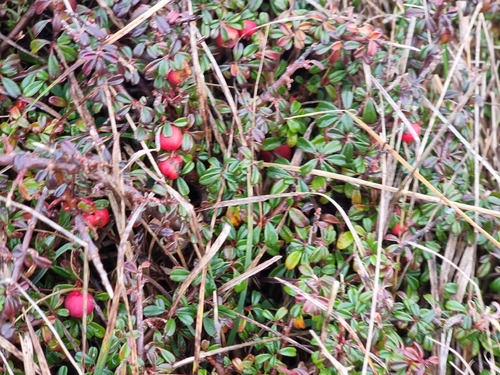
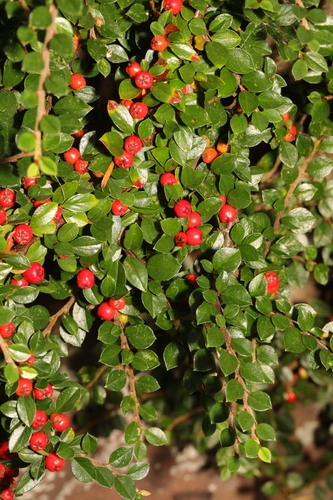
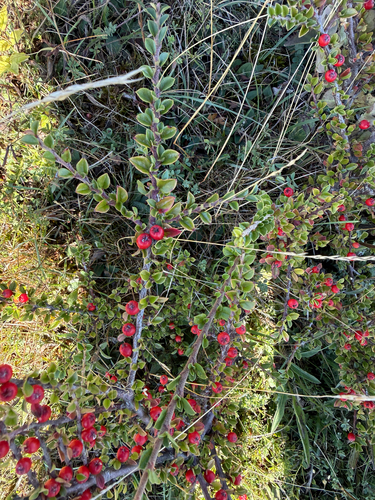
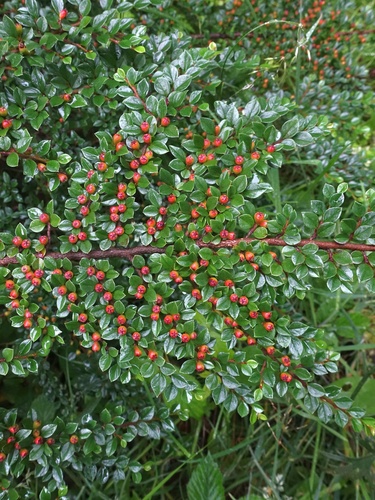
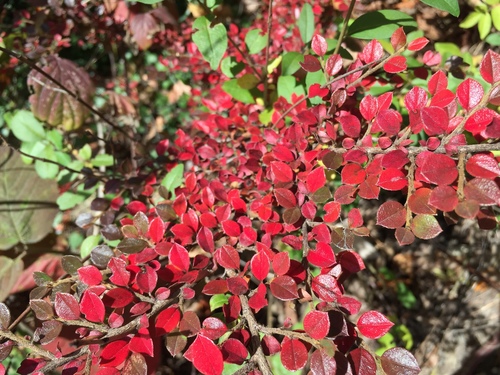
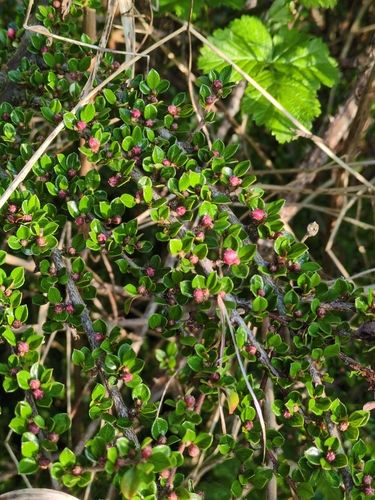
The photograph at the top: Alfredo F. Fuentes Claros, no rights reserved (CC0), in cultivation, observed 2022-05-02. Photographs: Stephen Gasson, no rights reserved (CC0); Stephen James McWilliam, no rights reserved (CC0); Sim Elliott, no rights reserved (CC0); (c) Jamie O'Neill, some rights reserved (CC BY); (c) Jason Grant, some rights reserved (CC BY); (c) guywallbanks, some rights reserved (CC BY). Credits as read from iNaturalist on 2026-11-04. What each licence allows.
Related
Other Cotoneaster 103 in the reference
 Cotoneaster acuminatus Acuminate cotoneaster Photo: CC BY, Sagnik Dutta Roy
 Cotoneaster acutifolius Peking cotoneaster Photo: CC BY, Oleksandr Shynder
 Cotoneaster adpressus Creeping cotoneaster Photo: Public domain, Daderot
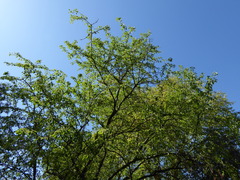 Cotoneaster affinis Purpleberry cotoneaster Photo: CC BY, jamie-aa
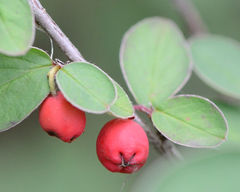 Cotoneaster alaunicus Rosaceae Photo: CC BY, Fyodor Pudovikov
 Cotoneaster ambiguus Ambiguous Cotoneaster Photo: CC BY-SA, Jens Kristiansen
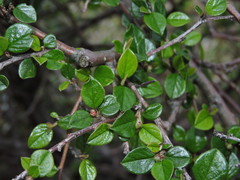 Cotoneaster apiculatus Cranberry cotoneaster Photo: CC BY, Jacy Chen
 Cotoneaster armenus Rosaceae Photo: CC BY-SA, Krzysztof Ziarnek, Kenraiz
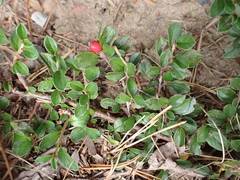 Cotoneaster ascendens Ascending Cotoneaster Photo: CC0, Yann Kemper
 Cotoneaster bullatus Hollyberry cotoneaster Photo: CC BY, Wolfgang Jauch all 104 ›
Names & registers
Also known as Cotoneaster acuminata var. prostrata; Cotoneaster acuminatus subsp. prostratus; Cotoneaster acuminatus var. prostratus; Cotoneaster atropurpureus; Cotoneaster atrovirens and 11 more. (GBIF Backbone)
WFO Plant List (2026-06) accepted. World Flora Online, CC0; read 2026-11-13.
Same spelling, another plant GBIF's record of this species holds Cotoneaster microphyllus Diels as an older name. The reference's Cotoneaster microphyllus is another plant, named by another author. (GBIF Backbone)
Published in Ann. Gén. Hort. 22: 168 (1879) (WCVP, RBG Kew, file of 2026-06-04)
Elsewhere Tropicos · Catalogue of Life · NatureServe · Flora of North America · Flora of China · USDA PLANTS · Calflora · APNI · VicFlora · Missouri Plant Finder · CalPhotos · EOL · ITIS · NCBI (identifiers from Wikidata's item Q159650, read 2026-11-13, CC0)
Chromosomes no count in ChromoDB's IAPT/IOPB set (the file holds no count under IPNI id 722522-1). ChromoDB, IAPT/IOPB chromosome data (Simon, Bosch & Blanché), version 3.1 of 8 November 2026, CC BY 4.0; read 2026-11-13.
The record
Predicted extinction risk 8% probability of being threatened (95% interval 4% to 12%); predicted not threatened, the model is confident of this class. A model's prediction, not an assessment. Bachman et al. 2024, New Phytologist; Kew's data of 1 February 2024, CC BY 4.0; read 2026-11-13.
CITES Not decided from this page's names: CITES lists Diospyros spp. (Appendix II); Kew holds a name of this species in that genus as a synonym, and the Appendices read a genus by their own reference, which is not read here. CITES Appendices I, II and III, valid from 5 March 2026; read 2026-11-13. The Appendices
Every figure here is derived from public data by a stated rule and names its source; nothing about this species is written for its page by a person or by AI, apart from the marked, credited quotations. How →
Where this page came from built 2026-11-18
gbif.species answeredkept from this page's build of 2026-11-01gbif.synonyms answeredkept from this page's build of 2026-11-01gbif.vernacular answeredasked 2026-11-18names fetched 2026-10-21; carried by an offline re-derivation of 2026-11-18wcvp.distribution answeredas of 2026-06-04gbif.occurrences answeredas of 2026-10-21GBIF occurrence download https://doi.org/10.15468/dl.hbdw64, of 2026-10-21; records tested against the native regions' shapes, openly licensed and restricted alike (Natural Earth's provinces, placed in TDWG's regions; shapes rule r87); a record within the margin, off a coast or on an island too small to draw counted only when it states the region's country, and only on no other region's land but within 0.02° of a native shape across a border, where its stated state or province does not name the other region (read by Natural Earth's name, its ISO 3166-2 code or an old province's name); 37 records within 1 km of a botanic garden, herbarium or zoo left out (22 at a botanic garden or arboretum, 2 at a herbarium, 13 at a zoo; Wikidata's list)climate nothing to reportasked 2026-11-1849 in-range records, none placed to within 10 km by the climate's rule (none states an accuracy of 10 km or better, and none is a person's observation given to three decimals)wikidata answeredkept from this page's build of 2026-10-21wikipedia answeredkept from this page's build of 2026-10-21; not asked againinat.taxon answerediNaturalist's taxon 53771 (Cotoneaster horizontalis), kept from an earlier build, checked 2026-10-23: active and this species' own (kept from this page's build of 2026-10-21)inat.photos.wild answeredasked 2026-10-26from iNaturalist's API: research-grade observations not marked captive with an open-licence photograph, the observations iNaturalist puts first by votes, 24 of them (the open data of 2026-09-27 holds 471, and no votes); filled 2026-10-26; descendants read against Kew's file of 2026-06-04; kept by the build of 2026-11-18 (this build: not asked: this build left iNaturalist to the daily fill, which asks for the photographs once the page's taxon is known)inat.photos.cultivated answeredasked 2026-10-26observations marked captive or cultivated whose identifications agree; filled 2026-10-26; kept by the build of 2026-11-18 (this build: not asked: this build left iNaturalist to the daily fill, which asks for the photographs once the page's taxon is known)gbif.media answeredas of 2026-10-21from the GBIF download https://doi.org/10.15468/dl.hbdw64, of 2026-10-21commons not askedkept from this page's build of 2026-10-30openalex not askedthe reference does not ask OpenAlex for papersEvery source is recorded as having answered, reported nothing, refused, failed, not been asked, or answered twice where one answer is taken (“not taken: two items answered”), and, for a source asked when this page was built, when: the figures are as the source held them that day; a source read from a file (Kew's World Checklist, a GBIF download) says "as of" the file's day instead; a row carried from an earlier build of the page names that build instead. Only “nothing to report” is ever shown as an absence. Records came from 131 datasets via GBIF.org; each carries its own licence.