Elaeocarpus grandis F.Muell.
English names not checked: Wikidata's common names were not read for this page.
Photographs not checked
iNaturalist and GBIF media were skipped (not asked) when this page was built. Not asked, or not answered, is not "none": nothing here claims there is none. Why the site says it this way.GBIF's records not checked. GBIF's backbone holds no one accepted species of this name, and a name it holds only as another species' synonym is not taken for this one, so GBIF's records were not asked. So this page has no points on its map, no map marker, no habitat climate, no cultivation sheet and no species of nearest climate; the range is Kew's. Not a statement that none exist. How.
Summary
Elaeocarpus grandis, commonly known as blue quandong, is a species of flowering plant in the family Elaeocarpaceae first described in 1860. It is a large buttressed tree native to the coastal rainforests of northeastern Australia. The validity of this taxon is disputed, with some authorities accepting it and others presenting it as Elaeocarpus angustifolius.
Quoted from Wikipedia, "Elaeocarpus grandis", CC BY-SA 4.0.
About the genus · Elaeocarpus
Elaeocarpus is a genus of nearly five hundred species of flowering plants in the family Elaeocarpaceae native to the western Indian Ocean, tropical and subtropical Asia, Australia and the Pacific. Plants in the genus are trees or shrubs with simple leaves, flowers with four or five petals, and usually blue fruit.
Quoted from Wikipedia, "Elaeocarpus", CC BY-SA 4.0.
Cultivation
Climate across the habitat
Natural habitat
Photographs
Related
Similar habitat climate Not checked: GBIF's records were not asked (why, under the name), and the nearest habitat climates are read from the climate they give.
Other Elaeocarpus 23 in the reference
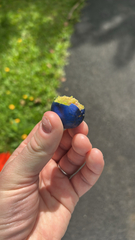 Elaeocarpus angustifolius Blue marble tree Photo: CC BY, Grze Swis
 Elaeocarpus balansae Elaeocarpaceae Photo: CC BY-SA, 阿橋 HQ
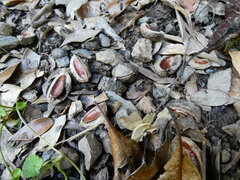 Elaeocarpus bancroftii Johnstone River-almond Photo: CC BY-SA, Steve Fitzgerald
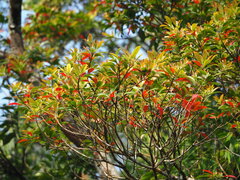 Elaeocarpus decipiens Common Elaeocarpus Photo: CC0, author not stated
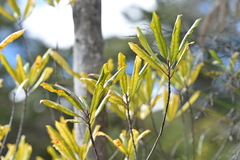 Elaeocarpus dentatus Elaeocarpaceae Photo: CC BY-SA, Christopher Stephens
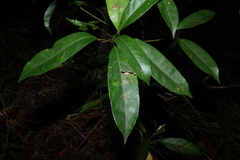 Elaeocarpus eumundi Smooth-leaved Quandong Photo: CC BY-SA, Greg Tasney Elaeocarpus glabripetalus Elaeocarpaceae
 Elaeocarpus grandiflorus Elaeocarpaceae Photo: CC BY, PEAK99
 Elaeocarpus hainanensis Hainan Elaeocarpus Photo: CC0, author not stated
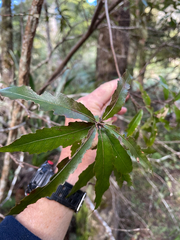 Elaeocarpus hookerianus Elaeocarpaceae Photo: CC BY, nick_goldwater Elaeocarpus hygrophilus Elaeocarpaceae
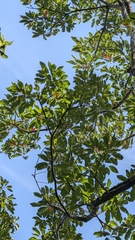 Elaeocarpus japonicus Elaeocarpaceae Photo: CC BY-SA, 許文俊 all 24 ›
Names & registers
Also known as Elaeocarpus drymophilus. (WCVP, RBG Kew)
The record
Every figure here is derived from public data by a stated rule and names its source; nothing about this species is written for its page by a person or by AI, apart from the marked, credited quotations. How →
Where this page came from built 2026-10-22
kew.names answeredas of 2026-06-04Kew's entry Elaeocarpus grandis F.Muell. (plant_name_id 2785591), read from Kew's names filegbif.species not askedGBIF's backbone holds no one accepted species of this name, and a name it holds only as another species' synonym is not taken for this one, so GBIF's records were not askedgbif.synonyms not askedGBIF's backbone holds no one accepted species of this name, and a name it holds only as another species' synonym is not taken for this one, so GBIF's records were not askedgbif.vernacular not askedGBIF's backbone holds no one accepted species of this name, and a name it holds only as another species' synonym is not taken for this one, so GBIF's records were not askedgbif.occurrences not askedGBIF's backbone holds no one accepted species of this name, and a name it holds only as another species' synonym is not taken for this one, so GBIF's records were not askedwcvp.distribution answeredas of 2026-06-04climate not askedGBIF's backbone holds no one accepted species of this name, and a name it holds only as another species' synonym is not taken for this one, so GBIF's records were not asked, and the habitat climate is read only from themwikidata answeredasked 2026-10-22found by Kew's IPNI identifier 833835-1, POWO 833835-1wikipedia answeredasked 2026-10-22inat.photos.wild not askedinat.photos.cultivated not askedgbif.media not askedGBIF's backbone holds no one accepted species of this name, and a name it holds only as another species' synonym is not taken for this one, so GBIF's records were not askedcommons nothing to reportasked 2026-10-22openalex not askednot yet asked for this reference; a later fill takes the papers from OpenAlex's snapshotEvery source is recorded as having answered, reported nothing, refused, failed, not been asked, or answered twice where one answer is taken (“not taken: two items answered”), and, for a source asked when this page was built, when: the figures are as the source held them that day; a source read from a file (Kew's World Checklist, a GBIF download) says "as of" the file's day instead; a row carried from an earlier build of the page names that build instead. Only “nothing to report” is ever shown as an absence.