Encephalartos afer (Thunb.) Lehm.
English names not checked: Wikidata's common names were not read for this page.
Photographs not checked
iNaturalist and GBIF media were skipped (not asked) when this page was built. Not asked, or not answered, is not "none": nothing here claims there is none. Why the site says it this way.GBIF's records not checked. GBIF's backbone holds no one accepted species of this name, and a name it holds only as another species' synonym is not taken for this one, so GBIF's records were not asked. So this page has no points on its map, no map marker, no habitat climate, no cultivation sheet and no species of nearest climate; the range is Kew's. Not a statement that none exist. How.
Summary
Encephalartos afer, commonly known as the Eastern Cape dwarf cycad, is a species of cycad in the genus Encephalartos. It is a near threatened species native to South Africa.
Quoted from Wikipedia, "Encephalartos afer", CC BY-SA 4.0.
About the genus · Encephalartos
Encephalartos is a genus of cycad native to Africa. Several species of Encephalartos are commonly referred to as bread trees, or bread palms since a bread-like starchy food can be prepared from the centre of the stem. The genus name is derived from Ancient Greek ἐγκέφαλος, meaning "head", and ἄρτος, meaning "bread", referring to the use of the pith to make food. More on Wikipedia ›
Quoted from Wikipedia, "Encephalartos", CC BY-SA 4.0.
Cultivation
Climate across the habitat
Natural habitat
Photographs
Related
Similar habitat climate Not checked: GBIF's records were not asked (why, under the name), and the nearest habitat climates are read from the climate they give.
Other Encephalartos 48 in the reference
 Encephalartos aemulans Ngotshe Cycad Photo: CC BY-SA, andy_king50
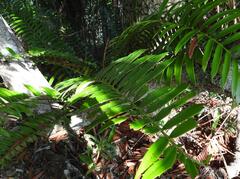 Encephalartos altensteinii Eastern Cape Cycad Photo: CC BY, Henry de Lange
 Encephalartos aplanatus Cycad Photo: CC BY-SA, andy_king50
 Encephalartos arenarius Alexandria Cycad Photo: CC BY-SA, J Brew
 Encephalartos barteri Cycad Photo: CC BY-SA, C T Johansson
 Encephalartos bubalinus Lake Natron Cycad Photo: CC BY-SA, Dryas
 Encephalartos cerinus Waxen Cycad Photo: CC BY-SA, andy_king50
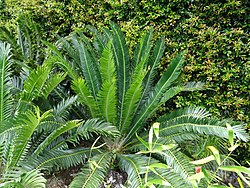 Encephalartos chimanimaniensis Chimanimani Cycad Photo: CC BY-SA, andy_king50
 Encephalartos concinnus Runde Cycad Photo: CC BY-SA, J Brew
 Encephalartos cupidus Blyde River Cycad Photo: CC BY-SA, User:BotBln Encephalartos dyerianus Lowveld Cycad
 Encephalartos eugene-maraisii Waterberg Cycad Photo: CC BY-SA, C T Johansson all 49 ›
Names & registers
Also known as Encephalartos brachyphyllus; Encephalartos afer var. brachyphyllus; Encephalartos afer var. integrifolius; Encephalartos cycadis; Zamia elliptica and 6 more. (WCVP, RBG Kew)
The record
Every figure here is derived from public data by a stated rule and names its source; nothing about this species is written for its page by a person or by AI, apart from the marked, credited quotations. How →
Where this page came from built 2026-10-22
kew.names answeredas of 2026-06-04Kew's entry Encephalartos afer (Thunb.) Lehm. (plant_name_id 385154), read from Kew's names filegbif.species not askedGBIF's backbone holds no one accepted species of this name, and a name it holds only as another species' synonym is not taken for this one, so GBIF's records were not askedgbif.synonyms not askedGBIF's backbone holds no one accepted species of this name, and a name it holds only as another species' synonym is not taken for this one, so GBIF's records were not askedgbif.vernacular not askedGBIF's backbone holds no one accepted species of this name, and a name it holds only as another species' synonym is not taken for this one, so GBIF's records were not askedgbif.occurrences not askedGBIF's backbone holds no one accepted species of this name, and a name it holds only as another species' synonym is not taken for this one, so GBIF's records were not askedwcvp.distribution answeredas of 2026-06-04climate not askedGBIF's backbone holds no one accepted species of this name, and a name it holds only as another species' synonym is not taken for this one, so GBIF's records were not asked, and the habitat climate is read only from themwikidata answeredasked 2026-10-22found by Kew's IPNI identifier 297071-1, POWO 297071-1wikipedia answeredasked 2026-10-22inat.photos.wild not askedinat.photos.cultivated not askedgbif.media not askedGBIF's backbone holds no one accepted species of this name, and a name it holds only as another species' synonym is not taken for this one, so GBIF's records were not askedcommons nothing to reportasked 2026-10-22openalex not askednot yet asked for this reference; a later fill takes the papers from OpenAlex's snapshotEvery source is recorded as having answered, reported nothing, refused, failed, not been asked, or answered twice where one answer is taken (“not taken: two items answered”), and, for a source asked when this page was built, when: the figures are as the source held them that day; a source read from a file (Kew's World Checklist, a GBIF download) says "as of" the file's day instead; a row carried from an earlier build of the page names that build instead. Only “nothing to report” is ever shown as an absence.