Epiphyllum grandilobum (F.A.C.Weber) Britton & Rose
Photographs not checked
iNaturalist was skipped (not asked) when this page was built. Not asked, or not answered, is not "none": nothing here claims there is none. Why the site says it this way.Summary
Epiphyllum grandilobum is an epiphytic species of cactus native to Costa Rica, Nicaragua, Panama. This species occurs in elevations of 20 to 1100 m in continuously declining forest habitats, which are threatened by housing and urban areas, tourism and recreational areas, in addition to annual and perennial non-timber crops. The populations are severely fragmented. International trade is restricted to the terms of CITES appendix II, in order to prevent poaching of wild populations. More on Wikipedia ›
Quoted from Wikipedia, "Epiphyllum grandilobum", CC BY-SA 4.0.
About the genus · Epiphyllum
Epiphyllum, ; from Ancient Greek ἐπι- (epi-), meaning "upon", and φύλλον (phúllon), meaning "leaf", is a genus of epiphytic plants in the cactus family (Cactaceae), native to Central America and South America. Common names for these species include climbing cacti, orchid cacti and leaf cacti, though the latter also refers to the genus Pereskia.
Quoted from Wikipedia, "Epiphyllum", CC BY-SA 4.0.
Cultivation
Grouped as an epiphyte, listed under the genus Epiphyllum in the archetype table, and Kew describes it as “epiphyte”.
How this section is made
Each card states this species' habitat figures with their sources, and what two fixed rules read from them; nothing here says what the plant does, wants or tolerates. The rules · the terms.
Group. Listed under the genus Epiphyllum in the archetype table, and Kew describes it as “epiphyte”. A group is taken only where Kew's description of the species agrees with the table's listing. The table gives no figure and no prose; the cold floor is the habitat's alone.
Climate across the habitat
Natural habitat
How this section is made
Photographs
Related
Other Epiphyllum 8 in the reference
 Epiphyllum chrysocardium Fern leaf orchid cactus Photo: CC BY-SA, sadambio
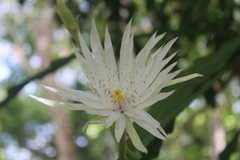 Epiphyllum hookeri Nightblooming cactus Photo: CC BY, Ricard Busquets Reverte
 Epiphyllum laui Cactaceae Photo: CC0, IMtheEyeInTheSky
 Epiphyllum oxypetalum Dutchman's pipe cactus Photo: CC0, author not stated
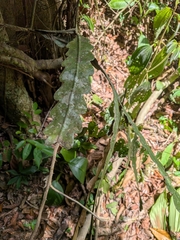 Epiphyllum phyllanthus Climbing Cactus Photo: CC BY, Guillaume Delaitre
 Epiphyllum pumilum Dutchman's pipe cactus Photo: CC BY, Manuel Campos
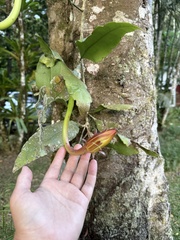 Epiphyllum thomasianum Cactaceae Photo: CC BY, ashleyrsteel
Names & registers
Also known as Epiphyllum gigas; Phyllocactus grandilobus. (GBIF Backbone)
The record
Every figure here is derived from public data by a stated rule and names its source; nothing about this species is written for its page by a person or by AI, apart from the marked, credited quotations. How →
Where this page came from built 2026-10-22
gbif.species answeredasked 2026-10-22gbif.synonyms answeredasked 2026-10-22gbif.vernacular answeredasked 2026-10-22names fetched 2026-10-22wcvp.distribution answeredas of 2026-06-04gbif.occurrences answeredas of 2026-10-21GBIF occurrence download https://doi.org/10.15468/dl.hbdw64, of 2026-10-21climate nothing to reportasked 2026-10-2242 in-range records, none placed to within 10 kmwikidata answeredasked 2026-10-22wikipedia answeredasked 2026-10-22inat.photos.wild nothing to reportasked 2026-10-22from iNaturalist's open data of 2026-09-27: research-grade observations with an open-licence photograph, the 24 whose photographs iNaturalist received last (the open data holds no votes); filled 2026-10-22inat.photos.cultivated not askedgbif.media nothing to reportasked 2026-10-22commons nothing to reportasked 2026-10-22openalex not askednot yet asked for this reference; a later fill takes the papers from OpenAlex's snapshotEvery source is recorded as having answered, reported nothing, refused, failed, not been asked, or answered twice where one answer is taken (“not taken: two items answered”), and, for a source asked when this page was built, when: the figures are as the source held them that day; a source read from a file (Kew's World Checklist, a GBIF download) says "as of" the file's day instead; a row carried from an earlier build of the page names that build instead. Only “nothing to report” is ever shown as an absence. Records came from 6 datasets via GBIF.org; each carries its own licence.