Eucalyptus annettae D.Nicolle & M.E.French
Tookle Jenna Mallet
Photographs not checked
iNaturalist was skipped (not asked) when this page was built. Not asked, or not answered, is not "none": nothing here claims there is none. Why the site says it this way.Summary
Eucalyptus annettae is a mallet that is endemic a small area in the south-west of Western Australia. It has rough, dark grey bark on the lower part of its stems and smooth bark on its upper parts. The adult leaves are lance-shaped, the flower buds are ribbed and arranged in groups of seven, the flowers are pale yellow and the fruit are conical with longitudinal ribs.
Quoted from Wikipedia, "Eucalyptus annettae", CC BY-SA 4.0.
About the genus · Eucalyptus
Eucalyptus is a genus of more than 700 species of flowering plants in the family Myrtaceae. Most species of Eucalyptus are trees, often mallees, and a few are shrubs. Along with several other genera in the tribe Eucalypteae, including Corymbia and Angophora, they are commonly known as eucalypts or "gum trees". More on Wikipedia ›
Quoted from Wikipedia, "Eucalyptus", CC BY-SA 4.0.
Cultivation
Climate across the habitat
Natural habitat
How this section is made
Photographs
Related
Other Eucalyptus 290 in the reference
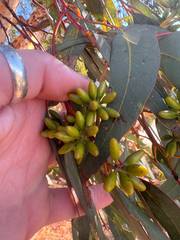 Eucalyptus accedens Powder-bark wandoo Photo: CC BY, Tyler Anthony
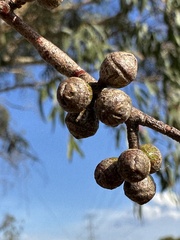 Eucalyptus aggregata Black gum Photo: CC BY, prossington
 Eucalyptus alatissima Wing-Fruited Mallee Photo: CC BY, Murray Fagg
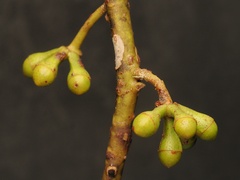 Eucalyptus alba Timor white gum Photo: CC BY, Roland Muench
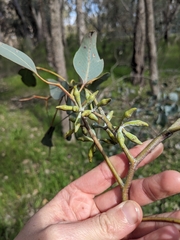 Eucalyptus albens White box Photo: CC BY, Nina Kerr
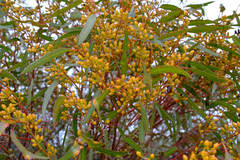 Eucalyptus albida White-leaved Mallee Photo: CC BY, Peter Crowcroft
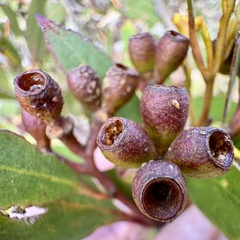 Eucalyptus albopurpurea Port Lincoln mallee Photo: CC BY, pimelea
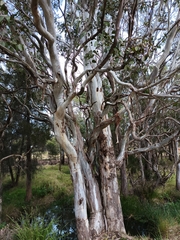 Eucalyptus amplifolia Cabbage gum Photo: CC BY, Carl Ramirez
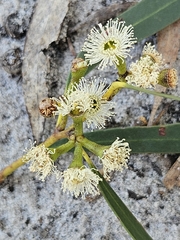 Eucalyptus amygdalina Black peppermint Photo: CC0, author not stated
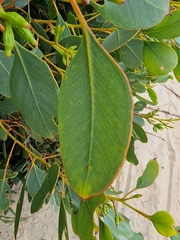 Eucalyptus angulosa Ridge-fruited mallee Photo: CC0, author not stated
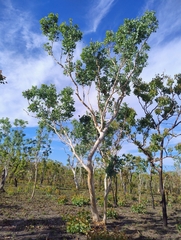 Eucalyptus apodophylla Whitebark Photo: CC BY, Ian Cowie
 Eucalyptus arachnaea Black Stem Mallee Photo: CC BY, Ian Brooker and David Kleinig all 291 ›
Names & registers
The record
Every figure here is derived from public data by a stated rule and names its source; nothing about this species is written for its page by a person or by AI, apart from the marked, credited quotations. How →
Where this page came from built 2026-10-22
gbif.species answeredasked 2026-10-22gbif.synonyms answeredasked 2026-10-22gbif.vernacular answeredasked 2026-10-22names fetched 2026-10-22wcvp.distribution answeredas of 2026-06-04gbif.occurrences answeredas of 2026-10-21GBIF occurrence download https://doi.org/10.15468/dl.hbdw64, of 2026-10-21climate nothing to reportasked 2026-10-22only 1 distinct land cell of the climate grid holds an in-range record placed to within 10 km; three are needed for an envelopewikidata answeredasked 2026-10-22wikipedia answeredasked 2026-10-22inat.photos.wild nothing to reportasked 2026-10-22from iNaturalist's open data of 2026-09-27: research-grade observations with an open-licence photograph, the 24 whose photographs iNaturalist received last (the open data holds no votes); filled 2026-10-22inat.photos.cultivated not askedgbif.media nothing to reportasked 2026-10-22commons nothing to reportasked 2026-10-22openalex not askednot yet asked for this reference; a later fill takes the papers from OpenAlex's snapshotEvery source is recorded as having answered, reported nothing, refused, failed, not been asked, or answered twice where one answer is taken (“not taken: two items answered”), and, for a source asked when this page was built, when: the figures are as the source held them that day; a source read from a file (Kew's World Checklist, a GBIF download) says "as of" the file's day instead; a row carried from an earlier build of the page names that build instead. Only “nothing to report” is ever shown as an absence. Records came from 2 datasets via GBIF.org; each carries its own licence.