Eulophia ugandae Rolfe
Photographs not checked
iNaturalist was skipped (not asked) when this page was built. Not asked, or not answered, is not "none": nothing here claims there is none. Why the site says it this way.Summary
Oeceoclades ugandae is a terrestrial orchid species in the genus Oeceoclades that is native to parts of tropical Africa, including west tropical Africa (Ghana and Ivory Coast), west-central tropical Africa (Gulf of Guinea islands and the Democratic Republic of the Congo), northeast tropical Africa (Ethiopia), and east tropical Africa (Kenya and Uganda). It was first described by the British botanist Robert Allen Rolfe in 1913 as Eulophia ugandae and later transferred to the genus Oeceoclades in 1976 when Leslie Andrew Garay and Peter Taylor resurrected and revised that genus. The English botanist V.S. Summerhayes treated this species as a synonym of O. latifolia, but Garay and Taylor noted that while the two species share a superficial resemblance in the appearance of the labellum, they are distinct in vegetative morphology. The labellum of O. ugandae also has two swellings or protuberances between the lateral and midlobes, a feature that O. latifolia lacks.
Quoted from Wikipedia, "Oeceoclades ugandae", CC BY-SA 4.0; its title is one of this species' older names (GBIF Backbone), which is the proof that the article is this species'.
Cultivation
Climate across the habitat
Natural habitat
Photographs
Related
Other Eulophia 17 in the reference
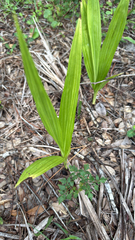 Eulophia alta Wild coco Photo: CC0, author not stated
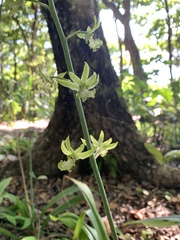 Eulophia andamanensis Orchidaceae Photo: CC BY, payalm
 Eulophia calcarata Orchidaceae Photo: CC BY, Michael A. Alcorn
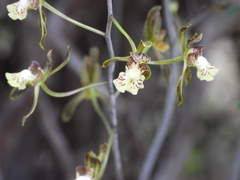 Eulophia decaryana Orchidaceae Photo: CC BY, amantedarmanin
 Eulophia euglossa Orchidaceae Photo: CC BY, Sandra Keller Eulophia falcigera Orchidaceae
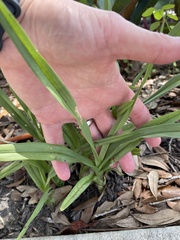 Eulophia graminea Chinese Crown Orchid Photo: CC BY, James Hardee
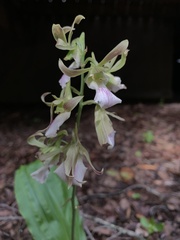 Eulophia guineensis Orchidaceae Photo: CC BY, Skjold Søndergaard
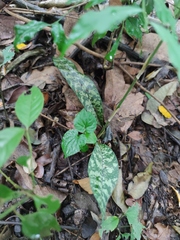 Eulophia maculata African Spotted Orchid Photo: CC BY, Liliana Ramírez-Freire
 Eulophia pardalina Orchidaceae Photo: CC BY-SA, Marcos Antonio Campacci
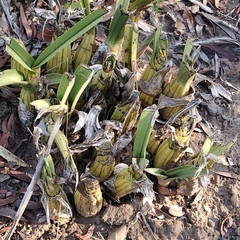 Eulophia petersii Desert Orchid Photo: CC BY, Benjamin Fredlund
 Eulophia picta Orchidaceae Photo: CC BY-SA, Vinayaraj all 18 ›
Names & registers
Also known as Oeceoclades ugandae. (GBIF Backbone)
The record
Every figure here is derived from public data by a stated rule and names its source; nothing about this species is written for its page by a person or by AI, apart from the marked, credited quotations. How →
Where this page came from built 2026-10-22
gbif.species answeredasked 2026-10-22gbif.synonyms answeredasked 2026-10-22gbif.vernacular answeredasked 2026-10-22names fetched 2026-10-22wcvp.distribution answeredas of 2026-06-04gbif.occurrences answeredas of 2026-10-21GBIF occurrence download https://doi.org/10.15468/dl.hbdw64, of 2026-10-21climate nothing to reportasked 2026-10-22only 1 distinct land cell of the climate grid holds an in-range record placed to within 10 km; three are needed for an envelopewikidata answeredasked 2026-10-22wikipedia answeredasked 2026-10-22Wikipedia redirects Eulophia ugandae to Oeceoclades ugandae, an older name of this species (Oeceoclades ugandae)inat.taxon not askedinat.photos.wild not askedinat.photos.cultivated not askedgbif.media nothing to reportasked 2026-10-22commons nothing to reportasked 2026-10-22openalex not askednot yet asked for this reference; a later fill takes the papers from OpenAlex's snapshotEvery source is recorded as having answered, reported nothing, refused, failed, not been asked, or answered twice where one answer is taken (“not taken: two items answered”), and, for a source asked when this page was built, when: the figures are as the source held them that day; a source read from a file (Kew's World Checklist, a GBIF download) says "as of" the file's day instead; a row carried from an earlier build of the page names that build instead. Only “nothing to report” is ever shown as an absence. Records came from 2 datasets via GBIF.org; each carries its own licence.