Euonymus frigidus Wall.
Photographs not checked
iNaturalist was skipped (not asked) when this page was built. Not asked, or not answered, is not "none": nothing here claims there is none. Why the site says it this way.Summary
Euonymus frigidus (synonym Euonymus assamicus) is a species of plant in the family Celastraceae. It is native to China, the Himalayas, Assam and Myanmar.
Quoted from Wikipedia, "Euonymus frigidus", CC BY-SA 4.0.
About the genus · Euonymus
Euonymus is a genus of flowering plants in the staff vine family Celastraceae. Common names vary widely among different species and between different English-speaking countries, but include spindle, burning-bush, strawberry-bush, wahoo, wintercreeper, or simply euonymus. It has about 140 species of deciduous and evergreen shrubs, small trees and lianas. More on Wikipedia ›
Quoted from Wikipedia, "Euonymus", CC BY-SA 4.0.
Cultivation
Climate across the habitat
Natural habitat
How this section is made
Photographs
Related
Other Euonymus 40 in the reference
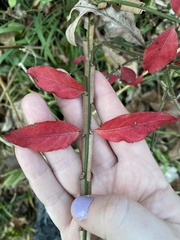 Euonymus alatus Winged euonymus Photo: CC BY, Emily Summerbell
 Euonymus americanus Hearts-bustin'-with-love Photo: CC BY, Alex Abair
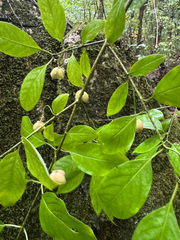 Euonymus atropurpureus Eastern burning-bush Photo: CC BY, Shelby Lyn Sanders
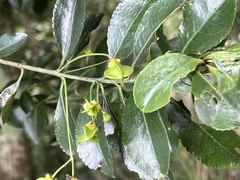 Euonymus carnosus Fleshy-flowered spindle tree Photo: CC BY, 謝麗霦
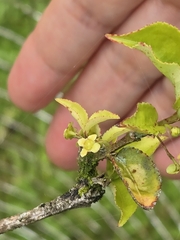 Euonymus centidens Celastraceae Photo: CC BY, 賴碧珠
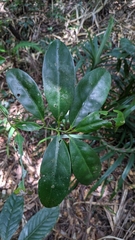 Euonymus cochinchinensis Celastraceae Photo: CC BY, Cheng-Te Hsu
 Euonymus cornutus Celastraceae Photo: CC BY-SA, peganum
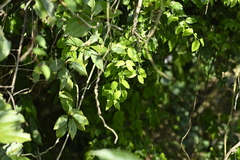 Euonymus echinatus Celastraceae Photo: CC BY, 曾昱承 Yu-Cheng Zeng
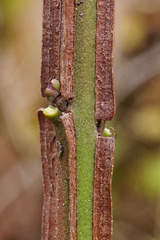 Euonymus europaeus European spindle-tree Photo: CC BY, Patrick Hacker
 Euonymus fimbriatus Celastraceae Photo: CC BY-SA, Dinesh Valke from Thane, India
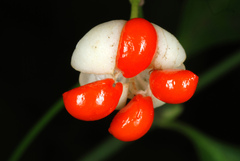 Euonymus fortunei Winter creeper Photo: CC BY-SA, Douglas Goldman all 41 ›
Names & registers
Also known as Euonymus assamicus; Euonymus austrotibetanus; Euonymus burmanicus; Euonymus ceratophorus; Euonymus crinitus and 13 more. (GBIF Backbone)
The record
Every figure here is derived from public data by a stated rule and names its source; nothing about this species is written for its page by a person or by AI, apart from the marked, credited quotations. How →
Where this page came from built 2026-10-22
gbif.species answeredasked 2026-10-22gbif.synonyms answeredasked 2026-10-22gbif.vernacular answeredasked 2026-10-22names fetched 2026-10-22wcvp.distribution answeredas of 2026-06-04gbif.occurrences answeredas of 2026-10-21GBIF occurrence download https://doi.org/10.15468/dl.hbdw64, of 2026-10-21climate nothing to reportasked 2026-10-22only 2 distinct land cells of the climate grid hold an in-range record placed to within 10 km; three are needed for an envelopewikidata answeredasked 2026-10-22IPNI and POWO linked by Kew's number for Euonymus frigidus Wall. (the item's: IPNI 160895-1, POWO 160894-1)wikipedia answeredasked 2026-10-22inat.photos.wild nothing to reportasked 2026-10-22from iNaturalist's open data of 2026-09-27: research-grade observations with an open-licence photograph, the 24 whose photographs iNaturalist received last (the open data holds no votes); filled 2026-10-22inat.photos.cultivated not askedgbif.media nothing to reportasked 2026-10-22commons nothing to reportasked 2026-10-22openalex not askednot yet asked for this reference; a later fill takes the papers from OpenAlex's snapshotEvery source is recorded as having answered, reported nothing, refused, failed, not been asked, or answered twice where one answer is taken (“not taken: two items answered”), and, for a source asked when this page was built, when: the figures are as the source held them that day; a source read from a file (Kew's World Checklist, a GBIF download) says "as of" the file's day instead; a row carried from an earlier build of the page names that build instead. Only “nothing to report” is ever shown as an absence. Records came from 24 datasets via GBIF.org; each carries its own licence.