
 2 photographs ›
Summary
Fritillaria sororum is a species of bulb-forming flowering plant in the lily family Liliaceae, found only in the Taurus Mountains of southern Turkey.
Quoted from Wikipedia, "Fritillaria sororum", CC BY-SA 4.0.
About the genus · Fritillaria
Fritillaria (fritillaries) is a genus of spring flowering herbaceous bulbous perennial plants in the lily family (Liliaceae). The type species, Fritillaria meleagris, was first described in Europe in 1571, while other species from the Middle East and Asia were also introduced to Europe at that time. The genus has about 130–140 species divided among eight subgenera. More on Wikipedia ›
Quoted from Wikipedia, "Fritillaria", CC BY-SA 4.0.
Cultivation
Grouped as a bulb, tuber or caudex, listed under the genus Fritillaria in the archetype table, and Kew describes it as “bulbous geophyte”.
How this section is made
Each card states this species' habitat figures with their sources, and what two fixed rules read from them; nothing here says what the plant does, wants or tolerates. The rules · the terms.
Group. Listed under the genus Fritillaria in the archetype table, and Kew describes it as “bulbous geophyte”. A group is taken only where Kew's description of the species agrees with the table's listing. The table gives no figure and no prose; the cold floor is the habitat's alone.
Climate across the habitat
Natural habitat
Photographs

Photographs: Ziegler175, CC BY-SA 3.0, via Wikimedia Commons.
Related
Other Fritillaria 117 in the reference
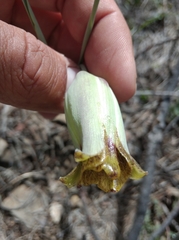 Fritillaria acmopetala Liliaceae Photo: CC BY, Ben Costamagna
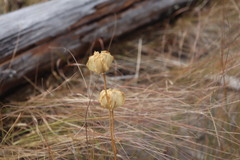 Fritillaria affinis Checker lily Photo: CC BY-SA, Henry "Nick" Robertson
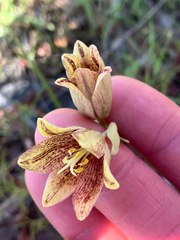 Fritillaria agrestis Stinkbells Photo: CC0, author not stated
 Fritillaria alburyana Liliaceae Photo: CC BY, Averater Fritillaria alfredae Liliaceae
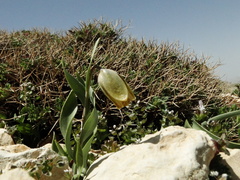 Fritillaria amana Liliaceae Photo: CC BY, Moustapha Itani Fritillaria anhuiensis Liliaceae Fritillaria ariana Liliaceae Fritillaria armena Liliaceae
 Fritillaria assyriaca Liliaceae Photo: CC0, Dûrzan Fritillaria atrolineata Liliaceae
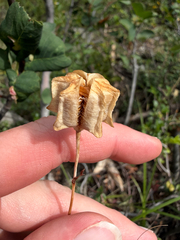 Fritillaria atropurpurea Spotted fritillary Photo: CC BY, Whitney Brook Matson all 118 ›
Names & registers
The record
Every figure here is derived from public data by a stated rule and names its source; nothing about this species is written for its page by a person or by AI, apart from the marked, credited quotations. How →
Where this page came from built 2026-10-22
gbif.species answeredasked 2026-10-22gbif.synonyms answeredasked 2026-10-22gbif.vernacular answeredasked 2026-10-22names fetched 2026-10-22wcvp.distribution answeredas of 2026-06-04gbif.occurrences nothing to reportasked 2026-10-22climate nothing to reportasked 2026-10-22no georeferenced record inside the rangewikidata answeredasked 2026-10-22wikipedia answeredasked 2026-10-22inat.photos.wild nothing to reportasked 2026-10-22from iNaturalist's open data of 2026-09-27: research-grade observations with an open-licence photograph, the 24 whose photographs iNaturalist received last (the open data holds no votes); filled 2026-10-22inat.photos.cultivated not askedgbif.media nothing to reportasked 2026-10-22commons answeredasked 2026-10-22openalex not askednot yet asked for this reference; a later fill takes the papers from OpenAlex's snapshotEvery source is recorded as having answered, reported nothing, refused, failed, not been asked, or answered twice where one answer is taken (“not taken: two items answered”), and, for a source asked when this page was built, when: the figures are as the source held them that day; a source read from a file (Kew's World Checklist, a GBIF download) says "as of" the file's day instead; a row carried from an earlier build of the page names that build instead. Only “nothing to report” is ever shown as an absence.