
Gagea chrysantha (Jan) Schult. & Schult.f.
Golden Gagea
Summary
Gagea chrysantha is a European species of plants in the lily family, found only in Italy and Sicily. Similar populations from the eastern Mediterranean have long been referred to G. chrysantha but recent evidence suggests that this group is actually a complex of several species rather than a single species.
Quoted from Wikipedia, "Gagea chrysantha", CC BY-SA 4.0.
Cultivation
Grouped as a bulb, tuber or caudex, listed under the family Liliaceae in the archetype table, and Kew describes it as “bulbous geophyte”.
How this section is made
Each card states this species' habitat figures with their sources, and what two fixed rules read from them; nothing here says what the plant does, wants or tolerates. The rules · the terms.
Group. Listed under the family Liliaceae in the archetype table, and Kew describes it as “bulbous geophyte”. A group is taken only where Kew's description of the species agrees with the table's listing. The table gives no figure and no prose; the cold floor is the habitat's alone.
Climate across the habitat
Natural habitat
How this section is made
Related
Other Gagea 19 in the reference
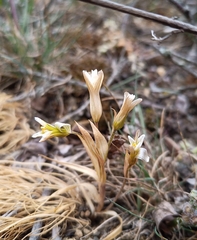 Gagea bohemica Early star-of-bethlehem Photo: CC BY, Michal Honskus
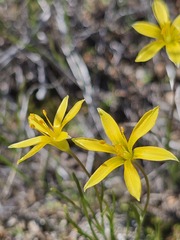 Gagea bulbifera Liliaceae Photo: CC BY, Yeskendir Satekov
 Gagea fibrosa Acute-flowered Star-of-Bethlehem Photo: CC BY, Eleftherios Katsillis
 Gagea flavonutans Liliaceae Photo: CC BY, Siddarth Machado
 Gagea foliosa Leafy Gagea Photo: CC BY-SA, Xemenendura
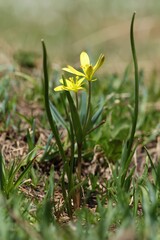 Gagea fragifera Star of Bethlehem Photo: CC BY, Antoine Thivolle
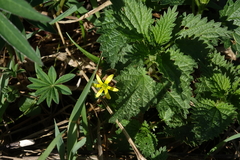 Gagea granulosa Granular gagea Photo: CC BY, Oleg Kosterin
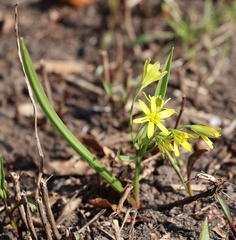 Gagea lutea Yellow star-of-Bethlehem Photo: CC BY, Andrejus Gaidamavičius
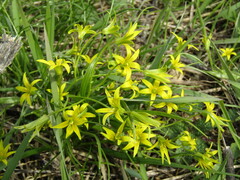 Gagea minima Least Gagea Photo: CC BY, snaily_naily
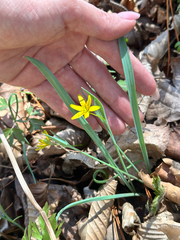 Gagea nakaiana Oriental yellow gagea Photo: CC BY, Tatyana Petrenko Gagea oxycarpa Liliaceae all 20 ›
Names & registers
Also known as Ornithogalum chrysanthum; Stellaster chrysanthus. (GBIF Backbone)
The record
Every figure here is derived from public data by a stated rule and names its source; nothing about this species is written for its page by a person or by AI, apart from the marked, credited quotations. How →
Where this page came from built 2026-10-22
gbif.species answeredasked 2026-10-22gbif.synonyms answeredasked 2026-10-22gbif.vernacular answeredasked 2026-10-22names fetched 2026-10-22wcvp.distribution answeredas of 2026-06-04gbif.occurrences answeredas of 2026-10-21GBIF occurrence download https://doi.org/10.15468/dl.hbdw64, of 2026-10-21climate nothing to reportasked 2026-10-226 in-range records, none placed to within 10 kmwikidata answeredasked 2026-10-22wikipedia answeredasked 2026-10-22inat.photos.wild nothing to reportasked 2026-10-22from iNaturalist's open data of 2026-09-27: research-grade observations with an open-licence photograph, the 24 whose photographs iNaturalist received last (the open data holds no votes); filled 2026-10-22inat.photos.cultivated not askedgbif.media nothing to reportasked 2026-10-22commons answeredasked 2026-10-22openalex not askednot yet asked for this reference; a later fill takes the papers from OpenAlex's snapshotEvery source is recorded as having answered, reported nothing, refused, failed, not been asked, or answered twice where one answer is taken (“not taken: two items answered”), and, for a source asked when this page was built, when: the figures are as the source held them that day; a source read from a file (Kew's World Checklist, a GBIF download) says "as of" the file's day instead; a row carried from an earlier build of the page names that build instead. Only “nothing to report” is ever shown as an absence. Records came from 13 datasets via GBIF.org; each carries its own licence.