Goeppertia argyraea (Linden ex Larché) Borchs. & S.Suárez
Cited as Kew's World Checklist cites it, Goeppertia argyraea (Linden ex Larché) Borchs. & S.Suárez: GBIF's backbone key for this page carries the name with another author, (Linden ex J.Dix) Borchs. & S.Suárez.
Photographs not checked
iNaturalist was skipped (not asked) when this page was built. Not asked, or not answered, is not "none": nothing here claims there is none. Why the site says it this way.About the genus · Goeppertia
Goeppertia is a genus of flowering plants in the family Marantaceae, native to the New World Tropics. It contains 243 accepted species, many of which were until recently assigned to Calathea. It was first described by Nees von Esenbeck in 1831, who erroneously erected another genus Goeppertia in 1836, which has now been synonymized with Endlicheria. More on Wikipedia ›
Quoted from Wikipedia, "Goeppertia", CC BY-SA 4.0.
Cultivation
Grouped as a tropical foliage plant, listed under the genus Goeppertia in the archetype table, and Kew describes it as “perennial”, “wet tropical”.
How this section is made
Each card states this species' habitat figures with their sources, and what two fixed rules read from them; nothing here says what the plant does, wants or tolerates. The rules · the terms.
Group. Listed under the genus Goeppertia in the archetype table, and Kew describes it as “perennial”, “wet tropical”. A group is taken only where Kew's description of the species agrees with the table's listing. The table gives no figure and no prose; the cold floor is the habitat's alone.
Climate across the habitat
Natural habitat
Photographs
Related
Other Goeppertia 48 in the reference
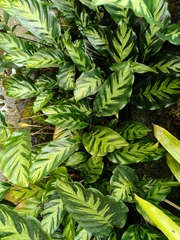 Goeppertia albertii Marantaceae Photo: CC BY, Diogo Luiz
 Goeppertia allouia Guinea arrowroot Photo: CC0, author not stated
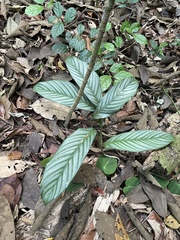 Goeppertia argyrophylla Marantaceae Photo: CC BY, B. Phalan
 Goeppertia bachemiana Marantaceae Photo: CC BY-SA, James Steakley
 Goeppertia burle-marxii Marantaceae Photo: CC BY-SA, KENPEI
 Goeppertia concinna Marantaceae Photo: CC BY, Magucination Guzmán
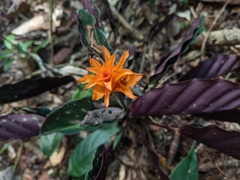 Goeppertia crocata Eternal Flame Photo: CC BY, Martin Vallejos
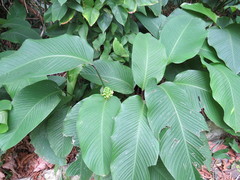 Goeppertia cylindrica Marantaceae Photo: CC BY, Victor Farjalla Pontes
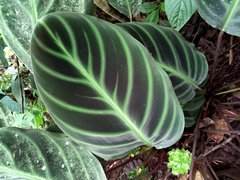 Goeppertia ecuadoriana Marantaceae Photo: CC BY, Frank Dietze
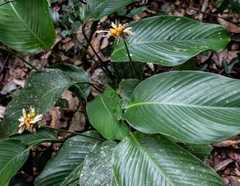 Goeppertia elliptica Marantaceae Photo: CC BY, Gerry van Tonder
 Goeppertia fasciata Marantaceae Photo: CC BY-SA, Krzysztof Ziarnek, Kenraiz all 49 ›
Names & registers
Also known as Calathea argyraea; Maranta argyraea; Phyllodes argyraea. (GBIF Backbone)
The record
Every figure here is derived from public data by a stated rule and names its source; nothing about this species is written for its page by a person or by AI, apart from the marked, credited quotations. How →
Where this page came from built 2026-10-22
gbif.species answeredasked 2026-10-22GBIF's key 9423844 is Goeppertia argyraea (Linden ex J.Dix) Borchs. & S.Suárez; the page links Kew's Goeppertia argyraea (Linden ex Larché) Borchs. & S.Suárez, and the name is cited as Kew cites itgbif.synonyms answeredasked 2026-10-22gbif.vernacular answeredasked 2026-10-22names fetched 2026-10-22wcvp.distribution answeredas of 2026-06-04gbif.occurrences answeredas of 2026-10-21GBIF occurrence download https://doi.org/10.15468/dl.hbdw64, of 2026-10-21; 2 records within 1 km of a botanic garden, herbarium or zoo left out (2 at a botanic garden or arboretum; Wikidata's list)climate nothing to reportasked 2026-10-22native range is stated at country level only, with no region boxes to test records againstwikidata answeredasked 2026-10-22wikipedia nothing to reportasked 2026-10-22inat.taxon not askedinat.photos.wild not askedinat.photos.cultivated not askedgbif.media nothing to reportasked 2026-10-22commons nothing to reportasked 2026-10-22openalex not askednot yet asked for this reference; a later fill takes the papers from OpenAlex's snapshotEvery source is recorded as having answered, reported nothing, refused, failed, not been asked, or answered twice where one answer is taken (“not taken: two items answered”), and, for a source asked when this page was built, when: the figures are as the source held them that day; a source read from a file (Kew's World Checklist, a GBIF download) says "as of" the file's day instead; a row carried from an earlier build of the page names that build instead. Only “nothing to report” is ever shown as an absence.