
Harrisia aboriginum Small ex Britton & Rose
Cited as Kew's World Checklist cites it, Harrisia aboriginum Small ex Britton & Rose: GBIF's backbone key for this page carries the name with another author, Small, 1920.


 19 photographs ›
Summary
Harrisia aboriginum (commonly known as the west-coast prickly apple, prickly applecactus, yellow prickly apple, and aboriginal prickly apple) is a species of columnar cactus endemic to peninsular Florida, on the Gulf Coast of the counties of Lee, Sarasota County, and Charlotte. Only 12 occurrences are known, and the species is threatened by horticultural collection, shading from fire suppression, competition from invasive flora, and most of all habitat destruction. It is a federally listed endangered species of the United States.
Quoted from Wikipedia, "Harrisia aboriginum", CC BY-SA 4.0.
Cultivation
Grouped as a cactus or succulent, listed under the family Cactaceae in the archetype table, and Kew describes it as “succulent shrub or tree”.
How this section is made
Each card states this species' habitat figures with their sources, and what two fixed rules read from them; nothing here says what the plant does, wants or tolerates. The rules · the terms.
Group. Listed under the family Cactaceae in the archetype table, and Kew describes it as “succulent shrub or tree”. A group is taken only where Kew's description of the species agrees with the table's listing. The table gives no figure and no prose; the cold floor is the habitat's alone.
Climate across the habitat
Natural habitat
How this section is made
Photographs

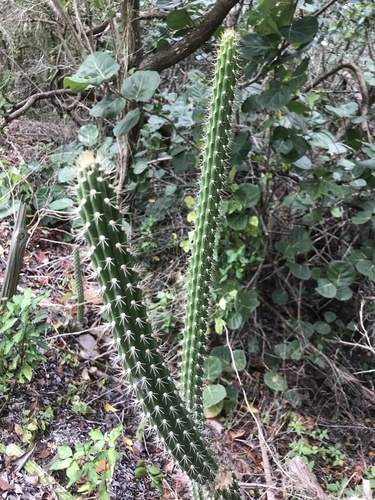

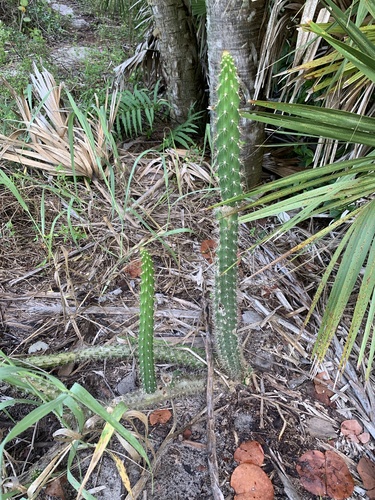
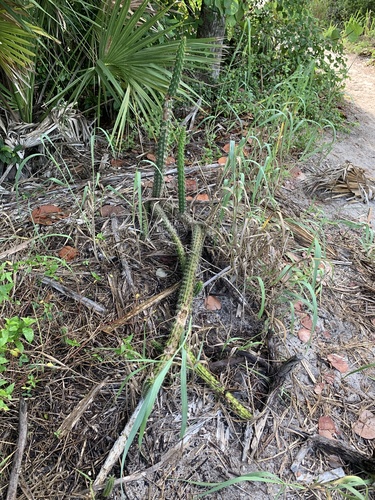
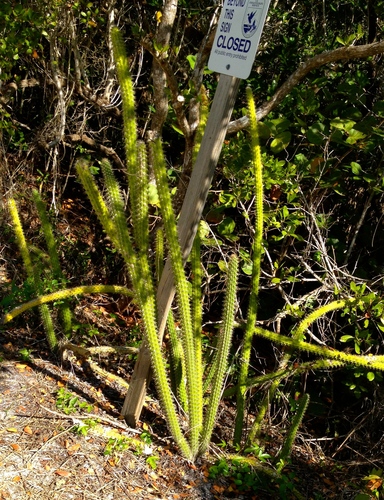
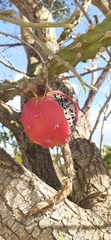
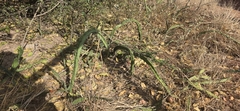
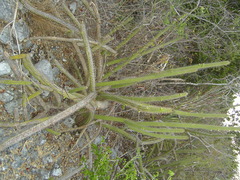
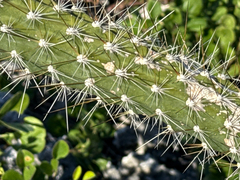
Photographs: author not stated, no rights reserved · CC0 (2); (c) Claire Herzog, some rights reserved (CC BY) (3); (c) Fluff Berger, some rights reserved (CC BY-SA).
Related
Other Harrisia 13 in the reference
 Harrisia adscendens Cactaceae Photo: CC0, author not stated
 Harrisia bonplandii Giant Red Dragon Apple Cactus Photo: CC BY, Barry Stewart
 Harrisia brookii Brook's dildo Photo: CC BY-SA, Stephanie Dolrenry
 Harrisia caymanensis Cactaceae Photo: CC0, author not stated
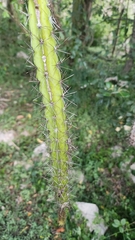 Harrisia divaricata Cactaceae Photo: CC0, author not stated
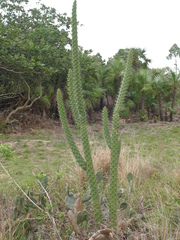 Harrisia eriophora Fragrant prickly-apple Photo: CC BY, Yoannis Domínguez
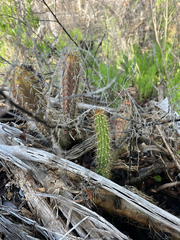 Harrisia fragrans Caribbean apple cactus Photo: CC0, author not stated
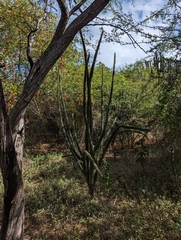 Harrisia gracilis Cactaceae Photo: CC BY, Joshua Hall
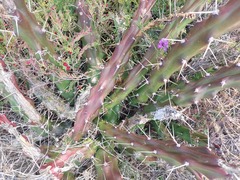 Harrisia martinii Moon cactus Photo: CC BY-SA, Ruth Palsson
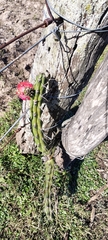 Harrisia pomanensis Midnight-lady Photo: CC BY, Pablo H Capovilla
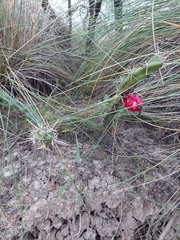 Harrisia regelii Cactaceae Photo: CC BY, Tomás Tamagno
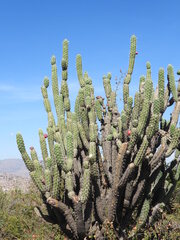 Harrisia tetracantha Cactaceae Photo: CC0, author not stated all 14 ›
Names & registers
The record
Every figure here is derived from public data by a stated rule and names its source; nothing about this species is written for its page by a person or by AI, apart from the marked, credited quotations. How →
Where this page came from built 2026-10-22
gbif.species answeredasked 2026-10-22GBIF's key 5384198 is Harrisia aboriginum Small, 1920; the page links Kew's Harrisia aboriginum Small ex Britton & Rose, and the name is cited as Kew cites itgbif.synonyms answeredasked 2026-10-22gbif.vernacular answeredasked 2026-10-22names fetched 2026-10-22wcvp.distribution answeredas of 2026-06-04gbif.occurrences answeredas of 2026-10-21GBIF occurrence download https://doi.org/10.15468/dl.hbdw64, of 2026-10-21climate nothing to reportasked 2026-10-22only 1 distinct land cell of the climate grid holds an in-range record placed to within 10 km; three are needed for an envelopewikidata answeredasked 2026-10-22wikipedia answeredasked 2026-10-22inat.photos.wild answeredasked 2026-10-22from iNaturalist's open data of 2026-09-27: research-grade observations with an open-licence photograph, the 24 whose photographs iNaturalist received last (the open data holds no votes); filled 2026-10-22inat.photos.cultivated not askedgbif.media answeredasked 2026-10-22none of the photographs on this page is credited to GBIF: those shown are other sources', and GBIF's were the same photographs or were set aside by the photograph rulescommons answeredasked 2026-10-22openalex not askednot yet asked for this reference; a later fill takes the papers from OpenAlex's snapshotEvery source is recorded as having answered, reported nothing, refused, failed, not been asked, or answered twice where one answer is taken (“not taken: two items answered”), and, for a source asked when this page was built, when: the figures are as the source held them that day; a source read from a file (Kew's World Checklist, a GBIF download) says "as of" the file's day instead; a row carried from an earlier build of the page names that build instead. Only “nothing to report” is ever shown as an absence. Records came from 3 datasets via GBIF.org; each carries its own licence.