
Hibiscadelphus distans L.E.Bishop & D.R.Herbst
Kauai hau kuahiwi
Cited as Kew's World Checklist cites it, Hibiscadelphus distans L.E.Bishop & D.R.Herbst: GBIF's backbone key for this page carries the name with another author, L.E.Bishop & Herbst.


 8 photographs ›
Summary
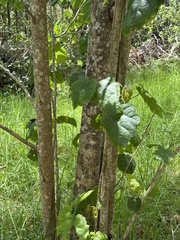
Hibiscadelphus distans (Kauai hau kuahiwi) is an extremely rare species of flowering plant in the mallow family, Malvaceae, that is endemic to the island of Kauaʻi in Hawaii. It is known as hau kuahiwi in Hawaiian, which means "upland Hibiscus tiliaceus." It is a bush or small tree with heart-shaped leaves and yellow flowers and grows at between 1,000 and 1,800 feet (300 and 550 m) in the remnants of native dry forests. Despite its rarity, it is believed to be the only surviving species in the genus Hibiscadelphus which is only known from Hawaii, the other five species having recently become extinct in the wild, some being known from only a single plant.
Quoted from Wikipedia, "Hibiscadelphus distans", CC BY-SA 4.0.
Cultivation
Climate across the habitat
Natural habitat
How this section is made
Photographs


Photographs: Daderot., CC BY-SA 3.0, via Wikimedia Commons; David Eickhoff from Pearl City, Hawaii, USA, CC BY 2.0, via Wikimedia Commons (5).
Related
Other Hibiscadelphus 1 in the reference
Names & registers
The record
Every figure here is derived from public data by a stated rule and names its source; nothing about this species is written for its page by a person or by AI, apart from the marked, credited quotations. How →
Where this page came from built 2026-10-22
gbif.species answeredasked 2026-10-22GBIF's key 3152785 is Hibiscadelphus distans L.E.Bishop & Herbst; the page links Kew's Hibiscadelphus distans L.E.Bishop & D.R.Herbst, and the name is cited as Kew cites itgbif.synonyms answeredasked 2026-10-22gbif.vernacular answeredasked 2026-10-22names fetched 2026-10-22wcvp.distribution answeredas of 2026-06-04gbif.occurrences answeredas of 2026-10-21GBIF occurrence download https://doi.org/10.15468/dl.hbdw64, of 2026-10-21; 3 records within 1 km of a botanic garden, herbarium or zoo left out (3 at a botanic garden or arboretum; Wikidata's list)climate nothing to reportasked 2026-10-223 in-range records, none placed to within 10 kmwikidata answeredasked 2026-10-22wikipedia answeredasked 2026-10-22inat.photos.wild nothing to reportasked 2026-10-22from iNaturalist's open data of 2026-09-27: research-grade observations with an open-licence photograph, the 24 whose photographs iNaturalist received last (the open data holds no votes); filled 2026-10-22inat.photos.cultivated not askedgbif.media nothing to reportasked 2026-10-22commons answeredasked 2026-10-22openalex not askednot yet asked for this reference; a later fill takes the papers from OpenAlex's snapshotEvery source is recorded as having answered, reported nothing, refused, failed, not been asked, or answered twice where one answer is taken (“not taken: two items answered”), and, for a source asked when this page was built, when: the figures are as the source held them that day; a source read from a file (Kew's World Checklist, a GBIF download) says "as of" the file's day instead; a row carried from an earlier build of the page names that build instead. Only “nothing to report” is ever shown as an absence. Records came from 3 datasets via GBIF.org; each carries its own licence.