
Hoya obscura Elmer ex C.M.Burton
Cited as Kew's World Checklist cites it, Hoya obscura Elmer ex C.M.Burton: GBIF's backbone key for this page carries the name with another author, Elmer ex Merr.
Summary
Hoya obscura is a fast-growing, climbing species of Hoya in the dogbane (milkweed) family, Apocynaceae, found in the Philippines. The plant's many aerial roots (which the vine produces along its entire length) will gradually adhere to vertical surfaces nearby, such as buildings, trees or poles, acting as anchors and enabling the plant to receive better sun exposure away from the ground. Adequate light is imperative for photosynthesis and the production of inflorescences; a Hoya with insufficient sun or light exposure will often become visibly "droopy" and lacking in vigor. Likewise, excessive sunlight potentially causes dehydration and sunburn of the vine.
Quoted from Wikipedia, "Hoya obscura", CC BY-SA 4.0.
Cultivation
Grouped as an epiphyte, listed under the genus Hoya in the archetype table, and Kew describes it as “climbing epiphyte or lithophyte”.
How this section is made
Each card states this species' habitat figures with their sources, and what two fixed rules read from them; nothing here says what the plant does, wants or tolerates. The rules · the terms.
Group. Listed under the genus Hoya in the archetype table, and Kew describes it as “climbing epiphyte or lithophyte”. A group is taken only where Kew's description of the species agrees with the table's listing. The table gives no figure and no prose; the cold floor is the habitat's alone.
Climate across the habitat
Natural habitat
How this section is made
Related
Other Hoya 56 in the reference
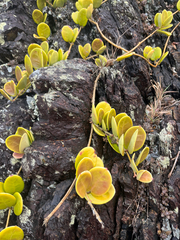 Hoya australis Samoan waxplant Photo: CC0, author not stated
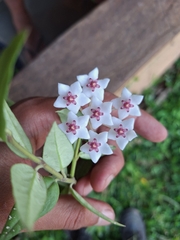 Hoya bella Miniature wax plant Photo: CC BY, Jefferson Ferreira Hoya blashernaezii Apocynaceae Hoya buotii Apocynaceae
 Hoya campanulata Apocynaceae Photo: CC BY, Cheongweei Gan
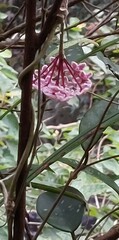 Hoya carnosa Porcelainflower Photo: CC BY, 胡正恆(Jackson Hu)
 Hoya caudata Apocynaceae Photo: CC BY, Cheongweei Gan Hoya cordata Apocynaceae
 Hoya coronaria Apocynaceae Photo: CC BY-SA, 阿橋 HQ Hoya crassicaulis Apocynaceae
 Hoya cumingiana Apocynaceae Photo: CC BY-SA, Engeser all 57 ›
Names & registers
The record
Every figure here is derived from public data by a stated rule and names its source; nothing about this species is written for its page by a person or by AI, apart from the marked, credited quotations. How →
Where this page came from built 2026-10-22
gbif.species answeredasked 2026-10-22GBIF's key 3573062 is Hoya obscura Elmer ex Merr.; the page links Kew's Hoya obscura Elmer ex C.M.Burton, and the name is cited as Kew cites itgbif.synonyms answeredasked 2026-10-22gbif.vernacular answeredasked 2026-10-22names fetched 2026-10-22wcvp.distribution answeredas of 2026-06-04gbif.occurrences answeredasked 2026-10-22GBIF occurrence download https://doi.org/10.15468/dl.hbdw64, of 2026-10-21; 10 records of GBIF's key 8107678, Hoya obscura Elmer ex C.M.Burton (Kew's file holds it as Hoya obscura Elmer ex C.M.Burton (accepted)): GBIF occurrence search APIclimate nothing to reportasked 2026-10-22only 2 distinct land cells of the climate grid hold an in-range record placed to within 10 km; three are needed for an envelopewikidata answeredasked 2026-10-22wikipedia answeredasked 2026-10-22inat.photos.wild nothing to reportasked 2026-10-22from iNaturalist's open data of 2026-09-27: research-grade observations with an open-licence photograph, the 24 whose photographs iNaturalist received last (the open data holds no votes); filled 2026-10-22inat.photos.cultivated not askedgbif.media nothing to reportasked 2026-10-22commons answeredasked 2026-10-22openalex not askednot yet asked for this reference; a later fill takes the papers from OpenAlex's snapshotEvery source is recorded as having answered, reported nothing, refused, failed, not been asked, or answered twice where one answer is taken (“not taken: two items answered”), and, for a source asked when this page was built, when: the figures are as the source held them that day; a source read from a file (Kew's World Checklist, a GBIF download) says "as of" the file's day instead; a row carried from an earlier build of the page names that build instead. Only “nothing to report” is ever shown as an absence. Records came from 6 datasets via GBIF.org; each carries its own licence.