Brassicaceae › Iberis › 4 of 15

Iberis contracta Pers.
Also called Iberis ciliata subsp. contracta, Iberis ciliata var. contracta, and 2 more.
Csa 9b H4Records 262 in 212 cells
| Family | Brassicaceae |
|---|---|
| Native to | Portugal, Spain, Morocco · Kew's World Checklist, file of 2026-06-04 |
| Your plants | Add one · related species |
Brassicaceae · Portugal +2
Family Brassicaceae
Native to Portugal, Spain, Morocco
Habitat in brief
In habitat, Iberis contracta rarely sees nights below −1.8 °C: only 1 night in 100 is colder at a typical spot. The lowest in 44 years of records was −6.6 °C, with 559 frost nights. That places its habitat in USDA zone 9b and RHS H4. Rain is 606 mm a year at the median across its range. The hottest 1 day in 100 reaches 33.7 °C. Kew places it in temperate; it is native to Portugal, Spain and Morocco.
NASA POWER, daily 1981–2024 · CHELSA V2.1, 1981–2010 · Kew, Plants of the World Online
Habitat in shortFigures ›
- Cold
- −1.8 °C: 1 night in 100 is colder coolest month's nights 0–7 °C yearly lows −7–0 °C, 559 frost nights in 44 years, 12.7 a year NASA POWER
- Heat
- 31.4 °Cwarmest month's mean daily high, 26–33 °C across the range hottest day in 100: 33.7 °C CHELSA, NASA POWER
- Rain
- 606 mma year, median across the range, 437 mm–863 mm Wet winters, Oct–Feb, Apr, your months CHELSA
- Light
- 13–50 lowest to highest month, under open sky CHELSA
- Air
- 46–62%humidity, lowest to highest month dryness 0.39–1.74 kPa, wind 2.6–3.2 m/s nights 8–14 °C cooler than days CHELSA
- Ground
- 1,024 melevation of the typical cell Range across the cells, and soil pH and texture: not read yet ETOPO 2022
The wild habitat’s figures, from 262 records in 212 grid cells · How


 16 photographs ›
About the genus · Iberis
Iberis ( eye-BEER-iss), commonly called candytuft, is a genus of flowering plants belonging to the family Brassicaceae. It comprises annuals, evergreen perennials and subshrubs native to the Old World. Species are native to the Mediterranean basin (southern Europe and North Africa), Western Asia, the Caucasus, and western Europe. More on Wikipedia ›
Quoted from Wikipedia, "Iberis", its opening paragraph, revision 1369297991, read 2026-11-08, CC BY-SA 4.0.
Cultivation
Seasons
The rain rule reads a winter growing season: 70% of the median year's rain (450 mm of 614 mm) falls in October to February and April, cooler than the year (wet-season mean 10.4 °C against a yearly mean of 15.3 °C). Months are the habitat's, northern hemisphere; shifted six months for a southern-hemisphere collection: April to August and October.
Rain
614 mm in the median year at the habitat, 450 mm of it October to February and April. Wettest month December at 105 mm, driest month July at 6 mm. Across the grid cells of the range the year's total runs 437 mm to 863 mm, the 10th to 90th percentile of each cell's own year. The median of the cells' own yearly totals, 606 mm, is the year's rain at the top of the page; the 614 mm here is the median year's, the twelve monthly medians added, which the rain rule reads. Habitat calendar, northern hemisphere; median year across the grid cells of the range, CHELSA.
Light
Open sky over the habitat: 13 to 50 mol/m²/day across the year (daily light integral, median year across the grid cells of the range, CHELSA; the lowest 10th-percentile month across the cells is 12, the highest 90th-percentile month 51).
Warmth and air
Coldest: the 1st-percentile night over 44 years at a typical spot in the range is -1.8 °C, the absolute minimum -6.6 °C, 559 frost nights in 44 years, 12.7 a year (NASA POWER daily minima). Warmest: the 99th-percentile day is 33.7 °C. Monthly means: the coldest month's mean nightly low 1.9 °C in January (across the grid cells of the range 0.1 °C to 7.0 °C), the warmest month's mean daily high 31.4 °C in July (median year across the grid cells of the range, CHELSA). Cold floor: -1.8 °C, which is the 1st-percentile night over 44 years at a typical spot in the range (NASA POWER).
Relative humidity at the habitat: 46 to 62% across the year (monthly means, median year across the grid cells of the range, CHELSA). A figure about the air, saying nothing about how the plant takes water.
How this section is made
Each card states this species' habitat figures with their sources, and what two fixed rules read from them; nothing here says what the plant does, wants or tolerates. The rules · the terms.
Seasons. Read from the median year of CHELSA monthly rainfall and mean temperature across the grid cells of the range: the rain rule takes the smallest set of months carrying 70% of the rain and calls it winter when its mean is more than half a degree below the year's, summer when more than that above, and neither in between; the temperature rule, used only under 120 mm, names the cooler six months when they are at least a degree cooler than the other six. Months are shifted for the other hemisphere only where the temperature curve moves 4 °C or more and the habitat lies 10° or more from the equator. A reading of the curves, not an observation of the plant.
Rain. CHELSA monthly precipitation, median year across the grid cells of the range. The rain that falls where the species is recorded; nothing about how the plant takes water.
Light. CHELSA shortwave radiation at each envelope cell, a daily-mean flux taken to a daily total and converted at 2.07 mol of PAR per MJ. The sky over the habitat, measured; what reaches a plant under a rock, a shrub or a shade cloth is not.
Temperature. NASA POWER daily minima and maxima over 44 years at a typical spot in the range, lapse-corrected +304 m to its elevation; CHELSA monthly means, median year across the grid cells of the range. The cold floor is the 1st-percentile night named in its sentence. Not a measured survival limit for any plant in a pot.
Humidity. CHELSA relative humidity, median year across the grid cells of the range.
How cold it gets
| of the habitat | 9b | the mean of the typical spot’s lowest night in each of 44 complete years, 1981–2024: −3.1 °C = −3.1 × 9 ÷ 5 + 32 = 26.42 °F, in zone 9b (25 to 30 °F). USDA’s zones are the 30-year mean of each year’s lowest temperature, in 10 °F zones with 5 °F half-zones (USDA Plant Hardiness Zone Map); this mean is of the years the series holds, not USDA’s 1991–2020. |
|---|---|---|
| of the record low | H4 | the record low falls in RHS’s H4 band (−10 to −5 °C: hardy, average winter; RHS hardiness rating): −6.6 °C, the lowest night in 44 years. |
Both are the habitat’s, worked out from where it grows wild: neither is a tested hardiness of the plant. Lows from NASA POWER (MERRA-2) daily 1981–2024, cell 37.00_-3.750, lapse-corrected +304 m at 6.5 °C/km.
Climate across the habitat
The year at the habitat
The median of each month across the range, 10th to 90th percentile shaded; CHELSA V2.1, 1981–2010; 212 cells.
| Month | Day °C | Night °C | Apart °C | Rain mm | DLI | RH % | VPD kPa | Wind m/s | Day h |
|---|---|---|---|---|---|---|---|---|---|
| Jan | 118–15 | 20–7 | 9 | 6536–104 | 1514–17 | 6158–63 | 0.390.32–0.51 | 2.92.3–3.9 | 9.9 |
| Feb | 1210–16 | 31–8 | 10 | 5633–91 | 2120–23 | 5958–61 | 0.450.37–0.56 | 3.02.4–4.0 | 10.8 |
| Mar | 1613–18 | 52–9 | 11 | 4627–70 | 3129–32 | 5554–59 | 0.610.49–0.71 | 3.12.5–4.1 | 11.9 |
| Apr | 1815–20 | 74–10 | 11 | 6549–91 | 3736–39 | 5553–58 | 0.680.54–0.79 | 3.22.6–4.1 | 13.1 |
| May | 2218–23 | 107–13 | 11 | 4936–64 | 4342–45 | 5451–58 | 0.900.68–1.01 | 3.02.4–3.9 | 14.1 |
| Jun | 2823–29 | 1512–17 | 13 | 2210–35 | 4947–50 | 5047–56 | 1.340.98–1.51 | 2.82.2–3.8 | 14.7 |
| Jul | 3126–33 | 1815–20 | 14 | 62–14 | 5048–51 | 4643–54 | 1.741.28–2.01 | 2.82.2–3.7 | 14.5 |
| Aug | 3126–33 | 1815–20 | 13 | 85–20 | 4542–46 | 4744–55 | 1.671.25–1.91 | 2.72.1–3.5 | 13.6 |
| Sep | 2623–28 | 1512–18 | 11 | 3326–44 | 3532–36 | 5149–57 | 1.240.93–1.37 | 2.62.1–3.4 | 12.4 |
| Oct | 2017–23 | 118–14 | 10 | 7353–102 | 2422–26 | 5655–60 | 0.800.64–0.93 | 2.82.2–3.6 | 11.2 |
| Nov | 1512–18 | 64–11 | 9 | 8650–131 | 1715–18 | 6059–62 | 0.520.43–0.65 | 2.92.3–3.9 | 10.1 |
| Dec | 119–15 | 31–9 | 8 | 10555–164 | 1312–15 | 6260–64 | 0.400.33–0.52 | 3.02.4–4.0 | 9.6 |
The wet months, Jan to Dec at the habitat: days of 14 °C and nights of 5 °C, 9 °C apart; 450 mm of the year's 614 mm; humidity 59%; light 21 DLI; days 9.6 to 13.1 h long.
The dry months, Mar to Sep at the habitat: days of 26 °C and nights of 14 °C, 12 °C apart; 164 mm of the year's 614 mm; humidity 51%; light 42 DLI; days 11.9 to 14.7 h long.
The year as one chart
Habitat months, northern hemisphere
Mean daily high from 11 °C in Jan and Dec to 31 °C in Jul and Aug; mean nightly low from 2 °C in Jan to 18 °C in Jul and Aug. The cold quarter, Dec to Feb, is the three months around the coldest month's mean nightly low. 614 mm of rain in the median year (the twelve monthly medians added), the wettest month Dec. The bands show the 10th to 90th percentile across 212 habitat cells. Over 44 years at a typical spot in the range (NASA POWER) the absolute minimum was -6.6 °C and the 1-in-100 hot day (the 99th-percentile day) 33.7 °C; neither is dated to a month. Beneath: daily light integral and relative humidity through the year, each on its own scale.
Wet winters: the rain comes October to February and April, read as a winter growing season. CHELSA How the rain rule reads it
9 months of 25 mm or more in the median year, CHELSA.
Your hemisphere is the habitat's, so its months are yours. Northern hemisphere unless you set your site.
Climate class and the Walter–Lieth diagram
Climate class
Csa , worked out from the median year of the range’s 212 cells
| C temperate | the coldest month 6.6 °C, over 0 and under 18 °C; the warmest 25.3 °C, over 10 °C; not arid: 614 mm a year, 10 × 30.6 mm (2 × 15.3: 70% of the rain in winter, 70% or more) or more |
|---|---|
| s dry summer | the driest summer month (summer April to September) 6 mm, under 40 mm and under a third of the wettest winter month's 105 mm |
| a hot summer | the warmest month 25.3 °C, 22 °C or more |
By the thresholds of Peel, Finlayson and McMahon (2007), Hydrology and Earth System Sciences 11, 1633–1644, Table 1; summer is the warmer of October to March and April to September. The class of the median year, each month’s median across the cells, not of each cell.
: arid in June to September, where the month’s rain in mm is under twice its mean temperature in °C (June 22 mm against 2 × 21.9 = 43.8). The scale of Walter and Lieth’s climate diagrams (1960–1967), 10 °C to 20 mm.
The months read: CHELSA V2.1 1981–2010 climatology, 0.05° cells (each the mean of ~36 1 km pixels).
How this section is made
Where it grows wild
Flowering by month
Not asked: this page has not been counted from GBIF's download yet.
How this section is made
Photographs
Not marked by their source · 16


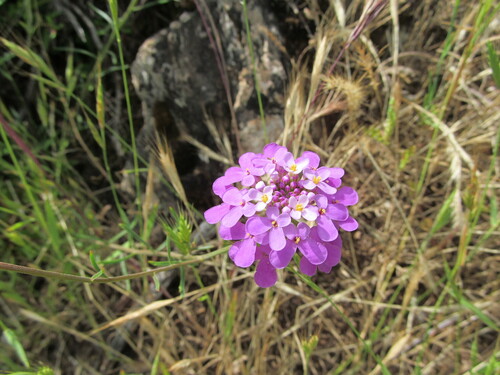
The photograph at the top: jbcblanco, CC BY-SA, via GBIF. Photographs: Daniel Heras González, CC BY, iNaturalist via GBIF; Shiqi Zhou, CC BY, iNaturalist via GBIF; Antón David Pérez Rodríguez, CC0, iNaturalist via GBIF; zebedeugalinha, CC BY, iNaturalist via GBIF. Credits as read from GBIF on 2026-11-25. What each licence allows.
Related
Similar habitat climate The 6 nearest by mean daily high, mean nightly low and rain, month by month. How.
 Linaria amethystea Plantaginaceae Photo: CC BY, zebedeugalinha
 Iberis pectinata Brassicaceae Photo: CC BY, Juan C. Espinosa
 Anchusa undulata Undulate alkanet Photo: CC BY, zebedeugalinha
 Narcissus cantabricus White hoop petticoat daffodil Photo: CC BY, Borja Fierro-Leva
 Sideritis lacaitae Lamiaceae Photo: CC BY-SA, Krzysztof Ziarnek, Kenraiz
Other Iberis 14 in the reference
 Iberis amara Wild candytuft Photo: CC0, Quentin Groom
 Iberis carnosa Pruit's candytuft Photo: CC BY, Eleftherios Katsillis
 Iberis ciliata Brassicaceae Photo: CC BY, Duarte Frade
 Iberis gibraltarica Gibraltar candytuft Photo: CC BY, Duarte Frade
 Iberis linifolia Candytuft Photo: CC BY-SA, Fabien Piednoir Iberis pectinata Brassicaceae Photo: CC BY, Juan C. Espinosa
 Iberis pinnata Winged Candytuft Photo: CC BY, Thomas Koffel
 Iberis procumbens Brassicaceae Photo: CC BY, zebedeugalinha
 Iberis saxatilis Brassicaceae Photo: CC BY, Josip Skejo
 Iberis semperflorens Brassicaceae Photo: CC BY, Sylvain Eichhorn
 Iberis sempervirens Evergreen candytuft Photo: CC BY, Michal Honskus
Names & registers
Also known as Iberis ciliata subsp. contracta; Iberis ciliata var. contracta; Iberis linifolia subsp. contracta; Iberis linifolia var. contracta. (GBIF Backbone)
WFO Plant List (2026-06) a synonym of Iberis ciliata subsp. contracta (Pers.) Moreno. World Flora Online, CC0; read 2026-11-25.
Published in Syn. Pl. 2: 186 (1806) (WCVP, RBG Kew, file of 2026-06-04)
Elsewhere Tropicos (identifiers from Wikidata's item Q50974900, read 2026-11-25, CC0)
Chromosomes no count in ChromoDB's IAPT/IOPB set (the file holds no count under IPNI id 285533-1). ChromoDB, IAPT/IOPB chromosome data (Simon, Bosch & Blanché), version 3.1 of 8 November 2026, CC BY 4.0; read 2026-11-25.
The record
Predicted extinction risk 13% probability of being threatened (95% interval 8% to 19%); predicted not threatened, the model is confident of this class. A model's prediction, not an assessment. Bachman et al. 2024, New Phytologist; Kew's data of 1 February 2024, CC BY 4.0; read 2026-11-25.
Not in the CITES Appendices (the edition in force from 5 March 2026): no listing of its name, its genus or its family. CITES Appendices I, II and III, valid from 5 March 2026; read 2026-11-25. The Appendices
Every figure here is derived from public data by a stated rule and names its source; nothing about this species is written for its page by a person or by AI, apart from the marked, credited quotations. How →
The name is accepted by
- Kew's World Checklist of Vascular Plants, the file of 2026-06-04: entry 2859766
Looked for, and not there
- Wikipedia, asked 2026-11-25
- iNaturalist photographs, cultivated, asked 2026-11-25
Where each figure comes from
- GBIF species record, read 2026-11-25
- GBIF synonyms, read 2026-11-25
- GBIF common names, read 2026-11-25
- WCVP native range, read 2026-06-04
- GBIF occurrence records, read 2026-11-25
- Habitat climate, read 2026-11-25
- Daily extremes (NASA POWER), read 2026-11-25
- Wikidata, read 2026-11-25
- iNaturalist taxon, read 2026-11-25
- GBIF media, read 2026-11-25
Cite this page
Cultifolio. Iberis contracta Pers.. Page built 2026-11-25, fingerprint 1c2ce06d07fbd475. https://cultifolio.com/species/iberis-contracta
Where this page came from built 2026-11-25
gbif.species answeredasked 2026-11-25gbif.synonyms answeredasked 2026-11-25gbif.vernacular answeredasked 2026-11-25names fetched 2026-11-25wcvp.distribution answeredas of 2026-06-04gbif.occurrences answeredasked 2026-11-25GBIF occurrence search API; records tested against the native regions' shapes, openly licensed and restricted alike (Natural Earth's provinces, placed in TDWG's regions; shapes rule r87); a record within the margin, off a coast or on an island too small to draw counted only when it states the region's country, and only on no other region's land but within 0.02° of a native shape across a border, where its stated state or province does not name the other region (read by Natural Earth's name, its ISO 3166-2 code or an old province's name); 3 records within 1 km of a botanic garden, herbarium or zoo left out (3 at a botanic garden or arboretum; Wikidata's list)climate answeredasked 2026-11-25climate.extremes answeredasked 2026-11-25NASA POWER (MERRA-2) daily 1981–2024, cell 37.00_-3.750, lapse-corrected +304 m at 6.5 °C/kmwikidata answeredasked 2026-11-25wikipedia nothing to reportasked 2026-11-25inat.taxon answeredasked 2026-11-25inat.photos.wild not asked16 wild photographs already from the GBIF downloadinat.photos.cultivated nothing to reportasked 2026-11-25observations marked captive or cultivated whose identifications agree; filled 2026-11-25gbif.media answeredasked 2026-11-25commons not askedthe page shows 16 photographs of its own sources, and Commons is asked only while a page shows fewer than 12openalex not askedthe reference does not ask OpenAlex for papersEvery source is recorded as having answered, reported nothing, refused, failed, not been asked, or answered twice where one answer is taken (“not taken: two items answered”), and, for a source asked when this page was built, when: the figures are as the source held them that day; a source read from a file (Kew's World Checklist, a GBIF download) says "as of" the file's day instead; a row carried from an earlier build of the page names that build instead. Only “nothing to report” is ever shown as an absence. Records came from 40 datasets via GBIF.org; each carries its own licence.