


 5 photographs ›
Summary
Illicium simonsii, commonly known as Simon's anise tree, is a species of flowering plant in the family Schisandraceae. It is a shrub or tree with leathery leaves, and pale yellow to white tepals. The leaves, flowers and fruit are toxic. The species is native to India, China, and Myanmar.
Quoted from Wikipedia, "Illicium simonsii", CC BY-SA 4.0.
About the genus · Illicium
Illicium is a genus of flowering plants treated as part of the family Schisandraceae, or alternately as the sole genus of the Illiciaceae. It has a disjunct distribution, with most species native to subtropical and tropical areas of East and Southeast Asia and several in parts of North America, including the southeastern United States, Mexico, and the Caribbean. General common names include star anise and anisetree. More on Wikipedia ›
Quoted from Wikipedia, "Illicium", CC BY-SA 4.0.
Cultivation
Climate across the habitat
Natural habitat
How this section is made
Photographs


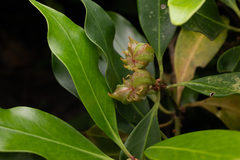
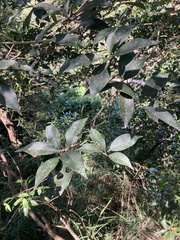
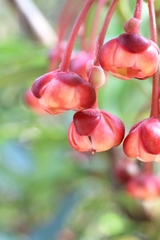
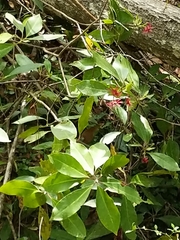
Photographs: This illustration was made by Citron, CC BY-SA 3.0, via Wikimedia Commons; Krzysztof Ziarnek, Kenraiz, CC BY-SA 4.0, via Wikimedia Commons (3).
Related
Other Illicium 12 in the reference
 Illicium anisatum Aniseed tree Photo: CC BY, Saryu Mae 前 朝琉
 Illicium arborescens Schisandraceae Photo: CC BY, Zheng-An Wang
 Illicium dunnianum Schisandraceae Photo: CC0, author not stated
 Illicium floridanum Florida anise-tree Photo: CC BY, Rob John
 Illicium henryi Henry's Anise Photo: CC BY-SA, Camphora
 Illicium lanceolatum Guandong Star Anise Photo: CC BY-SA, Krzysztof Golik Illicium leiophyllum Schisandraceae
 Illicium majus Schisandraceae Photo: CC BY-SA, Zhangmoon618 Illicium merrillianum Schisandraceae
 Illicium parviflorum Swamp star anise Photo: CC BY, Scott Ward Illicium parvifolium Schisandraceae
 Illicium verum Chinese star-anise Photo: CC0, Daderot
Names & registers
Also known as Illicium fargesii; Illicium fargesii subsp. szechuanense; Illicium fargesii var. szechuanense; Illicium fargesii var. szechuanensis; Illicium griffithii var. yunnanense and 4 more. (GBIF Backbone)
The record
Every figure here is derived from public data by a stated rule and names its source; nothing about this species is written for its page by a person or by AI, apart from the marked, credited quotations. How →
Where this page came from built 2026-10-22
gbif.species answeredasked 2026-10-22gbif.synonyms answeredasked 2026-10-22gbif.vernacular answeredasked 2026-10-22names fetched 2026-10-22wcvp.distribution answeredas of 2026-06-04gbif.occurrences answeredas of 2026-10-21GBIF occurrence download https://doi.org/10.15468/dl.hbdw64, of 2026-10-21; 1 record within 1 km of a botanic garden, herbarium or zoo left out (1 at a botanic garden or arboretum; Wikidata's list)climate nothing to reportasked 2026-10-22only 1 distinct land cell of the climate grid holds an in-range record placed to within 10 km; three are needed for an envelopewikidata answeredasked 2026-10-22wikipedia answeredasked 2026-10-22inat.photos.wild nothing to reportasked 2026-10-22from iNaturalist's open data of 2026-09-27: research-grade observations with an open-licence photograph, the 24 whose photographs iNaturalist received last (the open data holds no votes); filled 2026-10-22inat.photos.cultivated not askedgbif.media nothing to reportasked 2026-10-22commons answeredasked 2026-10-22openalex not askednot yet asked for this reference; a later fill takes the papers from OpenAlex's snapshotEvery source is recorded as having answered, reported nothing, refused, failed, not been asked, or answered twice where one answer is taken (“not taken: two items answered”), and, for a source asked when this page was built, when: the figures are as the source held them that day; a source read from a file (Kew's World Checklist, a GBIF download) says "as of" the file's day instead; a row carried from an earlier build of the page names that build instead. Only “nothing to report” is ever shown as an absence. Records came from 25 datasets via GBIF.org; each carries its own licence.