
Melocactus perezassoi Areces
English names not checked: Wikidata's common names were not read for this page.
GBIF's records not checked. GBIF's backbone holds no one accepted species of this name, and a name it holds only as another species' synonym is not taken for this one, so GBIF's records were not asked. So this page has no points on its map, no map marker, no habitat climate, no cultivation sheet and no species of nearest climate; the range is Kew's. Not a statement that none exist. How.
About the genus · Melocactus
Melocactus, also known as the Turk's head cactus, Turk's cap cactus, or Pope's head cactus, is a genus of cactus with about 30–40 species. They are native to the Caribbean, western Mexico through Central America to northern South America, with some species along the Andes down to southern Peru, and a concentration of species in northeastern Brazil.
Quoted from Wikipedia, "Melocactus", CC BY-SA 4.0.
Cultivation
Grouped as a cactus or succulent, listed under the genus Melocactus in the archetype table, and Kew describes it as “succulent subshrub”.
How this section is made
Each card states this species' habitat figures with their sources, and what two fixed rules read from them; nothing here says what the plant does, wants or tolerates. The rules · the terms.
Group. Listed under the genus Melocactus in the archetype table, and Kew describes it as “succulent subshrub”. A group is taken only where Kew's description of the species agrees with the table's listing. The table gives no figure and no prose; the cold floor is the habitat's alone.
Climate across the habitat
Natural habitat
Related
Similar habitat climate Not checked: GBIF's records were not asked (why, under the name), and the nearest habitat climates are read from the climate they give.
Other Melocactus 49 in the reference
 Melocactus acunae Cactaceae Photo: CC BY, Dayron Breto
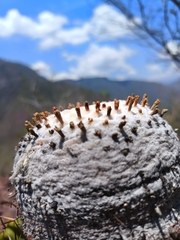 Melocactus andinus Cactaceae Photo: CC BY, marthayolimapardodiaz
 Melocactus azureus Turk's Cap Cactus Photo: CC BY-SA, Ericson Cernawsky Igual
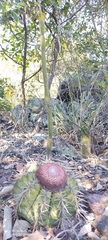 Melocactus bahiensis Cactaceae Photo: CC BY, Agente Itallo
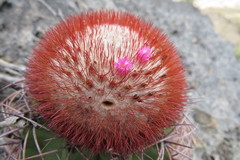 Melocactus bellavistensis Cactaceae Photo: CC0, author not stated
 Melocactus braunii Cactaceae Photo: CC BY-SA, PierreBraun Melocactus brederooanus Cactaceae
 Melocactus broadwayi Turk's cap Photo: CC BY, Pål A. Olsvik
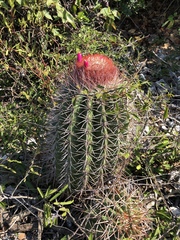 Melocactus caroli-linnaei Cactaceae Photo: CC BY, Judd Patterson
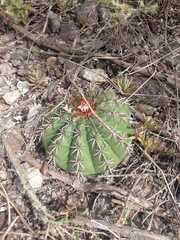 Melocactus conoideus Cone-like Turk's-head cactus Photo: CC BY, Anilton Junior
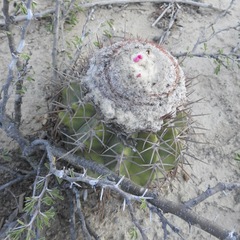 Melocactus curvispinus Cactaceae Photo: CC BY, Laura Gaudette
 Melocactus deinacanthus Wonderful-bristle Turk's-head cactus Photo: CC BY, Süleyman Demir all 50 ›
Names & registers
Also known as Melocactus harlowii subsp. perezassoi. (WCVP, RBG Kew)
The record
Every figure here is derived from public data by a stated rule and names its source; nothing about this species is written for its page by a person or by AI, apart from the marked, credited quotations. How →
Where this page came from built 2026-10-22
kew.names answeredas of 2026-06-04Kew's entry Melocactus perezassoi Areces (plant_name_id 2370678), read from Kew's names filegbif.species not askedGBIF's backbone holds no one accepted species of this name, and a name it holds only as another species' synonym is not taken for this one, so GBIF's records were not askedgbif.synonyms not askedGBIF's backbone holds no one accepted species of this name, and a name it holds only as another species' synonym is not taken for this one, so GBIF's records were not askedgbif.vernacular not askedGBIF's backbone holds no one accepted species of this name, and a name it holds only as another species' synonym is not taken for this one, so GBIF's records were not askedgbif.occurrences not askedGBIF's backbone holds no one accepted species of this name, and a name it holds only as another species' synonym is not taken for this one, so GBIF's records were not askedwcvp.distribution answeredas of 2026-06-04climate not askedGBIF's backbone holds no one accepted species of this name, and a name it holds only as another species' synonym is not taken for this one, so GBIF's records were not asked, and the habitat climate is read only from themwikidata answeredasked 2026-10-22found by Kew's IPNI identifier 304897-2, POWO 304897-2wikipedia nothing to reportasked 2026-10-22inat.photos.wild not askedinat.photos.cultivated not askedgbif.media not askedGBIF's backbone holds no one accepted species of this name, and a name it holds only as another species' synonym is not taken for this one, so GBIF's records were not askedcommons answeredasked 2026-10-22openalex not askednot yet asked for this reference; a later fill takes the papers from OpenAlex's snapshotEvery source is recorded as having answered, reported nothing, refused, failed, not been asked, or answered twice where one answer is taken (“not taken: two items answered”), and, for a source asked when this page was built, when: the figures are as the source held them that day; a source read from a file (Kew's World Checklist, a GBIF download) says "as of" the file's day instead; a row carried from an earlier build of the page names that build instead. Only “nothing to report” is ever shown as an absence.