


 4 photographs ›
Summary
Osmanthus yunnanensis is a species of flowering plant in the olive family Oleaceae, native to Yunnan and Sichuan in the far south west of China. Growing to 12 m (39 ft) tall and broad, it is an evergreen shrub or small tree with leathery oval leaves, which may be flat or undulate. In winter and spring, small clusters of white flowers in the leaf axils produce an intense fragrance.
Quoted from Wikipedia, "Osmanthus yunnanensis", CC BY-SA 4.0.
About the genus · Osmanthus
Osmanthus is a genus of about 30 species of flowering plants in the family Oleaceae. Most of the species are native to eastern Asia with a few species from the Caucasus, New Caledonia, and Sumatra. Osmanthus has been known in China since ancient times with the earliest writings coming from the Warring States period; the book Shanhai Jing: Nanshan Jing states: "The first peak of the Que Mountain range is Mount Zhaoyao, rising by the western sea, where many osmanthus trees grow, and where rich veins of metals and jade lie hidden."
Quoted from Wikipedia, "Osmanthus", CC BY-SA 4.0.
Cultivation
Climate across the habitat
Natural habitat
How this section is made
Photographs


Photographs: Krzysztof Golik, CC BY-SA 4.0, via Wikimedia Commons (3).
Related
Other Osmanthus 7 in the reference
 Osmanthus armatus Oleaceae Photo: CC BY-SA, You may select the license of your…
 Osmanthus decorus Oleaceae Photo: Public domain, Karduelis
 Osmanthus delavayi Delavay Teaolive Photo: CC BY-SA, Kurt Stüber
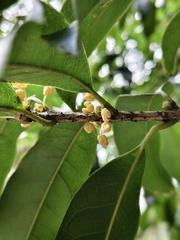 Osmanthus fragrans Sweet osmanthus Photo: CC BY, 振远 王
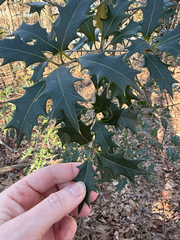 Osmanthus heterophyllus Holly osmanthus Photo: CC BY, Carrie Seltzer Osmanthus serrulatus Oleaceae
 Osmanthus suavis Oleaceae Photo: CC0, Daderot
Names & registers
Also known as Osmanthus bambusifolius; Osmanthus brevipetiolatus; Osmanthus forrestii; Osmanthus forrestii var. brevipedicellatus; Osmanthus liangshanensis and 4 more. (GBIF Backbone)
The record
Every figure here is derived from public data by a stated rule and names its source; nothing about this species is written for its page by a person or by AI, apart from the marked, credited quotations. How →
Where this page came from built 2026-10-22
gbif.species answeredasked 2026-10-22gbif.synonyms answeredasked 2026-10-22gbif.vernacular answeredasked 2026-10-22names fetched 2026-10-22wcvp.distribution answeredas of 2026-06-04gbif.occurrences answeredas of 2026-10-21GBIF occurrence download https://doi.org/10.15468/dl.hbdw64, of 2026-10-21; 2 records within 1 km of a botanic garden, herbarium or zoo left out (1 at a botanic garden or arboretum, 1 at a herbarium; Wikidata's list)climate nothing to reportasked 2026-10-2248 in-range records, none placed to within 10 kmwikidata answeredasked 2026-10-22wikipedia answeredasked 2026-10-22inat.photos.wild nothing to reportasked 2026-10-22from iNaturalist's open data of 2026-09-27: research-grade observations with an open-licence photograph, the 24 whose photographs iNaturalist received last (the open data holds no votes); filled 2026-10-22inat.photos.cultivated not askedgbif.media nothing to reportasked 2026-10-22commons answeredasked 2026-10-22openalex not askednot yet asked for this reference; a later fill takes the papers from OpenAlex's snapshotEvery source is recorded as having answered, reported nothing, refused, failed, not been asked, or answered twice where one answer is taken (“not taken: two items answered”), and, for a source asked when this page was built, when: the figures are as the source held them that day; a source read from a file (Kew's World Checklist, a GBIF download) says "as of" the file's day instead; a row carried from an earlier build of the page names that build instead. Only “nothing to report” is ever shown as an absence. Records came from 12 datasets via GBIF.org; each carries its own licence.