
Paphiopedilum insigne (Wall. ex Lindl.) Pfitzer
Splendid Paphiopedilum


 12 photographs ›
Summary
Paphiopedilum insigne is an Asian species of slipper orchid and the type species of the genus Paphiopedilum. Its name is derived from the Latin insigne, meaning 'badge of honor' due to the magnificent flower. In the 19th century it was very popular among European and American orchid growers, causing it to become very rare in the wild due to over collecting. There are many varieties of it and hybrids with it.
Quoted from Wikipedia, "Paphiopedilum insigne", CC BY-SA 4.0.
Cultivation
Climate across the habitat
Natural habitat
How this section is made
Photographs


Photographs: Orchi, CC BY-SA 3.0, via Wikimedia Commons; Arne and Bent Larsen, Haarby, Denmark, CC BY-SA 2.5 dk, via Wikimedia Commons (4); Daderot, CC0, via Wikimedia Commons.
Related
Other Paphiopedilum 71 in the reference
 Paphiopedilum acmodontum Pointed Tooth Paphiopedilum Photo: CC BY-SA, Dalton Holland Baptista
 Paphiopedilum appletonianum Appleton's Paphiopedilum Photo: CC BY-SA, Dalton Holland Baptista
 Paphiopedilum argus Argus Paphiopedilum Photo: CC BY-SA, Arne and Bent Larsen, Haarby, Denmark
 Paphiopedilum armeniacum Apricot Orange Paphiopedilum Photo: CC BY-SA, Orchi
 Paphiopedilum barbatum Bearded Paphiopedilum Photo: CC BY-SA, Orchi
 Paphiopedilum barbigerum Beard Carrying Paphiopedilum Photo: CC BY-SA, User:BotBln
 Paphiopedilum bellatulum Enchanting Paphiopedilum Photo: CC BY-SA, Orchi
 Paphiopedilum bullenianum Bullen's Paphiopedilum Photo: CC BY-SA, Dalton Holland Baptista
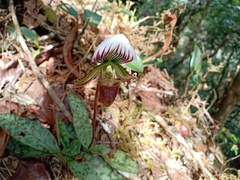 Paphiopedilum callosum Callus Paphiopedilum Photo: CC BY, Muhammad HEEMBOO
 Paphiopedilum canhii Canh's Paphiopedilum Photo: CC BY-SA, Phạm văn Thế
 Paphiopedilum charlesworthii Charlesworth Paphiopedilum Photo: CC BY-SA, Orchi
 Paphiopedilum ciliolare Short Haired Paphiopedilum Photo: CC BY-SA, Dalton Holland Baptista all 72 ›
Names & registers
Also known as Cordula insignis; Cypripedium albomarginatum; Cypripedium chantinii; Cypripedium insigne; Cypripedium insigne subsp. barrii and 71 more. (GBIF Backbone)
The record
Every figure here is derived from public data by a stated rule and names its source; nothing about this species is written for its page by a person or by AI, apart from the marked, credited quotations. How →
Where this page came from built 2026-10-22
gbif.species answeredasked 2026-10-22gbif.synonyms answeredasked 2026-10-22gbif.vernacular answeredasked 2026-10-22names fetched 2026-10-22wcvp.distribution answeredas of 2026-06-04gbif.occurrences answeredas of 2026-10-21GBIF occurrence download https://doi.org/10.15468/dl.hbdw64, of 2026-10-21; 2 records within 1 km of a botanic garden, herbarium or zoo left out (2 at a botanic garden or arboretum; Wikidata's list)climate nothing to reportasked 2026-10-223 in-range records, none placed to within 10 kmwikidata answeredasked 2026-10-22wikipedia answeredasked 2026-10-22inat.photos.wild nothing to reportasked 2026-10-22from iNaturalist's open data of 2026-09-27: research-grade observations with an open-licence photograph, the 24 whose photographs iNaturalist received last (the open data holds no votes); filled 2026-10-22inat.photos.cultivated not askedgbif.media nothing to reportasked 2026-10-22commons answeredasked 2026-10-22openalex not askednot yet asked for this reference; a later fill takes the papers from OpenAlex's snapshotEvery source is recorded as having answered, reported nothing, refused, failed, not been asked, or answered twice where one answer is taken (“not taken: two items answered”), and, for a source asked when this page was built, when: the figures are as the source held them that day; a source read from a file (Kew's World Checklist, a GBIF download) says "as of" the file's day instead; a row carried from an earlier build of the page names that build instead. Only “nothing to report” is ever shown as an absence. Records came from 7 datasets via GBIF.org; each carries its own licence.