
Phragmipedium besseae Dodson & J.Kuhn
Besse's Phragmipedium


 14 photographs ›
Summary
Phragmipedium besseae is a species of orchid in the genus Phragmipedium. It is a terrestrial plant native to the wet montane forests on the eastern slope of the Andes in Colombia, Ecuador, and Peru.
Quoted from Wikipedia, "Phragmipedium besseae", CC BY-SA 4.0.
Cultivation
Climate across the habitat
Natural habitat
How this section is made
Photographs


Photographs: (c) Thibaud Aronson, some rights reserved (CC BY-SA); author not stated, Public domain, via Wikimedia Commons; Orchi, CC BY-SA 3.0, via Wikimedia Commons (2); Arne and Bent Larsen, Haarby, Denmark, CC BY-SA 2.5 dk, via Wikimedia Commons (2).
Related
Other Phragmipedium 13 in the reference
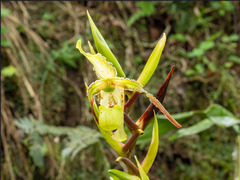 Phragmipedium boissierianum Boissier's Phragmipedium Photo: CC BY, Samuel Lee
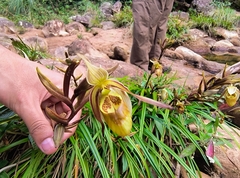 Phragmipedium caricinum Reed Grass-Like Phragmipedium Photo: CC BY, fernando vilar
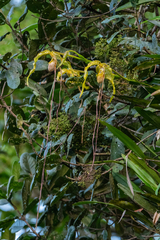 Phragmipedium caudatum Tailed Phragmipedium Photo: CC BY-SA, Thibaud Aronson
 Phragmipedium humboldtii Humboldt's Phragmipedium Photo: CC BY, Kai Squires
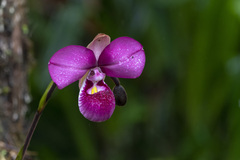 Phragmipedium kovachii Kovach's Phragmipedium Photo: CC BY, David F. Belmonte
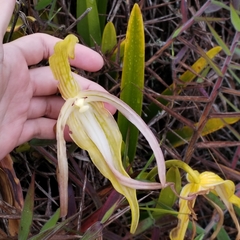 Phragmipedium lindenii Orchidaceae Photo: CC BY, Esteban Poveda
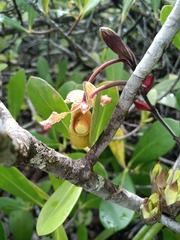 Phragmipedium lindleyanum Lindley's Phragmipedium Photo: CC BY, Guillaume Delaitre
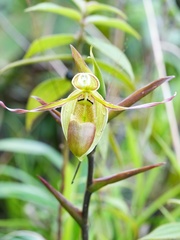 Phragmipedium longifolium Long-Leaf Phragmipedium Photo: CC0, author not stated
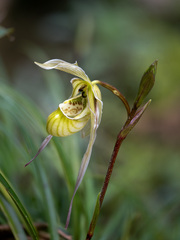 Phragmipedium pearcei Pearce's Phragmipedium Photo: CC BY, Alan Rockefeller Phragmipedium × pfitzerianum Orchidaceae Phragmipedium × richteri Richter's Phragmipedium
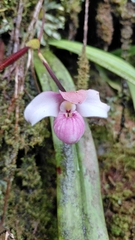 Phragmipedium schlimii Schlimm's Phragmipedium Photo: CC0, author not stated all 14 ›
Names & registers
Also known as Paphiopedilum besseae; Phragmipedium besseae f. flavum; Phragmipedium besseae var. besseae; Phragmipedium besseae var. flavum. (GBIF Backbone)
The record
Every figure here is derived from public data by a stated rule and names its source; nothing about this species is written for its page by a person or by AI, apart from the marked, credited quotations. How →
Where this page came from built 2026-10-22
gbif.species answeredasked 2026-10-22gbif.synonyms answeredasked 2026-10-22gbif.vernacular answeredasked 2026-10-22names fetched 2026-10-22wcvp.distribution answeredas of 2026-06-04gbif.occurrences answeredas of 2026-10-21GBIF occurrence download https://doi.org/10.15468/dl.hbdw64, of 2026-10-21climate nothing to reportasked 2026-10-226 in-range records, none placed to within 10 kmwikidata answeredasked 2026-10-22wikipedia answeredasked 2026-10-22inat.photos.wild answeredasked 2026-10-22from iNaturalist's open data of 2026-09-27: research-grade observations with an open-licence photograph, the 24 whose photographs iNaturalist received last (the open data holds no votes); filled 2026-10-22inat.photos.cultivated not askedgbif.media nothing to reportasked 2026-10-22commons answeredasked 2026-10-22openalex not askednot yet asked for this reference; a later fill takes the papers from OpenAlex's snapshotEvery source is recorded as having answered, reported nothing, refused, failed, not been asked, or answered twice where one answer is taken (“not taken: two items answered”), and, for a source asked when this page was built, when: the figures are as the source held them that day; a source read from a file (Kew's World Checklist, a GBIF download) says "as of" the file's day instead; a row carried from an earlier build of the page names that build instead. Only “nothing to report” is ever shown as an absence. Records came from 3 datasets via GBIF.org; each carries its own licence.