
Podophyllum versipelle Hance
English names not checked: Wikidata's common names were not read for this page.


 4 photographs ›
Summary
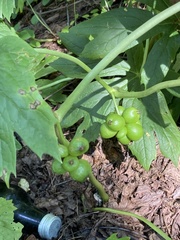
Dysosma versipellis is a species of flowering plant in the barberry family Berberidaceae, native to China. It is still widely referenced under Podophyllum versipelle and there is some debate as to its correct taxonomic status. Though it has quite a broad but sparse distribution in the damp, shady forests of south and west China, it has been designated as "Vulnerable" by the IUCN. A compact herbaceous perennial growing to 50 cm (20 in) tall and broad, it grows from underground rhizomes, with umbrella-shaped leaves and dark red, tubular, pendent flowers in spring.
Quoted from Wikipedia, "Dysosma versipellis", CC BY-SA 4.0; its title is one of this species' older names (GBIF Backbone), which is the proof that the article is this species'.
About the genus · Podophyllum
Podophyllum is a genus of flowering plant in the family Berberidaceae, native from Afghanistan to China, and from southeast Canada to the central and eastern United States. The genus was first described by Carl Linnaeus in 1753.
Quoted from Wikipedia, "Podophyllum", CC BY-SA 4.0.
Cultivation
Climate across the habitat
Natural habitat
This species has no GBIF key of its own. Its records are GBIF's under the key of the name Kew's World Checklist holds as this plant: 8336561 (Dysosma versipellis (Hance) M.Cheng, 138 records). No name was matched to GBIF; the keys are read from Kew's synonymy. How.
How this section is made
Photographs


Photographs: Krzysztof Ziarnek, Kenraiz, CC BY-SA 4.0, via Wikimedia Commons (2); Daderot, CC0, via Wikimedia Commons.
Related
Other Podophyllum 9 in the reference
 Podophyllum aurantiocaule Berberidaceae Photo: CC BY-SA, Steve Law Podophyllum cymosum Berberidaceae
 Podophyllum delavayi Berberidaceae Photo: Public domain, Daderot Podophyllum difforme Berberidaceae
 Podophyllum grayi Berberidaceae Photo: CC BY, Motohiro Sunouchi
 Podophyllum hexandrum Berberidaceae Photo: Public domain, Pekaje
 Podophyllum peltatum Mayapple Photo: CC0, author not stated
 Podophyllum pleianthum Berberidaceae Photo: CC BY-SA, peganum from Small Dole, England Podophyllum sinense Berberidaceae
Names & registers
Also known as Dysosma versipellis. (WCVP, RBG Kew)
The record
Every figure here is derived from public data by a stated rule and names its source; nothing about this species is written for its page by a person or by AI, apart from the marked, credited quotations. How →
Where this page came from built 2026-10-22
kew.names answeredas of 2026-06-04Kew's entry Podophyllum versipelle Hance (plant_name_id 2412808), read from Kew's names filegbif.species not askedGBIF's backbone holds no one accepted species of this name, and a name it holds only as another species' synonym is not taken for this one, so GBIF's records were not askedgbif.synonyms not askedGBIF's backbone holds no one accepted species of this name, and a name it holds only as another species' synonym is not taken for this one, so GBIF's records were not askedgbif.vernacular not askedGBIF's backbone holds no one accepted species of this name, and a name it holds only as another species' synonym is not taken for this one, so GBIF's records were not askedwcvp.distribution answeredas of 2026-06-04gbif.occurrences answeredas of 2026-10-21this species has no GBIF key of its own; its records are read under GBIF's keys for the names Kew's file holds as this plant, never by a name matched; GBIF occurrence download https://doi.org/10.15468/dl.hbdw64, of 2026-10-21; 138 records of GBIF's key 8336561, Dysosma versipellis (Hance) M.Cheng (Kew's file holds it as Dysosma versipellis (Hance) M.Cheng (synonym under Podophyllum versipelle Hance)): the GBIF downloadclimate nothing to reportasked 2026-10-22only 1 distinct land cell of the climate grid holds an in-range record placed to within 10 km; three are needed for an envelopewikidata answeredasked 2026-10-22found by Kew's IPNI identifier 107606-1, POWO 107606-1wikipedia answeredasked 2026-10-22Wikipedia redirects Podophyllum versipelle to Dysosma versipellis, an older name of this species (Dysosma versipellis)inat.taxon not askedinat.photos.wild not askedinat.photos.cultivated not askedgbif.media not askedGBIF's backbone holds no one accepted species of this name, and a name it holds only as another species' synonym is not taken for this one, so GBIF's records were not askedcommons answeredasked 2026-10-22openalex not askednot yet asked for this reference; a later fill takes the papers from OpenAlex's snapshotEvery source is recorded as having answered, reported nothing, refused, failed, not been asked, or answered twice where one answer is taken (“not taken: two items answered”), and, for a source asked when this page was built, when: the figures are as the source held them that day; a source read from a file (Kew's World Checklist, a GBIF download) says "as of" the file's day instead; a row carried from an earlier build of the page names that build instead. Only “nothing to report” is ever shown as an absence. Records came from 16 datasets via GBIF.org; each carries its own licence.