
Protea afra Meisn.
English names not checked: Wikidata's common names were not read for this page.
GBIF's records not checked. GBIF's backbone holds no one accepted species of this name, and a name it holds only as another species' synonym is not taken for this one, so GBIF's records were not asked. So this page has no points on its map, no map marker, no habitat climate, no cultivation sheet and no species of nearest climate; the range is Kew's. Not a statement that none exist. How.


 12 photographs ›
Summary
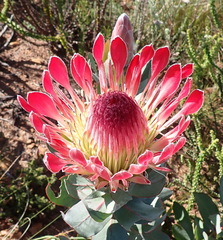
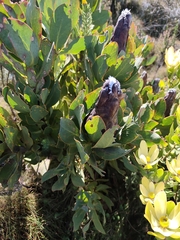
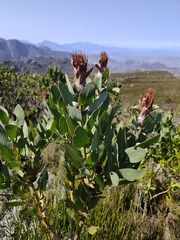
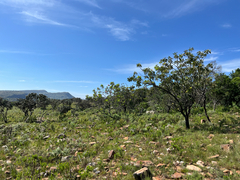
Protea afra (sometimes called the common protea), native to Africa, inhabiting from South Africa to Kenya, is a small tree or shrub which occurs in subtropical open or wooded grassland, usually on rocky ridges. Its leaves are leathery and hairless. The flower head is solitary or in clusters of 3 or 4 with the involucral bracts a pale red, pink or cream colour. The fruit is a densely hairy nut. More on Wikipedia ›
Quoted from Wikipedia, "Protea afra", CC BY-SA 4.0.
About the genus · Protea
Protea is a genus of South African flowering plants, also called sugarbushes. It is the type genus of the Proteaceae family.
Quoted from Wikipedia, "Protea", CC BY-SA 4.0.
Cultivation
Climate across the habitat
Natural habitat
Photographs


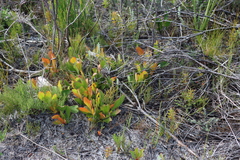
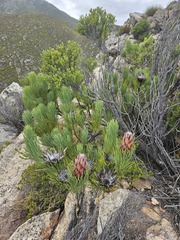
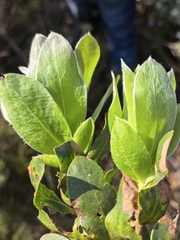
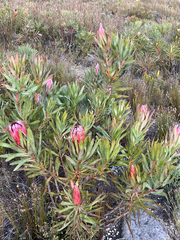
Photographs: Marco Schmidt, CC BY-SA 2.5, via Wikimedia Commons; Paul venter, CC BY-SA 3.0, via Wikimedia Commons (3); Ton Rulkens from Mozambique, CC BY-SA 2.0, via Wikimedia Commons; JMK, CC BY-SA 3.0, via Wikimedia Commons.
Related
Similar habitat climate Not checked: GBIF's records were not asked (why, under the name), and the nearest habitat climates are read from the climate they give.
Other Protea 33 in the reference
 Protea acaulos Common Ground Sugarbush Photo: CC BY-SA, Tony Rebelo
 Protea aristata Ladismith Sugarbush Photo: CC BY, Ren Hoekstra
 Protea aurea Shuttlecock Sugarbush Photo: CC0, author not stated
 Protea burchellii Burchell's Sugarbush Photo: CC BY, André Deschodt
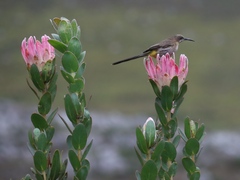 Protea compacta Bot River protea Photo: CC BY-SA, Tony Rebelo
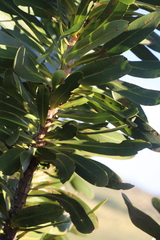 Protea comptonii Saddleback Sugarbush Photo: CC BY-SA, Suvarna Parbhoo Mohan
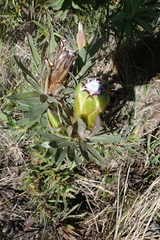 Protea coronata Green Sugarbush Photo: CC BY, Karen Eichholz
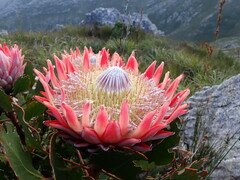 Protea cynaroides King protea Photo: CC BY, Ren Hoekstra
 Protea eximia Broad-leaved Sugarbush Photo: CC BY-SA, Nicola van Berkel
 Protea grandiceps Red Sugarbush Photo: CC BY-SA, Jeanette Clarke
 Protea lacticolor Hottentot Sugarbush Photo: CC BY-SA, Jeanette Clarke
 Protea laetans Blyde Sugarbush Photo: CC BY, katuchka all 34 ›
Names & registers
Also known as Scolymocephalus afer. (WCVP, RBG Kew)
The record
Every figure here is derived from public data by a stated rule and names its source; nothing about this species is written for its page by a person or by AI, apart from the marked, credited quotations. How →
Where this page came from built 2026-10-22
kew.names answeredas of 2026-06-04Kew's entry Protea afra Meisn. (plant_name_id 2564216), read from Kew's names filegbif.species not askedGBIF's backbone holds no one accepted species of this name, and a name it holds only as another species' synonym is not taken for this one, so GBIF's records were not askedgbif.synonyms not askedGBIF's backbone holds no one accepted species of this name, and a name it holds only as another species' synonym is not taken for this one, so GBIF's records were not askedgbif.vernacular not askedGBIF's backbone holds no one accepted species of this name, and a name it holds only as another species' synonym is not taken for this one, so GBIF's records were not askedgbif.occurrences not askedGBIF's backbone holds no one accepted species of this name, and a name it holds only as another species' synonym is not taken for this one, so GBIF's records were not askedwcvp.distribution answeredas of 2026-06-04climate not askedGBIF's backbone holds no one accepted species of this name, and a name it holds only as another species' synonym is not taken for this one, so GBIF's records were not asked, and the habitat climate is read only from themwikidata answeredasked 2026-10-22found by Kew's IPNI identifier 705664-1, POWO 705664-1wikipedia answeredasked 2026-10-22inat.photos.wild not askedinat.photos.cultivated not askedgbif.media not askedGBIF's backbone holds no one accepted species of this name, and a name it holds only as another species' synonym is not taken for this one, so GBIF's records were not askedcommons answeredasked 2026-10-22openalex not askednot yet asked for this reference; a later fill takes the papers from OpenAlex's snapshotEvery source is recorded as having answered, reported nothing, refused, failed, not been asked, or answered twice where one answer is taken (“not taken: two items answered”), and, for a source asked when this page was built, when: the figures are as the source held them that day; a source read from a file (Kew's World Checklist, a GBIF download) says "as of" the file's day instead; a row carried from an earlier build of the page names that build instead. Only “nothing to report” is ever shown as an absence.