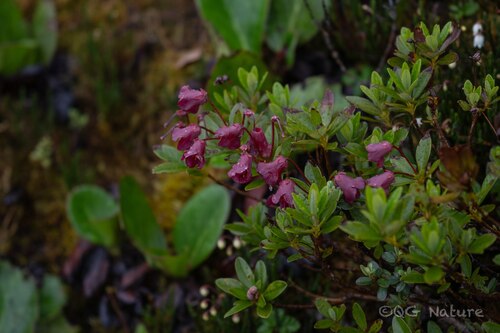
Rhododendron campylogynum Franch.
Bent-style rhododendron
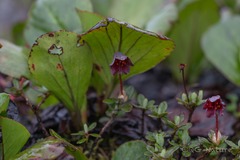


 14 photographs ›
Summary
Rhododendron campylogynum (独龙杜鹃), the bent-style rhododendron, is a rhododendron species native to northeast India and northeast Myanmar, where it grows at altitudes of 3,500–4,500 m (11,500–14,800 ft). It is a small creeping or prostrate shrub that grows 0.5–3 cm (0.20–1.18 in) in height, with leathery leaves, obovate to obovate-lanceolate in shape, up to 2.5 cm by 1.5 cm but often much smaller. The leaves are glandular and are strongly scented of myrrh when crushed. The flowers are purplish red or pink colour and of a distinctive simple, somewhat nodding, bell shape, borne singly or in pairs on a short stalk.
Quoted from Wikipedia, "Rhododendron campylogynum", CC BY-SA 4.0.
About the genus · Rhododendron
Rhododendron, from Ancient Greek ῥόδον (rhódon), meaning "rose", and δένδρον (déndron), meaning "tree", is a very large genus of about 1,024 species of woody plants in the heath family (Ericaceae). They can be either evergreen or deciduous. Most species are native to eastern Asia and the Himalayan region, but smaller numbers occur elsewhere in Asia, and in North America, Europe and Australia.
Quoted from Wikipedia, "Rhododendron", CC BY-SA 4.0.
Cultivation
Grouped as a temperate garden plant, listed under the genus Rhododendron in the archetype table, and Kew describes it as “subshrub or shrub”, “temperate”.
How this section is made
Each card states this species' habitat figures with their sources, and what two fixed rules read from them; nothing here says what the plant does, wants or tolerates. The rules · the terms.
Group. Listed under the genus Rhododendron in the archetype table, and Kew describes it as “subshrub or shrub”, “temperate”. A group is taken only where Kew's description of the species agrees with the table's listing. The table gives no figure and no prose; the cold floor is the habitat's alone.
Climate across the habitat
Natural habitat
How this section is made
Photographs
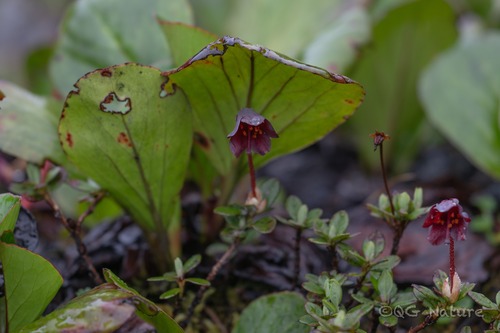


Photographs: Wang.QG, CC BY, iNaturalist via GBIF; Daderot, CC0, via Wikimedia Commons (5).
Related
Other Rhododendron 574 in the reference
 Rhododendron aberconwayi Ericaceae Photo: Public domain, Daderot Rhododendron abietifolium Ericaceae Rhododendron acrophilum Ericaceae
 Rhododendron adamsii Sagan Dalya Photo: CC BY, Valentin Kosterin
 Rhododendron adenogynum Ericaceae Photo: CC BY-SA, Kurt Stüber
 Rhododendron adenopodum Ericaceae Photo: CC BY-SA, Ulf Eliasson
 Rhododendron adenosum Ericaceae Photo: CC0, Daderot
 Rhododendron aeruginosum Ericaceae Photo: CC BY, Siddarth Machado
 Rhododendron aganniphum Ericaceae Photo: CC0, Daderot Rhododendron agathodaemonis Ericaceae
 Rhododendron alabamense Alabama azalea Photo: CC BY, Rob John
 Rhododendron albiflorum White rhododendron Photo: CC0, author not stated all 575 ›
Names & registers
Also known as Azalea campylogyna; Rhododendron amphichlorum; Rhododendron caeruleoglaucum; Rhododendron campylogynum var. celsum; Rhododendron campylogynum var. charopoeum and 8 more. (GBIF Backbone)
The record
Every figure here is derived from public data by a stated rule and names its source; nothing about this species is written for its page by a person or by AI, apart from the marked, credited quotations. How →
Where this page came from built 2026-10-22
gbif.species answeredasked 2026-10-22gbif.synonyms answeredasked 2026-10-22gbif.vernacular answeredasked 2026-10-22names fetched 2026-10-22wcvp.distribution answeredas of 2026-06-04gbif.occurrences answeredas of 2026-10-21GBIF occurrence download https://doi.org/10.15468/dl.hbdw64, of 2026-10-21climate nothing to reportasked 2026-10-22only 2 distinct land cells of the climate grid hold an in-range record placed to within 10 km; three are needed for an envelopewikidata answeredasked 2026-10-22wikipedia answeredasked 2026-10-22inat.taxon not askedinat.photos.wild not askedinat.photos.cultivated not askedgbif.media answeredasked 2026-10-22commons answeredasked 2026-10-22openalex not askednot yet asked for this reference; a later fill takes the papers from OpenAlex's snapshotEvery source is recorded as having answered, reported nothing, refused, failed, not been asked, or answered twice where one answer is taken (“not taken: two items answered”), and, for a source asked when this page was built, when: the figures are as the source held them that day; a source read from a file (Kew's World Checklist, a GBIF download) says "as of" the file's day instead; a row carried from an earlier build of the page names that build instead. Only “nothing to report” is ever shown as an absence. Records came from 19 datasets via GBIF.org; each carries its own licence.