
Ribes diacantha Pall.
English names not checked: Wikidata's common names were not read for this page.
Summary
Ribes diacanthum, the Siberian currant, is an Asian species of currant. It is native to northeastern Asia (Russia, Mongolia, Korea, northeastern China (Heilongjiang, Jilin, Inner Mongolia)). The species is also sparingly naturalised in the Canadian Province of Manitoba, having escaped in the 1940s from an agricultural experiment station near Brandon.
Quoted from Wikipedia, "Ribes diacanthum", CC BY-SA 4.0.
About the genus · Ribes
Ribes is a genus of approximately 200 known species of flowering plants, predominantly native to the temperate regions of the Northern Hemisphere. Ribes is the sole genus in the plant family Grossulariaceae. The genus includes species commonly referred to as redcurrants, blackcurrants, whitecurrants, and gooseberries. More on Wikipedia ›
Quoted from Wikipedia, "Ribes", CC BY-SA 4.0.
Cultivation
Climate across the habitat
Natural habitat
This species has no GBIF key of its own. Its records are GBIF's under the keys of the names Kew's World Checklist holds as this plant: 5687136 (Grossularia diacantha (Pall.) Mill. ex Steud., 0 records), 8676411 (Grossularia diacantha (Pall.) Mill., 0 records). No name was matched to GBIF; the keys are read from Kew's synonymy. How.
Related
Other Ribes 77 in the reference
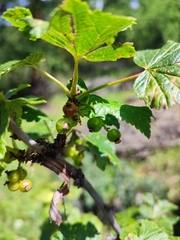 Ribes aciculare Grossulariaceae Photo: CC BY, K.P.
 Ribes alpestre Grossulariaceae Photo: CC BY-SA, Christian Hummert (Ixitixel)
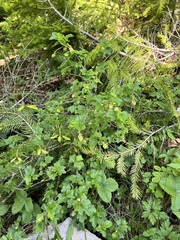 Ribes alpinum Mountain currant Photo: CC0, author not stated
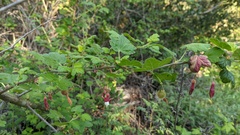 Ribes amarum Grossulariaceae Photo: CC BY, George Williams
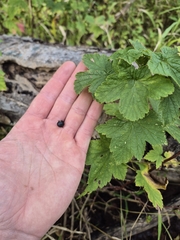 Ribes americanum Wild black currant Photo: CC BY, Sam Turner
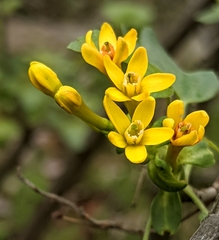 Ribes aureum Golden currant Photo: CC0, author not stated
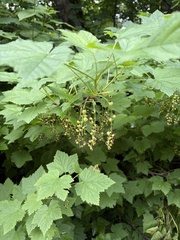 Ribes biebersteinii Grossulariaceae Photo: CC BY, Екатерина Кравцова
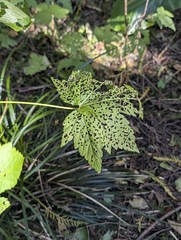 Ribes bracteosum Stink currant Photo: CC BY, Moe Meikle
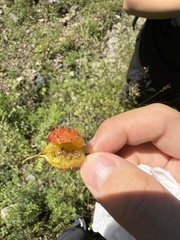 Ribes burejense Stinky black currant Photo: CC BY, Jane Charlen
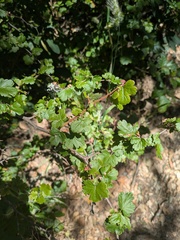 Ribes californicum Hillside gooseberry Photo: CC BY, jayjt
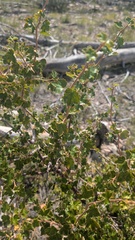 Ribes cereum Wax currant Photo: CC0, author not stated
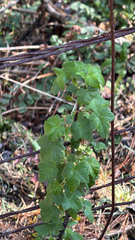 Ribes ciliatum Grossulariaceae Photo: CC BY, nebrooks all 78 ›
Names & registers
Also known as Grossularia diacantha; Ribes diacantha f. weichangense; Ribes dauricum; Ribes diacantha f. inermis. (WCVP, RBG Kew)
The record
Every figure here is derived from public data by a stated rule and names its source; nothing about this species is written for its page by a person or by AI, apart from the marked, credited quotations. How →
Where this page came from built 2026-10-22
kew.names answeredas of 2026-06-04Kew's entry Ribes diacantha Pall. (plant_name_id 2426118), read from Kew's names filegbif.species not askedGBIF's backbone holds no one accepted species of this name, and a name it holds only as another species' synonym is not taken for this one, so GBIF's records were not askedgbif.synonyms not askedGBIF's backbone holds no one accepted species of this name, and a name it holds only as another species' synonym is not taken for this one, so GBIF's records were not askedgbif.vernacular not askedGBIF's backbone holds no one accepted species of this name, and a name it holds only as another species' synonym is not taken for this one, so GBIF's records were not askedwcvp.distribution answeredas of 2026-06-04gbif.occurrences nothing to reportasked 2026-10-22this species has no GBIF key of its own; its records are read under GBIF's keys for the names Kew's file holds as this plant, never by a name matched; 0 records of GBIF's key 5687136, Grossularia diacantha (Pall.) Mill. ex Steud. (Kew's file holds it as Grossularia diacantha (Pall.) Ser. (synonym under Ribes diacantha Pall.)): GBIF occurrence search API; 0 records of GBIF's key 8676411, Grossularia diacantha (Pall.) Mill. (Kew's file holds it as Grossularia diacantha (Pall.) Ser. (synonym under Ribes diacantha Pall.)): GBIF occurrence search APIclimate nothing to reportasked 2026-10-22no georeferenced record inside the rangewikidata answeredasked 2026-10-22found by Kew's IPNI identifier 792657-1, POWO 792657-1wikipedia answeredasked 2026-10-22inat.photos.wild not askedinat.photos.cultivated not askedgbif.media not askedGBIF's backbone holds no one accepted species of this name, and a name it holds only as another species' synonym is not taken for this one, so GBIF's records were not askedcommons answeredasked 2026-10-22openalex not askednot yet asked for this reference; a later fill takes the papers from OpenAlex's snapshotEvery source is recorded as having answered, reported nothing, refused, failed, not been asked, or answered twice where one answer is taken (“not taken: two items answered”), and, for a source asked when this page was built, when: the figures are as the source held them that day; a source read from a file (Kew's World Checklist, a GBIF download) says "as of" the file's day instead; a row carried from an earlier build of the page names that build instead. Only “nothing to report” is ever shown as an absence.