
Salvia caespitosa Montbret & Aucher ex Benth.
Anatolian Cushion Sage
 2 photographs ›
Summary
Salvia caespitosa is a herbaceous perennial native to rocky limestone and volcanic slopes, at 4600–7900 ft elevation, in central and southern Anatolia. It has been grown in horticulture since the 1950s, typically in rock gardens, due to its dwarf, mat-growing habit. Caespitosa refers to its habit of "growing in dense clumps or tufts", with divided leaves and stems that grow in bunches, rather than being evenly spaced. The pale pinkish lilac flowers, about 1.6 in long, grow on very short inflorescences that are barely longer than the leaf.
Quoted from Wikipedia, "Salvia caespitosa", CC BY-SA 4.0.
About the genus · Salvia
Salvia is the largest genus of plants in the sage family Lamiaceae, with just under 1,000 species of shrubs, herbaceous perennials, and annuals. Within the Lamiaceae, Salvia is part of the tribe Mentheae within the subfamily Nepetoideae. One of several genera commonly referred to as sage, it includes two widely used herbs, Salvia officinalis and Salvia rosmarinus.
Quoted from Wikipedia, "Salvia", CC BY-SA 4.0.
Cultivation
Grouped as a temperate garden plant, listed under the genus Salvia in the archetype table, and Kew describes it as “subshrub”, “temperate”.
How this section is made
Each card states this species' habitat figures with their sources, and what two fixed rules read from them; nothing here says what the plant does, wants or tolerates. The rules · the terms.
Group. Listed under the genus Salvia in the archetype table, and Kew describes it as “subshrub”, “temperate”. A group is taken only where Kew's description of the species agrees with the table's listing. The table gives no figure and no prose; the cold floor is the habitat's alone.
Climate across the habitat
Natural habitat
Photographs

Photographs: Ghislain118 (AD) http://www.fleurs-des-montagnes.net, CC BY-SA 3.0, via Wikimedia Commons.
Related
Other Salvia 225 in the reference
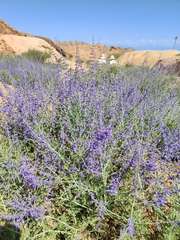 Salvia abrotanoides Caspian Sage Photo: CC BY, Станислав Чуванов
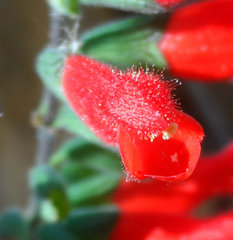 Salvia adenophora Oaxaca Red Sage Photo: CC BY-SA, Eugenio Padilla
 Salvia aethiopis African sage Photo: CC BY, Aleksei Baushev
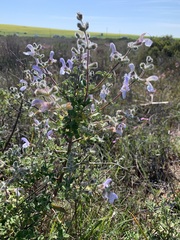 Salvia africana African Blue Sage Photo: CC BY, Ryan Rattray
 Salvia amethystina Lamiaceae Photo: CC BY, Nicolás Baresch Uribe
 Salvia amplexicaulis Lamiaceae Photo: CC BY, Zac Peterson
 Salvia angustiarum Lamiaceae Photo: CC0, author not stated
 Salvia apiana White sage Photo: CC BY, Trevor Harding
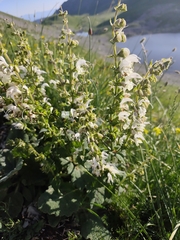 Salvia argentea Silver sage Photo: CC BY-SA, Jeanette Clarke
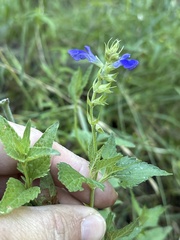 Salvia arizonica Desert indigo sage Photo: CC BY, Sam Kieschnick Salvia aucheri Waving Sage
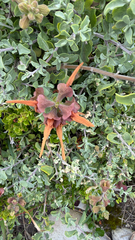 Salvia aurea Brown Sage Photo: CC BY, jk6000 all 226 ›
Names & registers
Also known as Salvia pectinifolia. (GBIF Backbone)
The record
Every figure here is derived from public data by a stated rule and names its source; nothing about this species is written for its page by a person or by AI, apart from the marked, credited quotations. How →
Where this page came from built 2026-10-22
gbif.species answeredasked 2026-10-22gbif.synonyms answeredasked 2026-10-22gbif.vernacular answeredasked 2026-10-22names fetched 2026-10-22wcvp.distribution answeredas of 2026-06-04gbif.occurrences answeredas of 2026-10-21GBIF occurrence download https://doi.org/10.15468/dl.hbdw64, of 2026-10-21; 4 records within 1 km of a botanic garden, herbarium or zoo left out (4 at a botanic garden or arboretum; Wikidata's list)climate nothing to reportasked 2026-10-22only 1 distinct land cell of the climate grid holds an in-range record placed to within 10 km; three are needed for an envelopewikidata answeredasked 2026-10-22found by its label; its IPNI identifier 455850-1 is Kew's for Salvia caespitosa Montbret & Aucher ex Benth.wikipedia answeredasked 2026-10-22inat.taxon not askedinat.photos.wild not askedinat.photos.cultivated not askedgbif.media nothing to reportasked 2026-10-22commons answeredasked 2026-10-22openalex not askednot yet asked for this reference; a later fill takes the papers from OpenAlex's snapshotEvery source is recorded as having answered, reported nothing, refused, failed, not been asked, or answered twice where one answer is taken (“not taken: two items answered”), and, for a source asked when this page was built, when: the figures are as the source held them that day; a source read from a file (Kew's World Checklist, a GBIF download) says "as of" the file's day instead; a row carried from an earlier build of the page names that build instead. Only “nothing to report” is ever shown as an absence. Records came from 2 datasets via GBIF.org; each carries its own licence.