
Schlumbergera russelliana (Hook.) Britton & Rose
English names not checked: Wikidata's common names were not read for this page.
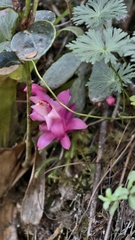
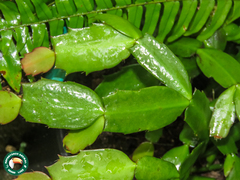
 2 photographs ›
Summary
Schlumbergera russelliana is a species of flowering plant in the family Cactaceae. It is endemic to a small area of the coastal mountains of southeastern Brazil, where its natural habitat is moist forest and it grows on trees as an epiphyte. It is one of the parent species from which many of the popular houseplants known as Christmas cactus or Thanksgiving cactus are descended.
Quoted from Wikipedia, "Schlumbergera russelliana", CC BY-SA 4.0.
About the genus · Schlumbergera
Schlumbergera is a small genus of cacti with six to nine species native to the coastal mountains of southeastern Brazil. These plants grow on trees or rocks in habitats that are generally shady with high humidity, and can be quite different in appearance from their desert-dwelling cousins. Most species of Schlumbergera have stems which resemble leaf-like pads joined one to the other and flowers which appear from areoles at the joints and tips of the stems. More on Wikipedia ›
Quoted from Wikipedia, "Schlumbergera", CC BY-SA 4.0.
Cultivation
Grouped as an epiphyte, listed under the genus Schlumbergera in the archetype table, and Kew describes it as “succulent epiphyte”.
How this section is made
Each card states this species' habitat figures with their sources, and what two fixed rules read from them; nothing here says what the plant does, wants or tolerates. The rules · the terms.
Group. Listed under the genus Schlumbergera in the archetype table, and Kew describes it as “succulent epiphyte”. A group is taken only where Kew's description of the species agrees with the table's listing. The table gives no figure and no prose; the cold floor is the habitat's alone.
Climate across the habitat
Natural habitat
This species has no GBIF key of its own. Its records are GBIF's under the keys of the names Kew's World Checklist holds as this plant: 3942548 (Phyllocactus russellianus (Gardner) Salm-Dyck, 0 records), 7280587 (Epiphyllum russellianum (Gardner) Hook., 1 record), 7542356 (Cereus russellianus Gardner, 0 records). No name was matched to GBIF; the keys are read from Kew's synonymy. How.
Photographs

Photographs: Isiwal, CC BY-SA 4.0, via Wikimedia Commons.
Related
Other Schlumbergera 4 in the reference
 Schlumbergera opuntioides Christmas Cactus Photo: CC BY, fmunoz Schlumbergera orssichiana Cactaceae
 Schlumbergera truncata False Christmas cactus Photo: CC BY, Diogo Luiz
Names & registers
Also known as Cereus russellianus; Epiphyllum bridgesii; Schlumbergera epiphylloides; Schlumbergera bridgesii; Epiphyllum truncatum var. bridgesii and 5 more. (WCVP, RBG Kew)
The record
Every figure here is derived from public data by a stated rule and names its source; nothing about this species is written for its page by a person or by AI, apart from the marked, credited quotations. How →
Where this page came from built 2026-10-22
kew.names answeredas of 2026-06-04Kew's entry Schlumbergera russelliana (Hook.) Britton & Rose (plant_name_id 2486311), read from Kew's names filegbif.species not askedGBIF's backbone holds no one accepted species of this name, and a name it holds only as another species' synonym is not taken for this one, so GBIF's records were not askedgbif.synonyms not askedGBIF's backbone holds no one accepted species of this name, and a name it holds only as another species' synonym is not taken for this one, so GBIF's records were not askedgbif.vernacular not askedGBIF's backbone holds no one accepted species of this name, and a name it holds only as another species' synonym is not taken for this one, so GBIF's records were not askedwcvp.distribution answeredas of 2026-06-04gbif.occurrences answeredasked 2026-10-22this species has no GBIF key of its own; its records are read under GBIF's keys for the names Kew's file holds as this plant, never by a name matched; GBIF occurrence download https://doi.org/10.15468/dl.hbdw64, of 2026-10-21; 0 records of GBIF's key 3942548, Phyllocactus russellianus (Gardner) Salm-Dyck (Kew's file holds it as Phyllocactus russellianus (Hook.) Salm-Dyck (synonym under Schlumbergera russelliana (Hook.) Britton & Rose)): GBIF occurrence search API; 1 record of GBIF's key 7280587, Epiphyllum russellianum (Gardner) Hook. (Kew's file holds it as Epiphyllum russellianum Hook. (synonym under Schlumbergera russelliana (Hook.) Britton & Rose)): the GBIF download; 0 records of GBIF's key 7542356, Cereus russellianus Gardner (Kew's file holds it as Cereus russellianus (Hook.) Gardner (synonym under Schlumbergera russelliana (Hook.) Britton & Rose)): GBIF occurrence search APIclimate nothing to reportasked 2026-10-221 in-range record, none placed to within 10 kmwikidata answeredasked 2026-10-22found by Kew's IPNI identifier 229596-2, POWO 229596-2wikipedia answeredasked 2026-10-22inat.photos.wild not askedinat.photos.cultivated not askedgbif.media not askedGBIF's backbone holds no one accepted species of this name, and a name it holds only as another species' synonym is not taken for this one, so GBIF's records were not askedcommons answeredasked 2026-10-22openalex not askednot yet asked for this reference; a later fill takes the papers from OpenAlex's snapshotEvery source is recorded as having answered, reported nothing, refused, failed, not been asked, or answered twice where one answer is taken (“not taken: two items answered”), and, for a source asked when this page was built, when: the figures are as the source held them that day; a source read from a file (Kew's World Checklist, a GBIF download) says "as of" the file's day instead; a row carried from an earlier build of the page names that build instead. Only “nothing to report” is ever shown as an absence. Records came from 1 datasets via GBIF.org; each carries its own licence.