
Sedum sedoides Pau
English names not checked: Wikidata's common names were not read for this page.


 7 photographs ›
About the genus · Sedum
Sedum is a large genus of flowering plants in the family Crassulaceae, members of which are commonly known as stonecrops. The genus has been described as containing up to 600 species, subsequently reduced to 400–500. They are leaf succulents found primarily in the Northern Hemisphere, but extending into the southern hemisphere in Africa and South America. More on Wikipedia ›
Quoted from Wikipedia, "Sedum", CC BY-SA 4.0.
Cultivation
Grouped as a cactus or succulent, listed under the genus Sedum in the archetype table, and Kew describes it as “succulent perennial”.
How this section is made
Each card states this species' habitat figures with their sources, and what two fixed rules read from them; nothing here says what the plant does, wants or tolerates. The rules · the terms.
Group. Listed under the genus Sedum in the archetype table, and Kew describes it as “succulent perennial”. A group is taken only where Kew's description of the species agrees with the table's listing. The table gives no figure and no prose; the cold floor is the habitat's alone.
Climate across the habitat
Natural habitat
This species has no GBIF key of its own. Its records are GBIF's under the key of the name Kew's World Checklist holds as this plant: 7334125 (Rosularia sedoides (Jacquem. ex Decne.) H.Ohba, 2 records). No name was matched to GBIF; the keys are read from Kew's synonymy. How.
Photographs


Photographs: Ghislain118 (AD) http://www.fleurs-des-montagnes.net, CC BY-SA 3.0, via Wikimedia Commons (2); Salicyna, CC BY-SA 4.0, via Wikimedia Commons (3); M108t, CC BY 4.0, via Wikimedia Commons.
Related
Other Sedum 114 in the reference
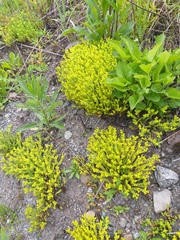 Sedum acre Biting stonecrop Photo: CC BY, Dmitriy Bochkov
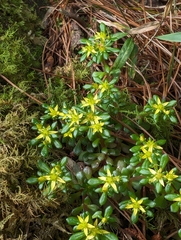 Sedum actinocarpum Crassulaceae Photo: CC BY, Francisca Wu
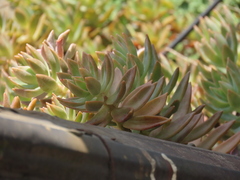 Sedum adolphi Coppertone Stonecrop Photo: CC BY, chiuluan
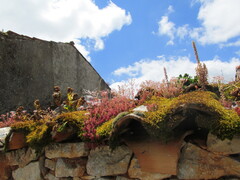 Sedum album White stonecrop Photo: CC BY, zebedeugalinha Sedum alexanderi Crassulaceae
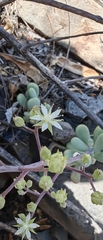 Sedum allantoides Crassulaceae Photo: CC BY, Leonardo O. Alvarado Cárdenas
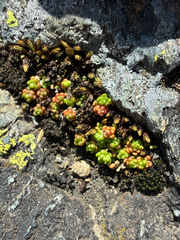 Sedum alpestre Alpine Stonecrop Photo: CC0, author not stated
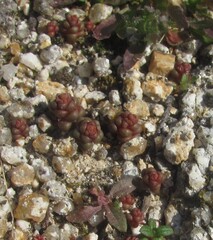 Sedum andegavense Crassulaceae Photo: CC BY, zebedeugalinha
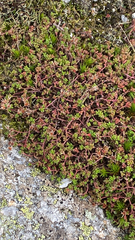 Sedum anglicum English stonecrop Photo: CC BY, Jon Davies
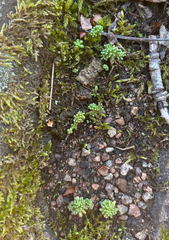 Sedum annuum Annual stonecrop Photo: CC BY, Andreas Schneider
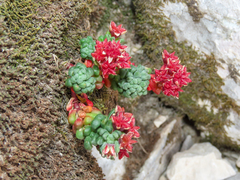 Sedum atratum Crassulaceae Photo: CC BY-SA, Emanuele Santarelli
 Sedum bellum Crassulaceae Photo: CC BY-SA, El Funcionario all 115 ›
Names & registers
Also known as Sempervivum album; Rosularia sedoides; Rosularia sedoides var. alba; Sedum jacquemontii; Sempervivum sedoides and 2 more. (WCVP, RBG Kew)
The record
Every figure here is derived from public data by a stated rule and names its source; nothing about this species is written for its page by a person or by AI, apart from the marked, credited quotations. How →
Where this page came from built 2026-10-22
kew.names answeredas of 2026-06-04Kew's entry Sedum sedoides Pau (plant_name_id 2489470), read from Kew's names filegbif.species not askedGBIF's backbone holds no one accepted species of this name, and a name it holds only as another species' synonym is not taken for this one, so GBIF's records were not askedgbif.synonyms not askedGBIF's backbone holds no one accepted species of this name, and a name it holds only as another species' synonym is not taken for this one, so GBIF's records were not askedgbif.vernacular not askedGBIF's backbone holds no one accepted species of this name, and a name it holds only as another species' synonym is not taken for this one, so GBIF's records were not askedwcvp.distribution answeredas of 2026-06-04gbif.occurrences answeredas of 2026-10-21this species has no GBIF key of its own; its records are read under GBIF's keys for the names Kew's file holds as this plant, never by a name matched; GBIF occurrence download https://doi.org/10.15468/dl.hbdw64, of 2026-10-21; 2 records of GBIF's key 7334125, Rosularia sedoides (Jacquem. ex Decne.) H.Ohba (Kew's file holds it as Rosularia sedoides (Pau) H.Ohba (synonym under Sedum sedoides Pau)): the GBIF downloadclimate nothing to reportasked 2026-10-22no georeferenced record inside the rangewikidata nothing to reportasked 2026-10-22no item carries Kew's IPNI identifier 276038-1, POWO 276038-1wikipedia nothing to reportasked 2026-10-22inat.taxon not askedinat.photos.wild not askedinat.photos.cultivated not askedgbif.media not askedGBIF's backbone holds no one accepted species of this name, and a name it holds only as another species' synonym is not taken for this one, so GBIF's records were not askedcommons answeredasked 2026-10-22openalex not askednot yet asked for this reference; a later fill takes the papers from OpenAlex's snapshotEvery source is recorded as having answered, reported nothing, refused, failed, not been asked, or answered twice where one answer is taken (“not taken: two items answered”), and, for a source asked when this page was built, when: the figures are as the source held them that day; a source read from a file (Kew's World Checklist, a GBIF download) says "as of" the file's day instead; a row carried from an earlier build of the page names that build instead. Only “nothing to report” is ever shown as an absence. Records came from 2 datasets via GBIF.org; each carries its own licence.