


 9 photographs ›
Summary
Tricyrtis macrantha, the yellow Chinese toad lily, is a species of flowering plant in the family Liliaceae. It is native to Japan's Kōchi Prefecture on the island of Shikoku. A perennial, it prefer partial to full shade and permanently wet soil, and is hardy to USDA zone 4. Although it reaches 60 cm (24 in) tall, in the garden it is best planted so that its stems and flowers can drape down to their fullest extent, about 100 cm (39 in).
Quoted from Wikipedia, "Tricyrtis macrantha", CC BY-SA 4.0.
About the genus · Tricyrtis
Tricyrtis is a genus of Asian flowering plants in the lily family, with approximately 20 known species. The species are commonly known in English as toad lilies. The genus has a native range from the Himalayas to eastern Asia, including China, Japan, Philippines and Taiwan, and a few species are cultivated for their ornamental qualities in other parts of the world.
Quoted from Wikipedia, "Tricyrtis", CC BY-SA 4.0.
Cultivation
Climate across the habitat
Natural habitat
Photographs


Photographs: Motohiro Sunouchi, CC BY 4.0, via Wikimedia Commons (6).
Related
Other Tricyrtis 13 in the reference
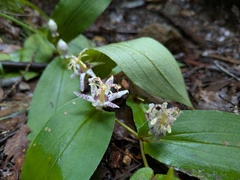 Tricyrtis affinis Tolmie's Alpine Saxifrage Photo: CC BY, Timur Kalininsky Tricyrtis dilatata Liliaceae
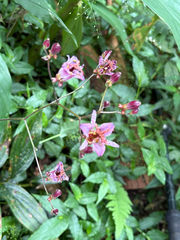 Tricyrtis formosana Formosan Toad Lily Photo: CC BY, 黃美滿
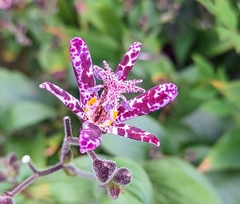 Tricyrtis hirta Toad lily Photo: CC0, author not stated
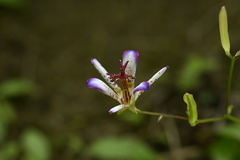 Tricyrtis lasiocarpa Liliaceae Photo: CC BY, 曾昱承 Yu-Cheng Zeng
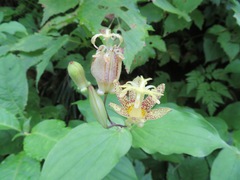 Tricyrtis latifolia Liliaceae Photo: CC BY, Marco Mussita
 Tricyrtis macranthopsis Liliaceae Photo: CC BY-SA, KENPEI
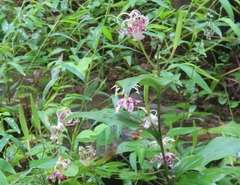 Tricyrtis macropoda Speckled toad lily Photo: CC BY, mami_t_t
 Tricyrtis maculata Liliaceae Photo: CC BY-SA, Ferruccio Zanone from Biella, Italia Tricyrtis ohsumiensis Liliaceae Tricyrtis perfoliata Liliaceae
 Tricyrtis puberula Liliaceae Photo: CC BY-SA, Agnieszka Kwiecień, Nova all 14 ›
Names & registers
Also known as Brachycyrtis macrantha. (GBIF Backbone)
The record
Every figure here is derived from public data by a stated rule and names its source; nothing about this species is written for its page by a person or by AI, apart from the marked, credited quotations. How →
Where this page came from built 2026-10-22
gbif.species answeredasked 2026-10-22gbif.synonyms answeredasked 2026-10-22gbif.vernacular answeredasked 2026-10-22names fetched 2026-10-22wcvp.distribution answeredas of 2026-06-04gbif.occurrences answeredas of 2026-10-21GBIF occurrence download https://doi.org/10.15468/dl.hbdw64, of 2026-10-21; 2 records within 1 km of a botanic garden, herbarium or zoo left out (2 at a botanic garden or arboretum; Wikidata's list)climate nothing to reportasked 2026-10-22only 1 distinct land cell of the climate grid holds an in-range record placed to within 10 km; three are needed for an envelopewikidata answeredasked 2026-10-22wikipedia answeredasked 2026-10-22inat.photos.wild nothing to reportasked 2026-10-22from iNaturalist's open data of 2026-09-27: research-grade observations with an open-licence photograph, the 24 whose photographs iNaturalist received last (the open data holds no votes); filled 2026-10-22inat.photos.cultivated not askedgbif.media nothing to reportasked 2026-10-22commons answeredasked 2026-10-22openalex not askednot yet asked for this reference; a later fill takes the papers from OpenAlex's snapshotEvery source is recorded as having answered, reported nothing, refused, failed, not been asked, or answered twice where one answer is taken (“not taken: two items answered”), and, for a source asked when this page was built, when: the figures are as the source held them that day; a source read from a file (Kew's World Checklist, a GBIF download) says "as of" the file's day instead; a row carried from an earlier build of the page names that build instead. Only “nothing to report” is ever shown as an absence. Records came from 2 datasets via GBIF.org; each carries its own licence.