


 5 photographs ›
Summary
Zamia skinneri is a species of plant in the family Zamiaceae. It is endemic to the coastal area of mainland Bocas del Toro Province, Panama. Its common name is cebolla roja.
Quoted from Wikipedia, "Zamia skinneri", CC BY-SA 4.0.
About the genus · Zamia
Zamia is a genus of cycad of the family Zamiaceae, native to North America from the United States throughout the West Indies, Central America, and South America as far south as Bolivia. The genus is considered to be the most ecologically and morphologically diverse of the cycads, and is estimated to have originated about 68.3 million years ago.
Quoted from Wikipedia, "Zamia", CC BY-SA 4.0.
Cultivation
Climate across the habitat
Natural habitat
How this section is made
Photographs


Photographs: C T Johansson, CC BY-SA 4.0, via Wikimedia Commons; Dick Culbert from Gibsons, B.C., Canada, CC BY 2.0, via Wikimedia Commons; David J. Stang, CC BY-SA 4.0, via Wikimedia Commons; NasserHalaweh, CC BY-SA 4.0, via Wikimedia Commons.
Related
Other Zamia 37 in the reference
 Zamia angustifolia Cycad Photo: CC BY-SA, Stan Shebs
 Zamia cunaria Zamiaceae Photo: CC BY, Kai Squires Zamia elegantissima Zamiaceae Zamia encephalartoides Cycad
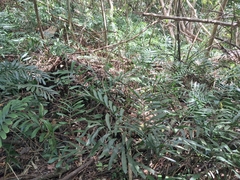 Zamia erosa Zamia Photo: CC BY-SA, Kurt Miller
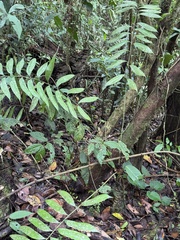 Zamia fairchildiana Zamiaceae Photo: CC BY, chrisdt
 Zamia fischeri Zamiaceae Photo: CC BY-SA, Juan Cruzado Cortés
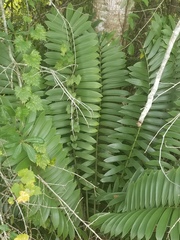 Zamia furfuracea Cardboard palm Photo: CC BY, Nash Turley Zamia herrerae Cycad
 Zamia huilensis Zamiaceae Photo: CC BY, Pompeya Reserva Natural Zamia imperialis Zamiaceae
 Zamia incognita Zamiaceae Photo: CC0, author not stated all 38 ›
Names & registers
Also known as Aulacophyllum skinneri; Palmifolium skinneri; Zamia forgetiana; Zamia skinneri var. latifolia. (GBIF Backbone)
The record
Every figure here is derived from public data by a stated rule and names its source; nothing about this species is written for its page by a person or by AI, apart from the marked, credited quotations. How →
Where this page came from built 2026-10-22
gbif.species answeredasked 2026-10-22gbif.synonyms answeredasked 2026-10-22gbif.vernacular answeredasked 2026-10-22names fetched 2026-10-22wcvp.distribution answeredas of 2026-06-04gbif.occurrences answeredas of 2026-10-21GBIF occurrence download https://doi.org/10.15468/dl.hbdw64, of 2026-10-21; 15 records within 1 km of a botanic garden, herbarium or zoo left out (15 at a botanic garden or arboretum; Wikidata's list)climate nothing to reportasked 2026-10-2237 in-range records, none placed to within 10 kmwikidata answeredasked 2026-10-22wikipedia answeredasked 2026-10-22inat.photos.wild nothing to reportasked 2026-10-22from iNaturalist's open data of 2026-09-27: research-grade observations with an open-licence photograph, the 24 whose photographs iNaturalist received last (the open data holds no votes); filled 2026-10-22inat.photos.cultivated not askedgbif.media nothing to reportasked 2026-10-22commons answeredasked 2026-10-22openalex not askednot yet asked for this reference; a later fill takes the papers from OpenAlex's snapshotEvery source is recorded as having answered, reported nothing, refused, failed, not been asked, or answered twice where one answer is taken (“not taken: two items answered”), and, for a source asked when this page was built, when: the figures are as the source held them that day; a source read from a file (Kew's World Checklist, a GBIF download) says "as of" the file's day instead; a row carried from an earlier build of the page names that build instead. Only “nothing to report” is ever shown as an absence. Records came from 13 datasets via GBIF.org; each carries its own licence.