Cadaba
2 species in the reference · family Capparaceae · 2 with a habitat climate · 2 grown, per iNaturalist
About the genus
Cadaba is a genus of shrubs in family Capparaceae, with about 30 species. These have simple, alternately set leaves. The zygomorphic flowers, are solitary or stand in small clusters at the end of short side branches. These flowers consist of four sepals, none or four petals with a narrow claw at base and a wider plate at the top, a tube-shaped nectar producing appendix, four or five stamens that are merged for about half their length into a so-called androgynophore, and a gynophore on top of which will develop a cylindrical capsule with one or two cavities that contain many small kindney-shaped seeds, and opens with two valves. More on Wikipedia
Quoted from Wikipedia, "Cadaba", its opening paragraph, revision 1372498275, read 2026-11-08, CC BY-SA 4.0.
Where Cadaba is native
| Bangladesh | 1 |
|---|---|
| Botswana | 1 |
| Cape Provinces | 1 |
| Free State | 1 |
| India | 1 |
| Namibia | 1 |
| Northern Provinces | 1 |
| Sri Lanka | 1 |
| Zimbabwe | 1 |
Species native to each region. A species counts in every region it is native to. Native ranges: Kew's World Checklist of Vascular Plants (Govaerts et al., CC BY 4.0), file of 4 June 2026.
2 species
Cadaba
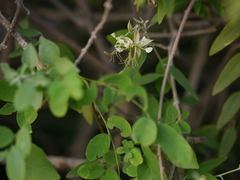 Cadaba fruticosa Indian cadaba Photo: CC BY-SA, Dinesh Valke
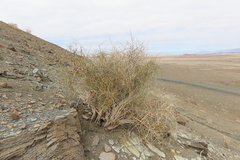 Cadaba aphylla Black-Storm Photo: CC0, dune_ninja
Grown: iNaturalist's observations of the species marked captive or cultivated; "not counted" where the species list does not count it. Native ranges: Kew's World Checklist of Vascular Plants (Govaerts et al., CC BY 4.0), file of 4 June 2026. Grown: iNaturalist's observations marked captive or cultivated, counted 17 October 2026 (the species list's count). Habitat climate known: the species page has a habitat climate, read from CHELSA's monthly climate and NASA POWER's daily extremes at its well-placed wild records inside Kew's native range; each page says its own sources and days. Record low: the lowest night in NASA POWER's daily series at the habitat's typical spot, as the species page gives it, held in °C to a tenth and shown in your units; each page says its own years and day read. Counts as the reference built on 23 November 2026 holds them. The CSV holds every result, not only this page's.