Cephalotaxus
4 species in the reference · family Cephalotaxaceae · 3 with a habitat climate · 4 grown, per iNaturalist
About the genus
Cephalotaxus, commonly called plum-yew or cowtail-pine, is a genus of conifers comprising 11 species, either considered the only member of the family Cephalotaxaceae, or in the Taxaceae when that family is considered in a broad sense. The genus is endemic to eastern Asia, though fossil evidence shows it had a wider Northern Hemisphere distribution in the past. The species are shrubs and small trees reaching 1.0–10 metres (3–33 ft) (rarely to 20 metres (66 ft)) tall.
Quoted from Wikipedia, "Cephalotaxus", its opening paragraph, revision 1372909923, read 2026-11-08, CC BY-SA 4.0.
Where Cephalotaxus is native
| China South-Central | 4 |
|---|---|
| China Southeast | 4 |
| China North-Central | 2 |
| Japan | 2 |
| Korea | 2 |
| Hainan | 1 |
| Myanmar | 1 |
| Taiwan | 1 |
Species native to each region. A species counts in every region it is native to. Native ranges: Kew's World Checklist of Vascular Plants (Govaerts et al., CC BY 4.0), file of 4 June 2026.
4 species
Cephalotaxus
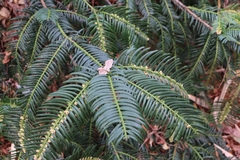 Cephalotaxus harringtonia Japanese plum-yew Photo: CC BY, Liam southwell
 Cephalotaxus fortunei Chinese plum-yew Photo: CC0, Homoarborea
 Cephalotaxus oliveri Oliver's Plum Yew Photo: CC BY, Krzysztof Ziarnek, Kenraiz
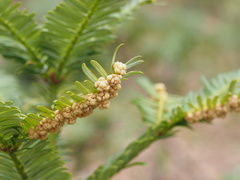 Cephalotaxus nana Photo: CC BY, ITÔ, Hiroki
Grown: iNaturalist's observations of the species marked captive or cultivated; "not counted" where the species list does not count it. Native ranges: Kew's World Checklist of Vascular Plants (Govaerts et al., CC BY 4.0), file of 4 June 2026. Grown: iNaturalist's observations marked captive or cultivated, counted 17 October 2026 (the species list's count). Habitat climate known: the species page has a habitat climate, read from CHELSA's monthly climate and NASA POWER's daily extremes at its well-placed wild records inside Kew's native range; each page says its own sources and days. Record low: the lowest night in NASA POWER's daily series at the habitat's typical spot, as the species page gives it, held in °C to a tenth and shown in your units; each page says its own years and day read. Counts as the reference built on 19 November 2026 holds them. The CSV holds every result, not only this page's.