Cuscuta
17 species in the reference · family Convolvulaceae · 16 with a habitat climate · 13 grown, per iNaturalist, 4 not counted
About the genus
Cuscuta, commonly known as dodder or amarbel, is a genus of over 201 species of yellow, orange, or red (rarely green) parasitic plants. The genus possess minimal chlorophyll and utilize haustoria to extract nutrient and water from host's vascular system. Formerly treated as the only genus in the family Cuscutaceae, it now is accepted as belonging in the morning glory family, Convolvulaceae, on the basis of the work of the Angiosperm Phylogeny Group.
Quoted from Wikipedia, "Cuscuta", its opening paragraph, revision 1360501316, read 2026-11-08, CC BY-SA 4.0.
Where Cuscuta is native
| Kazakhstan | 6 |
|---|---|
| Xinjiang | 6 |
| China North-Central | 5 |
| China South-Central | 5 |
| Inner Mongolia | 5 |
| Iran | 5 |
| Kirgizistan | 5 |
| Manchuria | 5 |
| Mexico Northwest | 5 |
| Tadzhikistan | 5 |
| Afghanistan | 4 |
| Arizona | 4 |
Species native to each region. A species counts in every region it is native to. Native ranges: Kew's World Checklist of Vascular Plants (Govaerts et al., CC BY 4.0), file of 4 June 2026.
17 species
Cuscuta
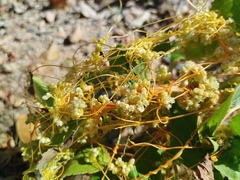 Cuscuta campestris Yellow dodder Photo: CC BY-SA, TOURDERA
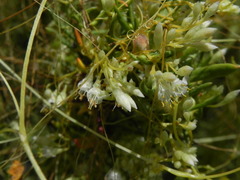 Cuscuta californica California dodder Photo: CC BY-SA, James C. Davis
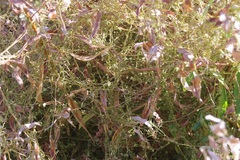 Cuscuta europaea Greater dodder Photo: CC BY, bernhard_hiller
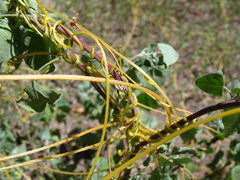 Cuscuta chinensis Chinese dodder Photo: CC BY, Alexis López Hernández
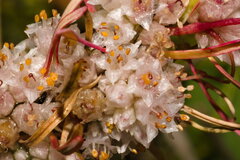 Cuscuta epithymum Clover dodder Photo: CC BY, Bobo-X
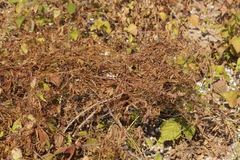 Cuscuta lupuliformis Hop dodder Photo: CC BY-SA, Björn Sothmann
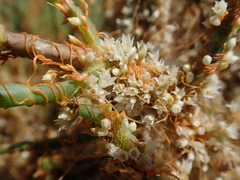 Cuscuta pacifica Large saltmarsh dodder Photo: CC BY, joergmlpts
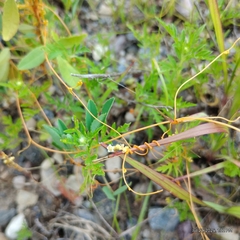 Cuscuta pentagona Five-angled dodder Photo: CC BY, Bryce
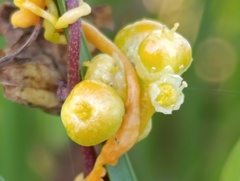 Cuscuta australis Australian dodder Photo: CC BY, Augustin Soulard
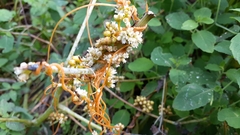 Cuscuta gronovii Scaldweed Photo: CC BY, Quinten Wiegersma
 Cuscuta japonica Japanese dodder Photo: CC BY, Repina Tatyana
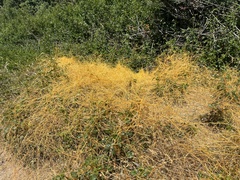 Cuscuta subinclusa Behr Canyon Dodder Photo: CC0, Chuck Wilson
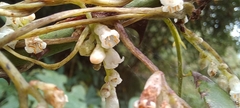 Cuscuta reflexa Giant dodder Photo: CC BY, Ramnarayan K
 Cuscuta epilinum Flax dodder Photo: Public domain, Steve Hurst @ USDA-NRCS PLANTS Database…
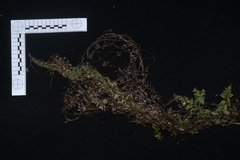 Cuscuta grandiflora Photo: CC BY, Jhon A. Yuca-Palomino
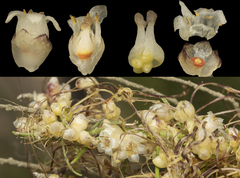 Cuscuta odorata Photo: CC BY, Pablo Silva
- no open photograph on file Cuscuta platyloba
Grown: iNaturalist's observations of the species marked captive or cultivated; "not counted" where the species list does not count it. Native ranges: Kew's World Checklist of Vascular Plants (Govaerts et al., CC BY 4.0), file of 4 June 2026. Grown: iNaturalist's observations marked captive or cultivated, counted 17 October 2026 (the species list's count). Habitat climate known: the species page has a habitat climate, read from CHELSA's monthly climate and NASA POWER's daily extremes at its well-placed wild records inside Kew's native range; each page says its own sources and days. Record low: the lowest night in NASA POWER's daily series at the habitat's typical spot, as the species page gives it, held in °C to a tenth and shown in your units; each page says its own years and day read. Counts as the reference built on 19 November 2026 holds them. The CSV holds every result, not only this page's.