Cymbidium
36 species in the reference · family Orchidaceae · 25 with a habitat climate · 34 grown, per iNaturalist, 2 not counted
About the genus
Cymbidium , commonly known as boat orchids, is a genus of evergreen flowering plants in the orchid family Orchidaceae. Orchids in this genus are epiphytic, lithophytic, terrestrial or rarely leafless saprophytic herbs usually with pseudobulbs. There are usually between three and twelve leaves arranged in two ranks on each pseudobulb or shoot and lasting for several years. From one to a large number of flowers are arranged on an unbranched flowering stem arising from the base of the pseudobulb. More on Wikipedia
Quoted from Wikipedia, "Cymbidium", its opening paragraph, revision 1354640765, read 2026-11-08, CC BY-SA 4.0.
Where Cymbidium is native
| China South-Central | 26 |
|---|---|
| Myanmar | 23 |
| Vietnam | 23 |
| Assam | 17 |
| East Himalaya | 16 |
| Thailand | 16 |
| China Southeast | 13 |
| Nepal | 11 |
| Tibet | 11 |
| Hainan | 10 |
| Taiwan | 10 |
| Laos | 9 |
Species native to each region. A species counts in every region it is native to. Native ranges: Kew's World Checklist of Vascular Plants (Govaerts et al., CC BY 4.0), file of 4 June 2026.
36 species
Cymbidium
 Cymbidium ensifolium Fukien-orchid Photo: CC BY, Fanghong
 Cymbidium sinense Photo: CC BY-SA, Averater
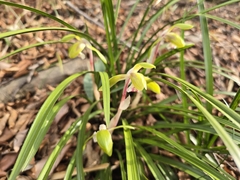 Cymbidium goeringii Goering’s cymbidium Photo: CC BY, WATANABE Hitoshi 渡辺仁
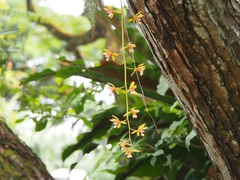 Cymbidium finlaysonianum Finlayson's Cymbidium Photo: CC BY, Michael Berardozzi
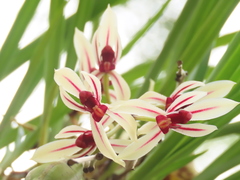 Cymbidium dayanum Day's Cymbidium Photo: CC BY, chiuluan
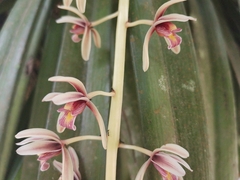 Cymbidium aloifolium Photo: CC BY, Cheryl Stinchcomb
 Cymbidium lowianum Photo: CC0, Dinkum
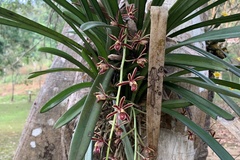 Cymbidium bicolor Two-Colored Cymbidium Photo: CC BY, Apichart Songsangchun
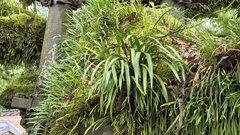 Cymbidium floribundum Photo: CC BY, Genevieve Early
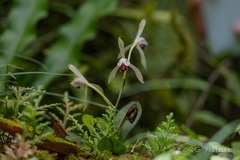 Cymbidium lancifolium Bamboo-leaf orchid Photo: CC BY, Wang.QG
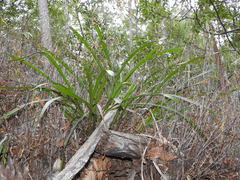 Cymbidium madidum Arrowroot Orchid Photo: CC BY-SA, Greg Tasney
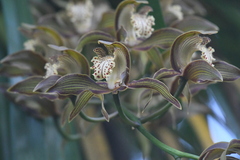 Cymbidium tracyanum Photo: CC BY, Tristan Jobin
 Cymbidium kanran Hanran Photo: CC BY-SA, Keisotyo
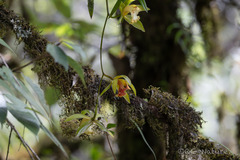 Cymbidium hookerianum Photo: CC BY, Wang.QG
 Cymbidium faberi Photo: CC BY-SA, 阿橋 HQ
 Cymbidium tortisepalum Photo: CC BY-SA, Kuo-Chu Yueh
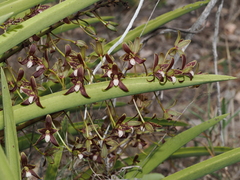 Cymbidium canaliculatum Channelled boat-lip orchid Photo: CC BY, Thomas Mesaglio
 Cymbidium iridioides Photo: CC BY-SA, Eric in SF
- no open photograph on file Cymbidium maguanense
 Cymbidium erythraeum Photo: CC BY-SA, Eric in SF
 Cymbidium insigne Photo: CC BY-SA, David J. Stang
 Cymbidium eburneum Photo: CC BY-SA, David J. Stang
 Cymbidium erythrostylum Photo: CC BY, Motohiro Sunouchi
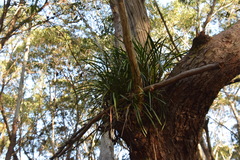 Cymbidium suave Snake orchid Photo: CC BY, Thomas Mesaglio
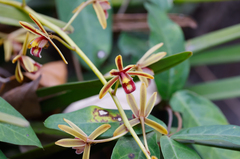 Cymbidium crassifolium Photo: CC BY, Thomas Galewski
 Cymbidium haematodes Photo: CC BY-SA, Pieter Prins
- no open photograph on file Cymbidium serratum
 Cymbidium atropurpureum Photo: CC BY, Alex Lomas
 Cymbidium chloranthum Photo: CC BY, snotch from Sapporo, Hokkaido, Japan
 Cymbidium devonianum Photo: CC BY-SA, Arne and Bent Larsen, Haarby, Denmark
 Cymbidium mastersii Photo: CC BY-SA, Yercaud-elango
- no open photograph on file Cymbidium suavissimum
 Cymbidium elegans Photo: CC BY-SA, 阿橋 HQ
 Cymbidium tigrinum Photo: CC BY-SA, 阿橋 HQ
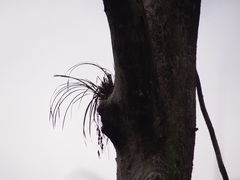 Cymbidium cochleare Photo: CC BY, 呂一起(Lyu yi-chi)
- no open photograph on file Cymbidium whiteae
Grown: iNaturalist's observations of the species marked captive or cultivated; "not counted" where the species list does not count it. Native ranges: Kew's World Checklist of Vascular Plants (Govaerts et al., CC BY 4.0), file of 4 June 2026. Grown: iNaturalist's observations marked captive or cultivated, counted 17 October 2026 (the species list's count). Habitat climate known: the species page has a habitat climate, read from CHELSA's monthly climate and NASA POWER's daily extremes at its well-placed wild records inside Kew's native range; each page says its own sources and days. Record low: the lowest night in NASA POWER's daily series at the habitat's typical spot, as the species page gives it, held in °C to a tenth and shown in your units; each page says its own years and day read. Counts as the reference built on 19 November 2026 holds them. The CSV holds every result, not only this page's.