Hesperaloe
8 species in the reference · family Asparagaceae · 4 with a habitat climate · 5 grown, per iNaturalist, 3 not counted
About the genus
Hesperaloe (false yucca) is a genus of flowering plants in the family Asparagaceae, subfamily Agavoideae. It contains perennial yucca-like plants with long, narrow leaves produced in a basal rosette and flowers borne on long panicles or racemes. The species are native to the arid parts of Texas in the United States and Mexico and are sometimes cultivated as xerophytic ornamental plants.
Quoted from Wikipedia, "Hesperaloe", its opening paragraph, revision 1382926781, read 2026-11-08, CC BY-SA 4.0.
Where Hesperaloe is native
| Mexico Northeast | 5 |
|---|---|
| Texas | 3 |
| Mexico Northwest | 2 |
Species native to each region. A species counts in every region it is native to. Native ranges: Kew's World Checklist of Vascular Plants (Govaerts et al., CC BY 4.0), file of 4 June 2026.
8 species
Hesperaloe
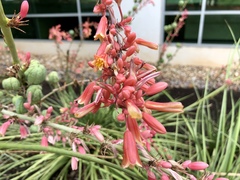 Hesperaloe parviflora Red hesperaloe Photo: CC BY, Sue Ann Kendall
 Hesperaloe funifera New Mexico false yucca Photo: CC BY, CK2AZ
 Hesperaloe nocturna Night-blooming hesperaloe Photo: CC BY-SA, Raffi Kojian
 Hesperaloe campanulata Photo: CC BY-SA, Francisco Martínez González
 Hesperaloe chiangii Photo: CC BY-SA, Fritz Hochstätter
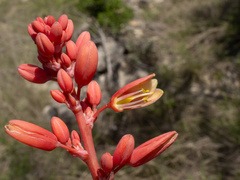 Hesperaloe engelmannii Photo: CC BY-SA, Turner Brockman
 Hesperaloe malacophylla Soft-Leaved Hesperaloe Photo: CC BY-SA, Fritz Hochstätter
- no open photograph on file Hesperaloe tenuifolia
Grown: iNaturalist's observations of the species marked captive or cultivated; "not counted" where the species list does not count it. Native ranges: Kew's World Checklist of Vascular Plants (Govaerts et al., CC BY 4.0), file of 4 June 2026. Grown: iNaturalist's observations marked captive or cultivated, counted 17 October 2026 (the species list's count). Habitat climate known: the species page has a habitat climate, read from CHELSA's monthly climate and NASA POWER's daily extremes at its well-placed wild records inside Kew's native range; each page says its own sources and days. Record low: the lowest night in NASA POWER's daily series at the habitat's typical spot, as the species page gives it, held in °C to a tenth and shown in your units; each page says its own years and day read. Counts as the reference built on 19 November 2026 holds them. The CSV holds every result, not only this page's.