Hippeastrum
22 species in the reference · family Amaryllidaceae · 15 with a habitat climate · 22 grown, per iNaturalist
About the genus
Hippeastrum is a genus of 116 species, and over 600 hybrids and cultivars, of perennial, herbaceous and bulbous plants, native to tropical and subtropical regions of the Americas, from Mexico south to Argentina and on some islands in the Caribbean. The majority have large, fleshy bulbs and tall, broad, strap-like leaves that are (generally) evergreen, and large red or purple flowers. Numerous colors and cultivars have been created over the past hundred years.
Quoted from Wikipedia, "Hippeastrum", its opening paragraph, revision 1365881933, read 2026-11-08, CC BY-SA 4.0.
Where Hippeastrum is native
| Brazil Southeast | 10 |
|---|---|
| Bolivia | 9 |
| Brazil Northeast | 8 |
| Brazil South | 8 |
| Peru | 6 |
| Argentina Northeast | 5 |
| Brazil West-Central | 4 |
| Argentina Northwest | 3 |
| Guyana | 3 |
| Colombia | 2 |
| Paraguay | 2 |
| Surinam | 2 |
Species native to each region. A species counts in every region it is native to. Native ranges: Kew's World Checklist of Vascular Plants (Govaerts et al., CC BY 4.0), file of 4 June 2026.
22 species
Hippeastrum
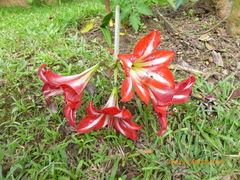 Hippeastrum puniceum Photo: CC BY, Daniel A. Monsalve Ortiz
 Hippeastrum reticulatum Netted-veined amaryllis Photo: CC BY, Jeremy Gilmore
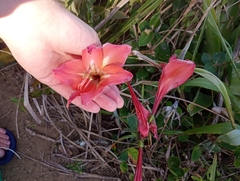 Hippeastrum striatum Striped Barbados lily Photo: CC0, Lucas Rodrigues
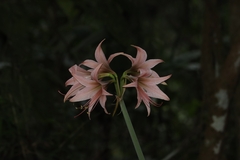 Hippeastrum stylosum Photo: CC BY, Inacio Oliveira
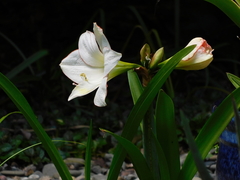 Hippeastrum reginae Mexican Lily Photo: CC BY, Michael J. Papay
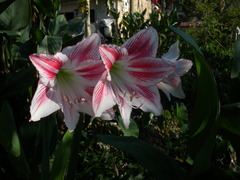 Hippeastrum vittatum Photo: CC0, Alfredo F. Fuentes Claros
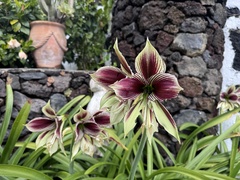 Hippeastrum papilio Butterfly Amaryllis Photo: CC BY, Enrico Tomschke
- no open photograph on file Hippeastrum peruvianum
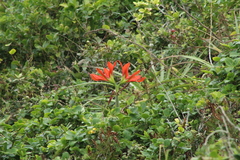 Hippeastrum aulicum Lily-of-the-palace Photo: CC BY, Paulo C. O. Cunha
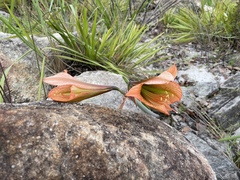 Hippeastrum glaucescens Photo: CC BY, B. Phalan
 Hippeastrum cybister Photo: CC BY, CaracalShan
 Hippeastrum petiolatum Photo: CC BY, Leonel Roget
 Hippeastrum correiense Photo: CC BY-SA, Jim Evans
 Hippeastrum morelianum Photo: CC BY, Ronald Péret
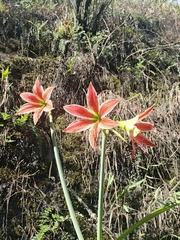 Hippeastrum lapacense Photo: CC0, Alfredo F. Fuentes Claros
- no open photograph on file Hippeastrum evansiarum
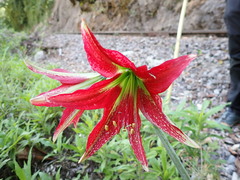 Hippeastrum machupijchense Photo: CC BY, Skjold Søndergaard
 Hippeastrum calyptratum Photo: CC BY, Diogo Luiz
 Hippeastrum elegans Photo: CC BY, Loren Cassin Sackett
 Hippeastrum pardinum Photo: CC BY, Averater
- no open photograph on file Hippeastrum psittacinum
 Hippeastrum argentinum Photo: CC BY, Gonzalo Martinez
Grown: iNaturalist's observations of the species marked captive or cultivated; "not counted" where the species list does not count it. Native ranges: Kew's World Checklist of Vascular Plants (Govaerts et al., CC BY 4.0), file of 4 June 2026. Grown: iNaturalist's observations marked captive or cultivated, counted 17 October 2026 (the species list's count). Habitat climate known: the species page has a habitat climate, read from CHELSA's monthly climate and NASA POWER's daily extremes at its well-placed wild records inside Kew's native range; each page says its own sources and days. Record low: the lowest night in NASA POWER's daily series at the habitat's typical spot, as the species page gives it, held in °C to a tenth and shown in your units; each page says its own years and day read. Counts as the reference built on 19 November 2026 holds them. The CSV holds every result, not only this page's.