Iberis
13 species in the reference · family Brassicaceae · 13 with a habitat climate · 13 grown, per iNaturalist
About the genus
Iberis ( eye-BEER-iss), commonly called candytuft, is a genus of flowering plants belonging to the family Brassicaceae. It comprises annuals, evergreen perennials and subshrubs native to the Old World. Species are native to the Mediterranean basin (southern Europe and North Africa), Western Asia, the Caucasus, and western Europe. The name "candytuft" is not related to candy, but derives from Candia, the former name of Iraklion on the island of Crete.
Quoted from Wikipedia, "Iberis", its opening paragraph, revision 1369297991, read 2026-11-08, CC BY-SA 4.0.
Where Iberis is native
| Spain | 10 |
|---|---|
| France | 8 |
| Italy | 7 |
| Yugoslavia | 6 |
| Morocco | 5 |
| Greece | 4 |
| Albania | 3 |
| Krym | 3 |
| Portugal | 3 |
| Switzerland | 3 |
| Turkey | 3 |
| Bulgaria | 2 |
Species native to each region. A species counts in every region it is native to. Native ranges: Kew's World Checklist of Vascular Plants (Govaerts et al., CC BY 4.0), file of 4 June 2026.
13 species
Iberis
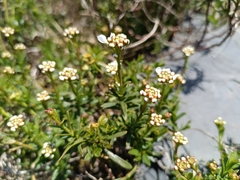 Iberis sempervirens Evergreen candytuft Photo: CC BY, Michal Honskus
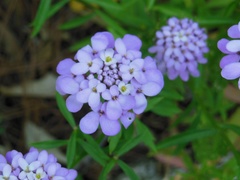 Iberis umbellata Globe candytuft Photo: CC BY, Neptalí Ramírez Marcial
 Iberis amara Wild candytuft Photo: CC0, Quentin Groom
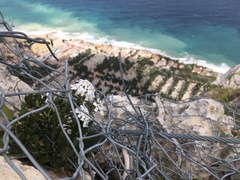 Iberis semperflorens Photo: CC BY, Sylvain Eichhorn
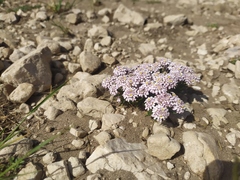 Iberis saxatilis Photo: CC BY, Josip Skejo
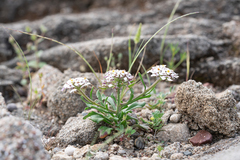 Iberis carnosa Pruit's candytuft Photo: CC BY, Eleftherios Katsillis
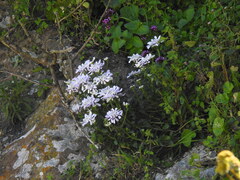 Iberis gibraltarica Gibraltar candytuft Photo: CC BY, Duarte Frade
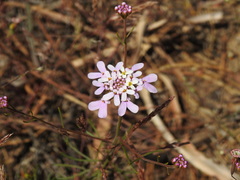 Iberis ciliata Photo: CC BY, Duarte Frade
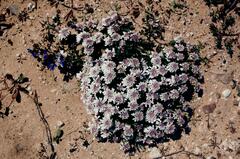 Iberis procumbens Photo: CC BY, zebedeugalinha
 Iberis simplex Photo: CC BY, Сергей Крыленко
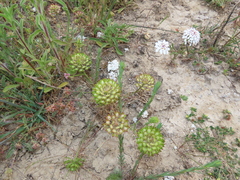 Iberis pectinata Photo: CC BY, Juan C. Espinosa
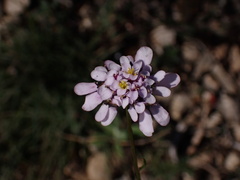 Iberis linifolia Candytuft Photo: CC BY-SA, Fabien Piednoir
 Iberis pinnata Winged Candytuft Photo: CC BY, Thomas Koffel
Grown: iNaturalist's observations of the species marked captive or cultivated; "not counted" where the species list does not count it. Native ranges: Kew's World Checklist of Vascular Plants (Govaerts et al., CC BY 4.0), file of 4 June 2026. Grown: iNaturalist's observations marked captive or cultivated, counted 17 October 2026 (the species list's count). Habitat climate known: the species page has a habitat climate, read from CHELSA's monthly climate and NASA POWER's daily extremes at its well-placed wild records inside Kew's native range; each page says its own sources and days. Record low: the lowest night in NASA POWER's daily series at the habitat's typical spot, as the species page gives it, held in °C to a tenth and shown in your units; each page says its own years and day read. Counts as the reference built on 19 November 2026 holds them. The CSV holds every result, not only this page's.