Radermachera
5 species in the reference · family Bignoniaceae · 2 with a habitat climate · 5 grown, per iNaturalist
About the genus
Radermachera is a genus of about 17 species of flowering plants in the family Bignoniaceae, native to southeastern Asia. They are evergreen trees reaching 5–40 m tall, with bipinnate to tripinnate leaves, and panicles of large bell-shaped, white, pink, pale purple or yellow flowers 5–7 cm diameter.
Quoted from Wikipedia, "Radermachera", its opening paragraph, revision 1321941647, read 2026-11-08, CC BY-SA 4.0.
Where Radermachera is native
| China South-Central | 3 |
|---|---|
| Thailand | 3 |
| China Southeast | 2 |
| Malaya | 2 |
| Vietnam | 2 |
| Assam | 1 |
| Borneo | 1 |
| Cambodia | 1 |
| East Himalaya | 1 |
| Hainan | 1 |
| Laos | 1 |
| Maluku | 1 |
Species native to each region. A species counts in every region it is native to. Native ranges: Kew's World Checklist of Vascular Plants (Govaerts et al., CC BY 4.0), file of 4 June 2026.
5 species
Radermachera
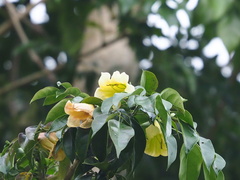 Radermachera hainanensis Photo: CC0, 葉子
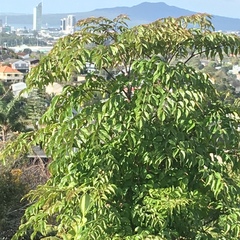 Radermachera sinica China doll plant Photo: CC0, Jenny Christianson
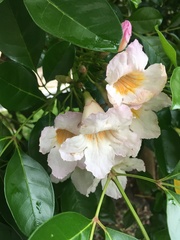 Radermachera peninsularis Photo: CC BY-SA, chen ying-hsiao
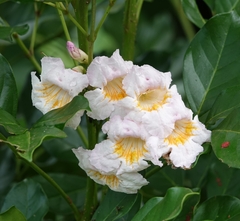 Radermachera yunnanensis Kunming Tree Jasmine Photo: CC0, MadMagpie
 Radermachera quadripinnata Photo: CC BY, Samuel Lee
Grown: iNaturalist's observations of the species marked captive or cultivated; "not counted" where the species list does not count it. Native ranges: Kew's World Checklist of Vascular Plants (Govaerts et al., CC BY 4.0), file of 4 June 2026. Grown: iNaturalist's observations marked captive or cultivated, counted 17 October 2026 (the species list's count). Habitat climate known: the species page has a habitat climate, read from CHELSA's monthly climate and NASA POWER's daily extremes at its well-placed wild records inside Kew's native range; each page says its own sources and days. Record low: the lowest night in NASA POWER's daily series at the habitat's typical spot, as the species page gives it, held in °C to a tenth and shown in your units; each page says its own years and day read. Counts as the reference built on 19 November 2026 holds them. The CSV holds every result, not only this page's.