Scolymus
3 species in the reference · family Asteraceae · 3 with a habitat climate · 3 grown, per iNaturalist
About the genus
Scolymus is a genus of annual, biennial or perennial, herbaceous plants that is assigned to the family Asteraceae, and can be found in Macaronesia, around the Mediterranean, and in the Middle East. All species are spiny, thistle-like in appearance, with flowerheads that consist of yellow (rarely orange or white) ligulate florets, and canals that contain latex. It is sometimes called golden thistle or oyster thistle, and is known as سكوليمس (skwlyms) in Arabic and scolyme in French.
Quoted from Wikipedia, "Scolymus", its opening paragraph, revision 1250770825, read 2026-11-08, CC BY-SA 4.0.
Where Scolymus is native
| Algeria | 3 |
|---|---|
| Baleares | 3 |
| Canary Is. | 3 |
| East Aegean Is. | 3 |
| France | 3 |
| Italy | 3 |
| Lebanon-Syria | 3 |
| Libya | 3 |
| Morocco | 3 |
| Sardegna | 3 |
| Sicilia | 3 |
| Tunisia | 3 |
Species native to each region. A species counts in every region it is native to. Native ranges: Kew's World Checklist of Vascular Plants (Govaerts et al., CC BY 4.0), file of 4 June 2026.
3 species
Scolymus
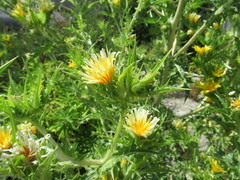 Scolymus hispanicus Golden thistle Photo: CC BY, Crap Fou
 Scolymus grandiflorus Large-flowered Golden Thistle Photo: CC BY, Mario Bassini
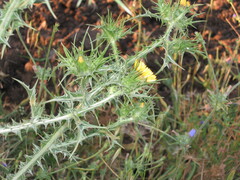 Scolymus maculatus Spotted golden thistle Photo: CC BY, zebedeugalinha
Grown: iNaturalist's observations of the species marked captive or cultivated; "not counted" where the species list does not count it. Native ranges: Kew's World Checklist of Vascular Plants (Govaerts et al., CC BY 4.0), file of 4 June 2026. Grown: iNaturalist's observations marked captive or cultivated, counted 17 October 2026 (the species list's count). Habitat climate known: the species page has a habitat climate, read from CHELSA's monthly climate and NASA POWER's daily extremes at its well-placed wild records inside Kew's native range; each page says its own sources and days. Record low: the lowest night in NASA POWER's daily series at the habitat's typical spot, as the species page gives it, held in °C to a tenth and shown in your units; each page says its own years and day read. Counts as the reference built on 19 November 2026 holds them. The CSV holds every result, not only this page's.