
Felicia elongata (Thunb.) O.Hoffm.
Saldanha Bay Daisy; Saldanha Felicia; Tricolor Felicia
Cited as Kew's World Checklist cites it, Felicia elongata (Thunb.) O.Hoffm.: GBIF's backbone key for this page carries the name with another author, (Thunb.) O.Hoffm. ex Zahlbr.
 53 photographs ›
At a glance
- Jan, shaded
- Feb, shaded
- Mar, shaded
- Apr
- May
- Jun
- Jul
- Aug
- Sep
- Oct
- Nov, shaded
- Dec, shaded
Summary
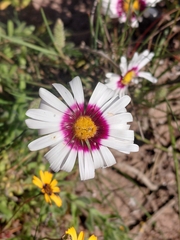
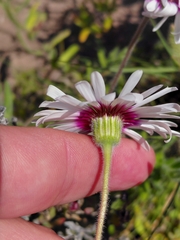
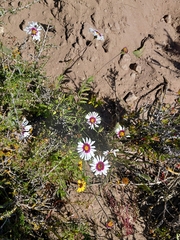
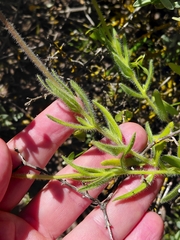
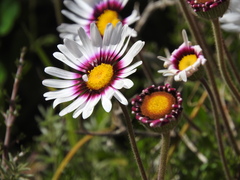
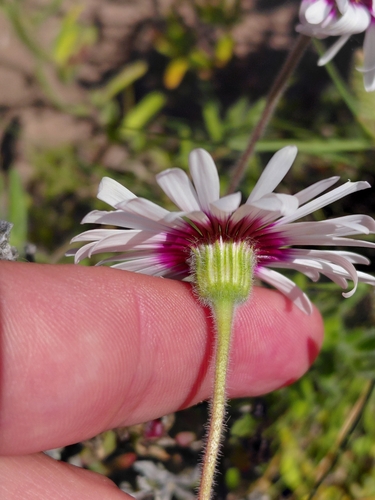
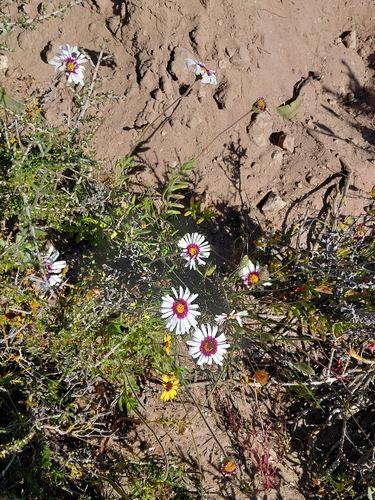
Felicia elongata is a perennial plant of up to 40 cm (1+1⁄3 ft) high that is assigned to the family Asteraceae. It has stiff, oval, opposing leaves with one distinctive vein and entire margin. The 5 cm (2 in) wide flower heads are very conspicuous in colour, white with a dark purple zone at the base of the ray florets and an orange-yellow disc. Flowering occurs from late August to September, or if the rains arrive late, sometimes October. More on Wikipedia ›
Quoted from Wikipedia, "Felicia elongata", CC BY-SA 4.0.
About the genus · Felicia
The name Felicia derives from the Latin adjective felix, meaning "happy, lucky", though in the neuter plural form felicia it literally means "happy things" and often occurred in the phrase tempora felicia, "happy times". The sense of it as a feminine personal name appeared in post-Classical use and is of uncertain origin. It is associated with saints, poets, astronomical objects, plant genera, fictional characters, and animals, especially cats.
Quoted from Wikipedia, "Felicia", CC BY-SA 4.0.
Cultivation
Seasons
The rain rule reads a winter growing season: 70% of the median year's rain (231 mm of 318 mm) falls in May to September, cooler than the year (wet-season mean 14.4 °C against a yearly mean of 16.3 °C). Months are the habitat's, southern hemisphere; shifted six months for a northern-hemisphere collection: November to March.
Rain
318 mm in the median year at the habitat, 231 mm of it May to September. Wettest months (2 at 56 mm), driest month February at 7 mm. Across the grid cells of the range the year's total runs 276 mm to 342 mm, the 10th to 90th percentile of each cell's own year. The median of the cells' own yearly totals, 316 mm, is the year's rain at the top of the page; the 318 mm here is the median year's, the twelve monthly medians added, which the rain rule reads. Habitat calendar, southern hemisphere; median year across the grid cells of the range, CHELSA.
Light
Open sky over the habitat: 17 to 54 mol/m²/day across the year (daily light integral, median year across the grid cells of the range, CHELSA).
Warmth and air
Coldest: the 1st-percentile night over 44 years at a typical spot in the range is 7.3 °C, the absolute minimum 4.8 °C, no frost in 44 years (NASA POWER daily minima). Warmest: the 99th-percentile day is 31.6 °C. Monthly means: the coldest month's mean nightly low 11.7 °C in July (across the grid cells of the range 10.4 °C to 12.6 °C), the warmest month's mean daily high 21.1 °C in February (median year across the grid cells of the range, CHELSA). Cold floor: 7.3 °C, which is the 1st-percentile night over 44 years at a typical spot in the range (NASA POWER).
Relative humidity at the habitat: 59 to 64% across the year (monthly means, median year across the grid cells of the range, CHELSA). A figure about the air, saying nothing about how the plant takes water.
How this section is made
Each card states this species' habitat figures with their sources, and what two fixed rules read from them; nothing here says what the plant does, wants or tolerates. The rules · the terms.
Seasons. Read from the median year of CHELSA monthly rainfall and mean temperature across the grid cells of the range: the rain rule takes the smallest set of months carrying 70% of the rain and calls it winter when its mean is more than half a degree below the year's, summer when more than that above, and neither in between; the temperature rule, used only under 120 mm, names the cooler six months when they are at least a degree cooler than the other six. Months are shifted for the other hemisphere only where the temperature curve moves 4 °C or more and the habitat lies 10° or more from the equator. A reading of the curves, not an observation of the plant.
Rain. CHELSA monthly precipitation, median year across the grid cells of the range. The rain that falls where the species is recorded; nothing about how the plant takes water.
Light. CHELSA shortwave radiation at each envelope cell, a daily-mean flux taken to a daily total and converted at 2.07 mol of PAR per MJ. The sky over the habitat, measured; what reaches a plant under a rock, a shrub or a shade cloth is not.
Temperature. NASA POWER daily minima and maxima over 44 years at a typical spot in the range, lapse-corrected -1 m to its elevation; CHELSA monthly means, median year across the grid cells of the range. The cold floor is the 1st-percentile night named in its sentence. Not a measured survival limit for any plant in a pot.
Humidity. CHELSA relative humidity, median year across the grid cells of the range.
Climate across the habitat
Habitat months, southern hemisphere
Mean daily high from 16 °C in Jun, Jul and Aug to 21 °C in Jan and Feb; mean nightly low from 12 °C in Jun, Jul and Aug to 17 °C in Jan and Feb. The cold quarter, Jun to Aug, is the three months around the coldest month's mean nightly low, centred on the 3 months in a row that tie for it. 318 mm of rain in the median year (the twelve monthly medians added), the wettest months (2 at 56 mm). The bands show the 10th to 90th percentile across 16 habitat cells. Over 44 years at a typical spot in the range (NASA POWER) the absolute minimum was 4.8 °C and the 99th-percentile day 31.6 °C; neither is dated to a month. Beneath: daily light integral and relative humidity through the year, each on its own scale.
Figures by month
| Figure | Jan | Feb | Mar | Apr | May | Jun | Jul | Aug | Sep | Oct | Nov | Dec |
|---|---|---|---|---|---|---|---|---|---|---|---|---|
| Day °C | 21 / 19–23 | 21 / 19–24 | 20 / 19–23 | 19 / 17–21 | 18 / 17–19 | 16 / 16–17 | 16 / 15–16 | 16 / 15–17 | 17 / 16–18 | 18 / 17–20 | 19 / 17–21 | 20 / 19–23 |
| Night °C | 17 / 17–17 | 17 / 17–17 | 16 / 16–16 | 15 / 14–15 | 14 / 13–14 | 12 / 11–13 | 12 / 10–13 | 12 / 11–13 | 13 / 12–13 | 14 / 13–14 | 15 / 14–15 | 16 / 16–17 |
| Rain mm | 8 / 6–9 | 7 / 7–8 | 11 / 9–12 | 25 / 22–27 | 42 / 37–46 | 56 / 49–60 | 56 / 49–61 | 45 / 39–48 | 32 / 28–34 | 15 / 13–16 | 12 / 10–13 | 9 / 8–10 |
| DLI | 54 / 54–54 | 48 / 48–48 | 39 / 39–39 | 28 / 28–28 | 20 / 20–21 | 17 / 17–17 | 18 / 18–19 | 24 / 24–24 | 32 / 32–33 | 43 / 42–43 | 50 / 50–50 | 54 / 53–54 |
| RH % | 63 / 61–66 | 64 / 62–66 | 64 / 62–66 | 63 / 62–64 | 62 / 61–62 | 59 | 59 | 61 / 60–61 | 62 / 61–62 | 62 / 60–63 | 62 / 60–64 | 63 / 60–65 |
How this section is made
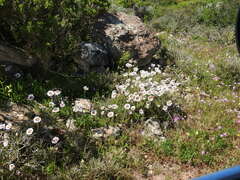
Natural habitat
How this section is made
Photographs

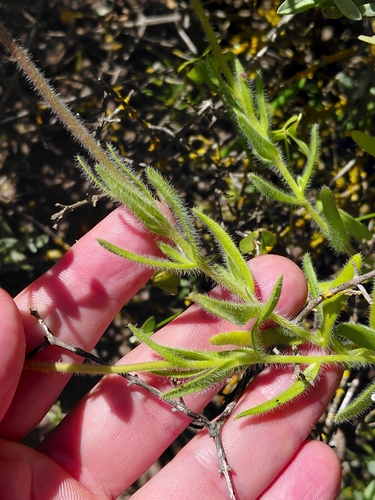
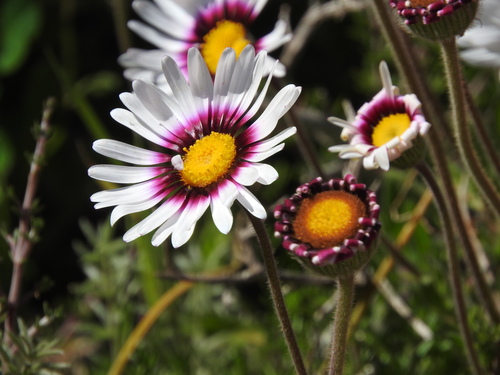
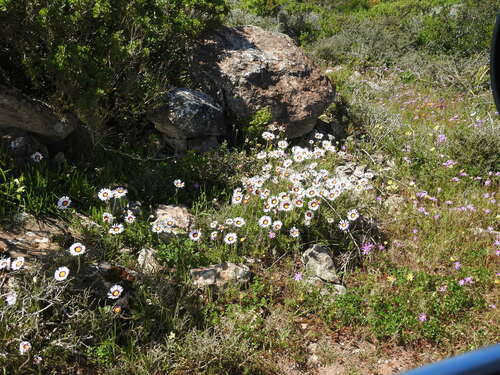
Photographs: (c) Brian du Preez, some rights reserved (CC BY-SA) (4); (c) Noeleen du Toit, some rights reserved (CC BY-SA) (2).
Related
Similar habitat climate The 6 nearest by mean daily high, mean nightly low and rain, month by month. How.
 Aloe distans Goldtooth Aloe Photo: CC BY-SA, Deon van Eeden
 Oscularia vredenburgensis Vredenberg Toothfig Photo: CC BY, Jeremy Gilmore
 Antimima limbata Framed Matfig Photo: CC BY, Mahomed Desai
 Daubenya zeyheri Lime Crownlily Photo: CC BY, Jeremy Gilmore
 Romulea saldanhensis Cadmium Froetang Photo: CC BY-SA, Tony Rebelo
 Cheiridopsis rostrata Beaked Clockfig Photo: CC BY, Morten Ross
Other Felicia 14 in the reference
 Felicia aethiopica African Felicia Photo: CC BY, Adele SL
 Felicia amelloides Blue marguerite Photo: CC BY, Jared Zachary Herman
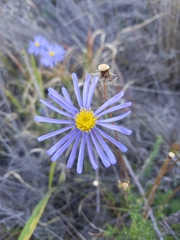 Felicia amoena Soft Felicia Photo: CC BY, Christiaan Viljoen
 Felicia bergeriana Kingfisher daisy Photo: CC BY-SA, Noeleen du Toit
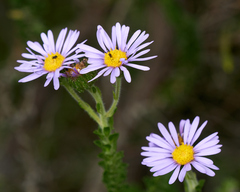 Felicia echinata Dune Felicia Photo: CC BY, Glynn Morris
 Felicia erigeroides Michaelmas Felicia Photo: CC BY, Andreas De Beer
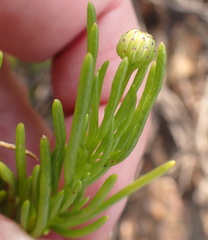 Felicia filifolia Fine Felicia Photo: CC BY-SA, Nicola van Berkel
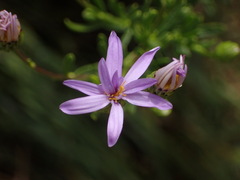 Felicia fruticosa Bush Felicia Photo: CC BY, Cricket Raspet
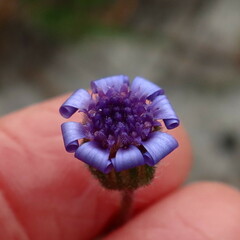 Felicia heterophylla Pureblue Felicia Photo: CC BY, Diana Studer
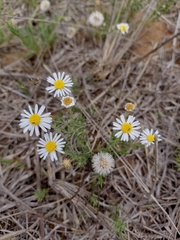 Felicia muricata Pale Felicia Photo: CC BY-SA, Brian du Preez
 Felicia petiolata Lesotho Felicia Photo: CC BY-SA, yakovlev.alexey from Moscow, Russia
 Felicia rosulata Natal Felicia Photo: CC BY-SA, Steve Law all 15 ›
Names & registers
Also known as Agathaea elongata; Agathaea tricolor; Aster elongatus; Aster elongatus var. thunbergii; Aster tricolor and 1 more. (GBIF Backbone)
The record
Every figure here is derived from public data by a stated rule and names its source; nothing about this species is written for its page by a person or by AI, apart from the marked, credited quotations. How →
Where this page came from built 2026-10-22
gbif.species answeredasked 2026-10-22GBIF's key 5401190 is Felicia elongata (Thunb.) O.Hoffm. ex Zahlbr.; the page links Kew's Felicia elongata (Thunb.) O.Hoffm., and the name is cited as Kew cites itgbif.synonyms answeredasked 2026-10-22gbif.vernacular answeredasked 2026-10-22names fetched 2026-10-22wcvp.distribution answeredas of 2026-06-04gbif.occurrences answeredasked 2026-10-22GBIF occurrence download https://doi.org/10.15468/dl.hbdw64, of 2026-10-21; 1 record of GBIF's key 7537208, Felicia elongata (Thunb.) O.Hoffm. ex O.Hoffm., 1905 (Kew's file holds it as Felicia elongata (Thunb.) O.Hoffm. (accepted)): GBIF occurrence search API; 3 records within 1 km of a botanic garden, herbarium or zoo left out (3 at a botanic garden or arboretum; Wikidata's list)climate answeredasked 2026-10-22climate.extremes answeredasked 2026-10-22NASA POWER (MERRA-2) daily 1981–2024, cell -33.00_18.125, lapse-corrected -1 m at 6.5 °C/kmwikidata answeredasked 2026-10-22wikipedia answeredasked 2026-10-22inat.photos.wild answeredasked 2026-10-22from iNaturalist's open data of 2026-09-27: research-grade observations with an open-licence photograph, the 24 whose photographs iNaturalist received last (the open data holds no votes); filled 2026-10-22inat.photos.cultivated not askedgbif.media answeredasked 2026-10-22none of the photographs on this page is credited to GBIF: those shown are other sources', and GBIF's were the same photographs or were set aside by the photograph rulesopenalex not askednot yet asked for this reference; a later fill takes the papers from OpenAlex's snapshotEvery source is recorded as having answered, reported nothing, refused, failed, not been asked, or answered twice where one answer is taken (“not taken: two items answered”), and, for a source asked when this page was built, when: the figures are as the source held them that day; a source read from a file (Kew's World Checklist, a GBIF download) says "as of" the file's day instead; a row carried from an earlier build of the page names that build instead. Only “nothing to report” is ever shown as an absence. Records came from 7 datasets via GBIF.org; each carries its own licence.