Anigozanthos
8 species in the reference · family Haemodoraceae · 8 with a habitat climate · 8 grown, per iNaturalist
About the genus
Anigozanthos is a genus of plant found naturally in the Southwestern Australia biogeographic region, belonging to the bloodwort family Haemodoraceae. The 11 species and their subspecies are commonly known as kangaroo paw or wallaby paw (formerly catspaw), depending on their size, and the shape and colour of their flowers. A further species, previously identified as Anigozanthos fuliginosus (black kangaroo paw), was separated to a monotypic genus as Macropidia fuliginosa. All 11 species of Anigozanthos are endemic to the south west of Western Australia, Noongar Boodjar.
Quoted from Wikipedia, "Anigozanthos", its opening paragraph, revision 1370480750, read 2026-11-08, CC BY-SA 4.0.
Where Anigozanthos is native
| Western Australia | 8 |
|---|
Species native to each region. A species counts in every region it is native to. Native ranges: Kew's World Checklist of Vascular Plants (Govaerts et al., CC BY 4.0), file of 4 June 2026.
8 species
Anigozanthos
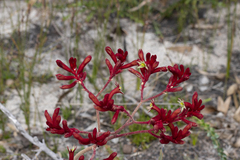 Anigozanthos rufus Red kangaroo-paw Photo: CC BY, Kym Nicolson
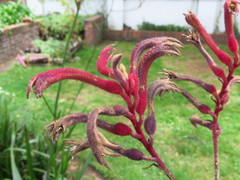 Anigozanthos flavidus Evergreen kangaroo-paw Photo: CC BY, Juan Carlos Caicedo Hernández
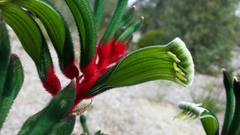 Anigozanthos manglesii Mangles's kangaroo-paw Photo: CC BY, Helium Luo
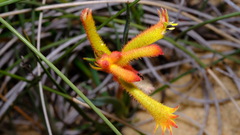 Anigozanthos humilis Cat's-paw Photo: CC BY, Peter Crowcroft
 Anigozanthos pulcherrimus Yellow kangaroo-paw Photo: CC BY, Hugo Innes
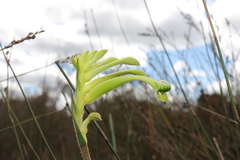 Anigozanthos viridis Green kangaroo-paw Photo: CC BY, Hayden Jones
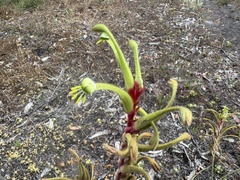 Anigozanthos bicolor Little kangaroo-paw Photo: CC BY, Ann Bentley
 Anigozanthos gabrielae Dwarf Kangaroo Paw Photo: CC BY-SA, Alexey Yakovlev
Grown: iNaturalist's observations of the species marked captive or cultivated; "not counted" where the species list does not count it. Native ranges: Kew's World Checklist of Vascular Plants (Govaerts et al., CC BY 4.0), file of 4 June 2026. Grown: iNaturalist's observations marked captive or cultivated, counted 17 October 2026 (the species list's count). Habitat climate known: the species page has a habitat climate, read from CHELSA's monthly climate and NASA POWER's daily extremes at its well-placed wild records inside Kew's native range; each page says its own sources and days. Record low: the lowest night in NASA POWER's daily series at the habitat's typical spot, as the species page gives it, held in °C to a tenth and shown in your units; each page says its own years and day read. Counts as the reference built on 19 November 2026 holds them. The CSV holds every result, not only this page's.