Globularia
20 species in the reference · family Plantaginaceae · 18 with a habitat climate · 17 grown, per iNaturalist, 3 not counted
About the genus
Globularia is a genus of about 22 species of flowering plants in the family Plantaginaceae, native to central and southern Europe, Macaronesia, northwest Africa and southwest Asia. They are dense low evergreen mat-forming perennials or subshrubs, with leathery oval leaves 1–10 cm (0.4–3.9 in) long. The flowers are produced in dense inflorescences (capitula) held above the plant on a 1–30 cm (0.4–11.8 in) tall stem; the capitula is 1–3 cm in diameter, with numerous tightly packed purple, violet, pink or white flowers.
Quoted from Wikipedia, "Globularia", its opening paragraph, revision 1371116372, read 2026-11-08, CC BY-SA 4.0.
Where Globularia is native
| Spain | 8 |
|---|---|
| Italy | 7 |
| France | 6 |
| Yugoslavia | 5 |
| Albania | 4 |
| Austria | 4 |
| Bulgaria | 4 |
| Canary Is. | 4 |
| Turkey | 4 |
| Germany | 3 |
| Greece | 3 |
| Switzerland | 3 |
Species native to each region. A species counts in every region it is native to. Native ranges: Kew's World Checklist of Vascular Plants (Govaerts et al., CC BY 4.0), file of 4 June 2026.
20 species
Globularia
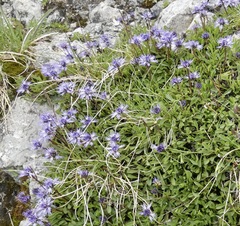 Globularia cordifolia Heart-leaved Globe-daisy Photo: CC BY, Jochen Essig
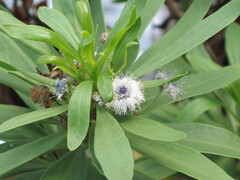 Globularia salicina Willow-leaved Globe Flower Photo: CC BY, zebedeugalinha
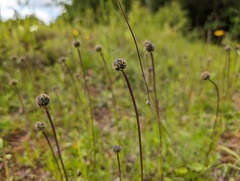 Globularia bisnagarica Common Globularia Photo: CC BY, arthur_haendler
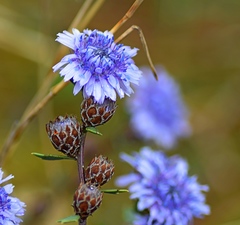 Globularia alypum Photo: CC BY, Kostas Zontanos
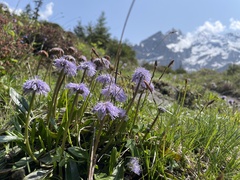 Globularia nudicaulis Leafless-stemmed Globularia Photo: CC BY, Harrison J Elkins
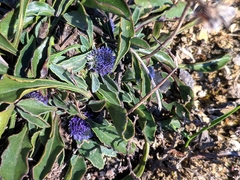 Globularia vulgaris Common Blue Daisy Photo: CC BY, Denys Vynokurov
 Globularia sarcophylla Photo: CC BY-SA, James Steakley
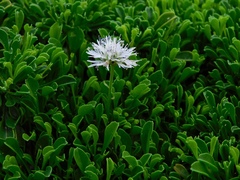 Globularia repens Photo: CC BY, Michael J. Papay
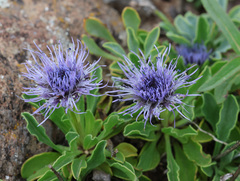 Globularia trichosantha Photo: CC BY, Joey Bom
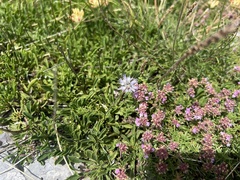 Globularia meridionalis Photo: CC0, Mirko Ubović
 Globularia ascanii Photo: CC BY-SA, Krzysztof Ziarnek, Kenraiz
- no open photograph on file Globularia × indubia
 Globularia arabica Photo: CC BY, MichellePrice_CJBG
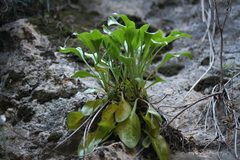 Globularia majoricensis Majorcan Globularia Photo: CC BY, fmunoz
 Globularia spinosa Photo: CC BY, Santiago Martín-Bravo
 Globularia fuxeensis Photo: CC BY-SA, Guérin Nicolas
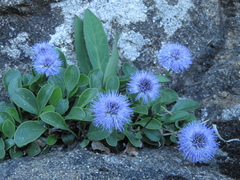 Globularia incanescens Apennine Globularia Photo: CC BY, Milan Chytrý
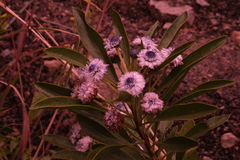 Globularia amygdalifolia Photo: CC BY, fmunoz
 Globularia dumulosa Photo: CC BY-SA, 阿橋 HQ
- no open photograph on file Globularia linifolia
Grown: iNaturalist's observations of the species marked captive or cultivated; "not counted" where the species list does not count it. Native ranges: Kew's World Checklist of Vascular Plants (Govaerts et al., CC BY 4.0), file of 4 June 2026. Grown: iNaturalist's observations marked captive or cultivated, counted 17 October 2026 (the species list's count). Habitat climate known: the species page has a habitat climate, read from CHELSA's monthly climate and NASA POWER's daily extremes at its well-placed wild records inside Kew's native range; each page says its own sources and days. Record low: the lowest night in NASA POWER's daily series at the habitat's typical spot, as the species page gives it, held in °C to a tenth and shown in your units; each page says its own years and day read. Counts as the reference built on 19 November 2026 holds them. The CSV holds every result, not only this page's.