Onobrychis
8 species in the reference · family Fabaceae · 8 with a habitat climate · 5 grown, per iNaturalist, 3 not counted
About the genus
Onobrychis, the sainfoins, are a genus of Eurasian perennial herbaceous plants of the legume family (Fabaceae). About 206 species are presently accepted. The Flora Europaea lists 23 species of Onobrychis; the main centre of diversity extends from Central Asia to Iran, with 56 species – 27 of which are endemic – in the latter country alone. O. viciifolia is naturalized throughout many countries in Europe and North America grasslands on calcareous soils.
Quoted from Wikipedia, "Onobrychis", its opening paragraph, revision 1368741974, read 2026-11-08, CC BY-SA 4.0.
Where Onobrychis is native
| France | 5 |
|---|---|
| Transcaucasus | 5 |
| Bulgaria | 4 |
| Greece | 4 |
| Italy | 4 |
| Turkey | 4 |
| Yugoslavia | 4 |
| Albania | 3 |
| Austria | 3 |
| Czechoslovakia | 3 |
| Germany | 3 |
| Iran | 3 |
Species native to each region. A species counts in every region it is native to. Native ranges: Kew's World Checklist of Vascular Plants (Govaerts et al., CC BY 4.0), file of 4 June 2026.
8 species
Onobrychis
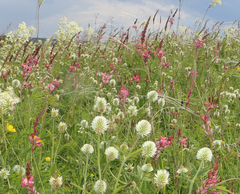 Onobrychis viciifolia Sainfoin Photo: CC BY, Полина Полежанкина
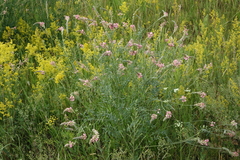 Onobrychis arenaria Sand esparcet Photo: CC BY, Oleg Kosterin
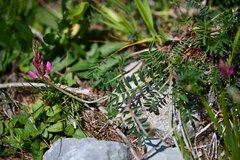 Onobrychis montana Mountain sainfoin Photo: CC BY, Flavien Saboureau
 Onobrychis cyri Photo: CC BY-SA, Krzysztof Ziarnek, Kenraiz
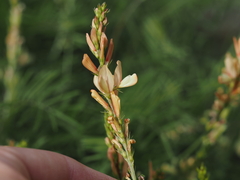 Onobrychis saxatilis Rock Sainfoin Photo: CC BY, Louis Aureglia
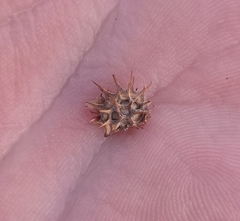 Onobrychis caput-galli Cockscomb sainfoin Photo: CC BY, David Sandler
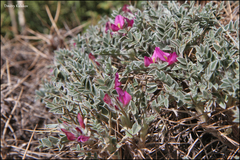 Onobrychis echidna Photo: CC BY, Dmitry Kulakov
- no open photograph on file Onobrychis transcaucasica
Grown: iNaturalist's observations of the species marked captive or cultivated; "not counted" where the species list does not count it. Native ranges: Kew's World Checklist of Vascular Plants (Govaerts et al., CC BY 4.0), file of 4 June 2026. Grown: iNaturalist's observations marked captive or cultivated, counted 17 October 2026 (the species list's count). Habitat climate known: the species page has a habitat climate, read from CHELSA's monthly climate and NASA POWER's daily extremes at its well-placed wild records inside Kew's native range; each page says its own sources and days. Record low: the lowest night in NASA POWER's daily series at the habitat's typical spot, as the species page gives it, held in °C to a tenth and shown in your units; each page says its own years and day read. Counts as the reference built on 19 November 2026 holds them. The CSV holds every result, not only this page's.