Santalum
7 species in the reference · family Santalaceae · 6 with a habitat climate · 7 grown, per iNaturalist
About the genus
Santalum is a genus of woody flowering plants in the Santalaceae family, the best known and most commercially valuable of which is the Indian sandalwood tree, S. album. Members of the genus are trees or shrubs. Most are root parasites which photosynthesize their own food, but tap the roots of other species for water and inorganic nutrients. Several species, most notably S. album, produce highly aromatic wood, used for scents and perfumes and for herbal medicine. More on Wikipedia
Quoted from Wikipedia, "Santalum", its opening paragraph, revision 1371203380, read 2026-11-08, CC BY-SA 4.0.
Where Santalum is native
| Western Australia | 4 |
|---|---|
| Northern Territory | 3 |
| South Australia | 3 |
| Hawaii | 2 |
| New South Wales | 2 |
| Queensland | 2 |
| Victoria | 2 |
| Jawa | 1 |
| Lesser Sunda Is. | 1 |
| New Caledonia | 1 |
| New Guinea | 1 |
| Philippines | 1 |
Species native to each region. A species counts in every region it is native to. Native ranges: Kew's World Checklist of Vascular Plants (Govaerts et al., CC BY 4.0), file of 4 June 2026.
7 species
Santalum
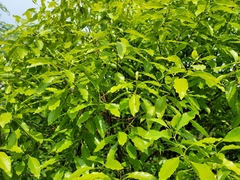 Santalum album Indian sandalwood Photo: CC BY, Yu-Huang Wang
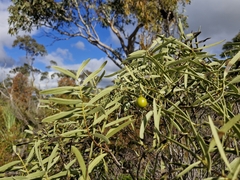 Santalum acuminatum Sweet quandong Photo: CC BY, ronavery
 Santalum ellipticum Coastal sandalwood Photo: CC0, Sonny Gamponia
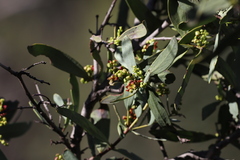 Santalum spicatum West Australian sandalwood Photo: CC BY, Hugo Innes
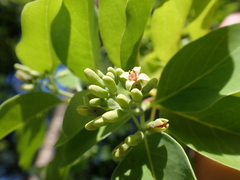 Santalum austrocaledonicum Coral Sea Sandalwood Photo: CC BY, Neal Kelso
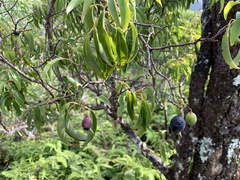 Santalum freycinetianum Lanai Sandalwood Photo: CC BY, Neal Kelso
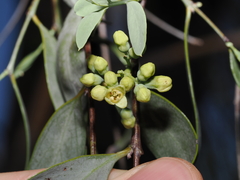 Santalum lanceolatum Plumbush Photo: CC BY, Thomas Mesaglio
Grown: iNaturalist's observations of the species marked captive or cultivated; "not counted" where the species list does not count it. Native ranges: Kew's World Checklist of Vascular Plants (Govaerts et al., CC BY 4.0), file of 4 June 2026. Grown: iNaturalist's observations marked captive or cultivated, counted 17 October 2026 (the species list's count). Habitat climate known: the species page has a habitat climate, read from CHELSA's monthly climate and NASA POWER's daily extremes at its well-placed wild records inside Kew's native range; each page says its own sources and days. Record low: the lowest night in NASA POWER's daily series at the habitat's typical spot, as the species page gives it, held in °C to a tenth and shown in your units; each page says its own years and day read. Counts as the reference built on 19 November 2026 holds them. The CSV holds every result, not only this page's.