Symphoricarpos
8 species in the reference · family Caprifoliaceae · 8 with a habitat climate · 7 grown, per iNaturalist, 1 not counted
About the genus
Symphoricarpos is a small genus of about 15 species of deciduous shrubs in the family Caprifoliaceae. With the exception of the Chinese coralberry, S. sinensis, which is indigenous to western China, all species are native to North and Central America. The name of the genus is derived from the Ancient Greek words συμφορεῖν (sumphoreîn), meaning "to bear together", and καρπός (karpós), meaning "fruit". It refers to the closely packed clusters of berries the species produces. More on Wikipedia
Quoted from Wikipedia, "Symphoricarpos", its opening paragraph, revision 1365197386, read 2026-11-08, CC BY-SA 4.0.
Where Symphoricarpos is native
| California | 5 |
|---|---|
| British Columbia | 4 |
| Colorado | 4 |
| Idaho | 4 |
| New Mexico | 4 |
| Oregon | 4 |
| Texas | 4 |
| Utah | 4 |
| Washington | 4 |
| Illinois | 3 |
| Indiana | 3 |
| Iowa | 3 |
Species native to each region. A species counts in every region it is native to. Native ranges: Kew's World Checklist of Vascular Plants (Govaerts et al., CC BY 4.0), file of 4 June 2026.
8 species
Symphoricarpos
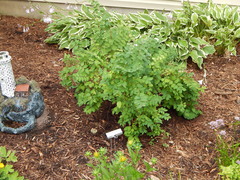
 Symphoricarpos albus Common Snowberry Photo: CC0, Älven
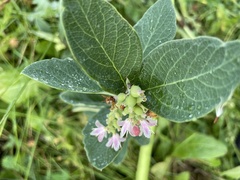
 Symphoricarpos orbiculatus Coralberry Photo: CC0, Tom Lazar
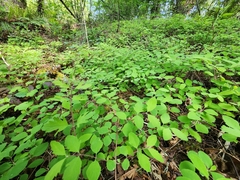
 Symphoricarpos occidentalis Wolfberry Photo: CC0, dregyn
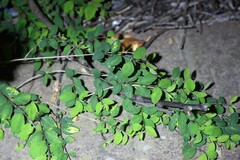
 Symphoricarpos mollis Spreading snowberry Photo: CC BY, Jeffrey Lee (he/him/his)
 Symphoricarpos microphyllus Small-leaved Snowberry Photo: CC0, Kian Hayles-Cotton
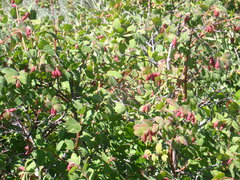 Symphoricarpos rotundifolius Round-leaved snowberry Photo: CC0, Steve Woodward
 Symphoricarpos oreophilus Mountain snowberry Photo: CC BY-SA, Stan Shebs
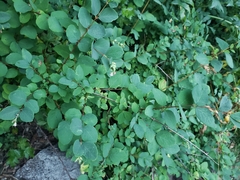 Symphoricarpos hesperius Trailing snowberry Photo: CC0, Jon Eilers
Grown: iNaturalist's observations of the species marked captive or cultivated; "not counted" where the species list does not count it. Native ranges: Kew's World Checklist of Vascular Plants (Govaerts et al., CC BY 4.0), file of 4 June 2026. Grown: iNaturalist's observations marked captive or cultivated, counted 17 October 2026 (the species list's count). Habitat climate known: the species page has a habitat climate, read from CHELSA's monthly climate and NASA POWER's daily extremes at its well-placed wild records inside Kew's native range; each page says its own sources and days. Record low: the lowest night in NASA POWER's daily series at the habitat's typical spot, as the species page gives it, held in °C to a tenth and shown in your units; each page says its own years and day read. Counts as the reference built on 19 November 2026 holds them. The CSV holds every result, not only this page's.