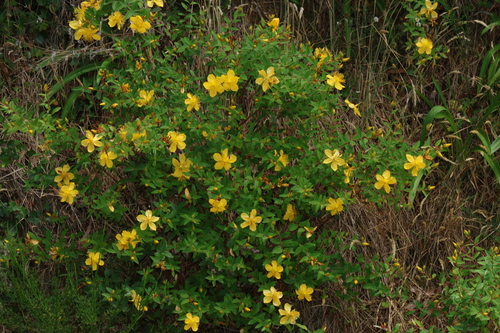
Hypericum kouytchense H.Lév.
Large-flowered St John's-wort


 13 photographs ›
Summary
Hypericum kouytchense, the large-flowered St John's wort, is a species of flowering plant in the family Hypericaceae, native to Western China. Growing up to 3 ft (0.91 m) tall and 5 ft (1.5 m) wide, it is a semi-evergreen rounded shrub with blue-green leaves and large yellow flowers with prominent stamens, appearing in midsummer. Flowers are followed by red seed capsules in autumn. Where conditions are favourable it can retain its leaves all year.
Quoted from Wikipedia, "Hypericum kouytchense", CC BY-SA 4.0.
About the genus · Hypericum
Hypericum is a genus of flowering plants in the family Hypericaceae. The genus has a nearly worldwide distribution, missing only from tropical lowlands, deserts and polar regions. Many Hypericum species are regarded as invasive species and noxious weeds. More on Wikipedia ›
Quoted from Wikipedia, "Hypericum", CC BY-SA 4.0.
Cultivation
Climate across the habitat
Natural habitat
How this section is made
Photographs
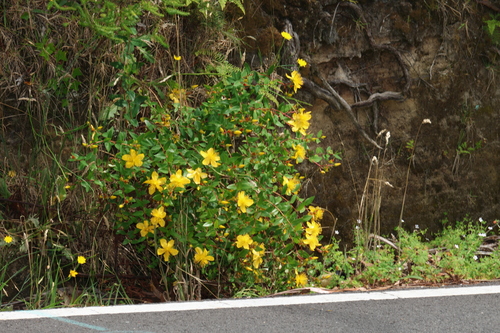
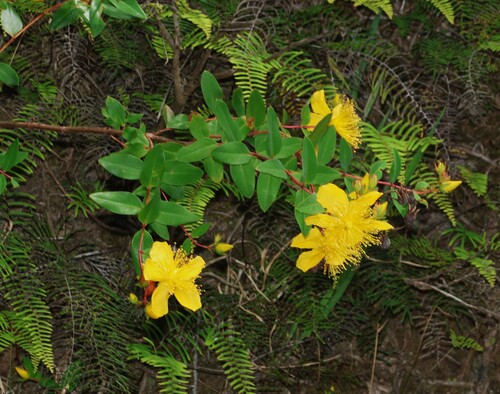


Photographs: (c) Greg Tasney, some rights reserved (CC BY-SA) (2); Leonora Enking from West Sussex, England, CC BY-SA 2.0, via Wikimedia Commons (2); Michael Kurz, CC BY-SA 3.0 at, via Wikimedia Commons; Daderot, CC0, via Wikimedia Commons.
Related
Other Hypericum 106 in the reference
 Hypericum adpressum Creeping St. Johnswort Photo: CC BY, Ryan Sorrells
 Hypericum aegypticum Egyptian St John's wort Photo: CC BY, Milan Chytrý
 Hypericum aethiopicum African St Johns Wort Photo: CC BY, Dr. Alexey Yakovlev
 Hypericum anagalloides Tinker's-penny Photo: CC BY, Alexis Tinker-Tsavalas
 Hypericum androsaemum Tutsan Photo: CC BY, Kieran Roy Powell
 Hypericum annulatum Hypericaceae Photo: CC BY-SA, susan brown
 Hypericum ascyron Great St. John's-wort Photo: CC BY, Oleg Kosterin
 Hypericum athoum Hypericaceae Photo: CC BY-SA, peganum from Henfield, England
 Hypericum balearicum Majorca St John's wort Photo: CC BY, Sheelagh Halsey Hypericum beanii St. Johnswort
 Hypericum bellum Hypericaceae Photo: CC BY-SA, Nick all 107 ›
Names & registers
Also known as Hypericum patulum var. grandiflorum; Hypericum penduliflorum; Norysca kouytchensis. (GBIF Backbone)
The record
Every figure here is derived from public data by a stated rule and names its source; nothing about this species is written for its page by a person or by AI, apart from the marked, credited quotations. How →
Where this page came from built 2026-10-22
gbif.species answeredasked 2026-10-22gbif.synonyms answeredasked 2026-10-22gbif.vernacular answeredasked 2026-10-22names fetched 2026-10-22wcvp.distribution answeredas of 2026-06-04gbif.occurrences answeredas of 2026-10-21GBIF occurrence download https://doi.org/10.15468/dl.hbdw64, of 2026-10-21; 4 records within 1 km of a botanic garden, herbarium or zoo left out (3 at a botanic garden or arboretum, 1 at a herbarium; Wikidata's list)climate nothing to reportasked 2026-10-2228 in-range records, none placed to within 10 kmwikidata answeredasked 2026-10-22wikipedia answeredasked 2026-10-22inat.photos.wild answeredasked 2026-10-22from iNaturalist's open data of 2026-09-27: research-grade observations with an open-licence photograph, the 24 whose photographs iNaturalist received last (the open data holds no votes); filled 2026-10-22inat.photos.cultivated not askedgbif.media nothing to reportasked 2026-10-22commons answeredasked 2026-10-22openalex not askednot yet asked for this reference; a later fill takes the papers from OpenAlex's snapshotEvery source is recorded as having answered, reported nothing, refused, failed, not been asked, or answered twice where one answer is taken (“not taken: two items answered”), and, for a source asked when this page was built, when: the figures are as the source held them that day; a source read from a file (Kew's World Checklist, a GBIF download) says "as of" the file's day instead; a row carried from an earlier build of the page names that build instead. Only “nothing to report” is ever shown as an absence. Records came from 17 datasets via GBIF.org; each carries its own licence.